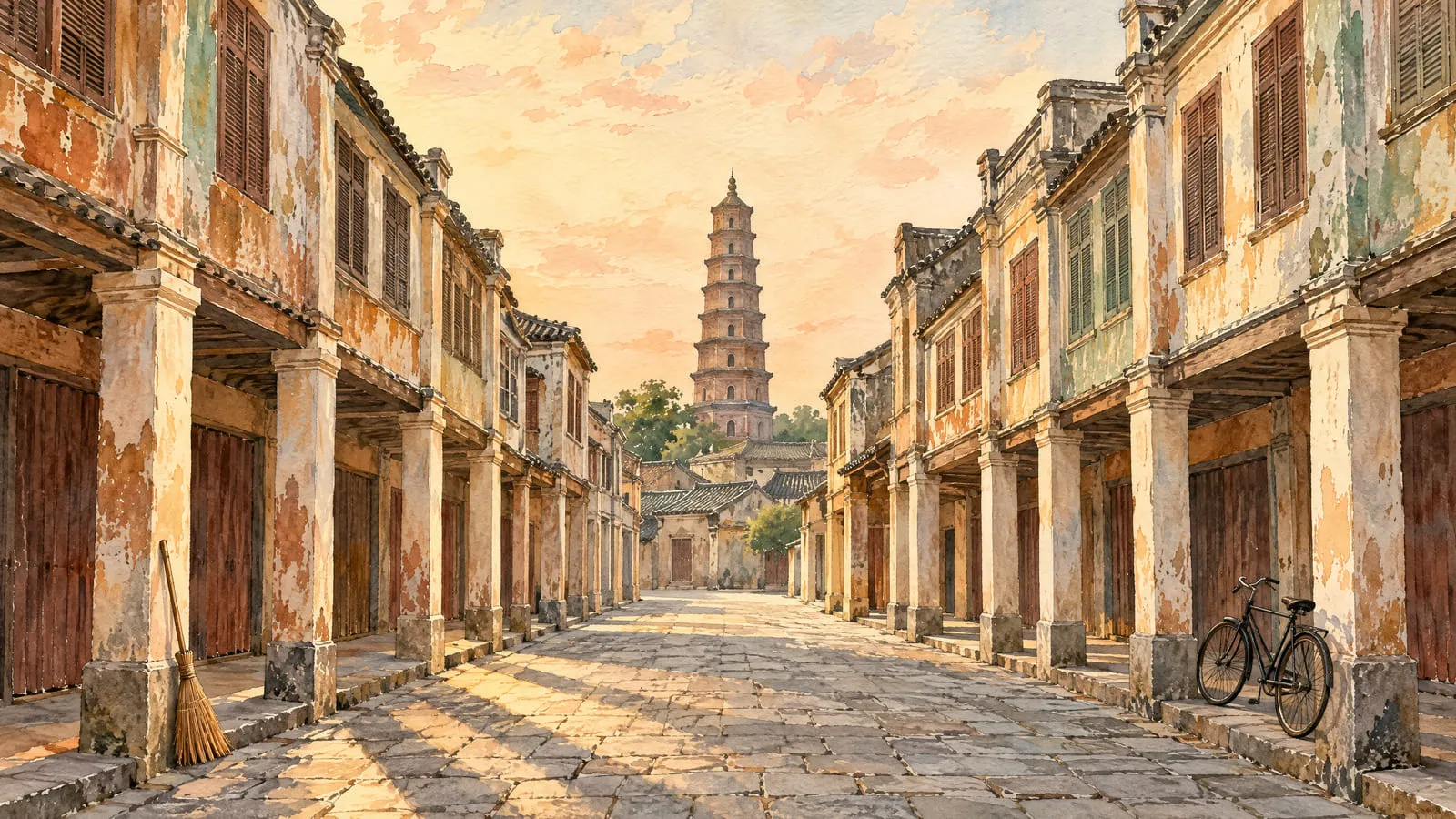
Leizhou City, 雷州市, is a town and the farmland and coast around it, in the middle of the Leizhou Peninsula in Guangdong, southern China. It is a county-level city, which means a city with the rank of a county. Zhanjiang, 湛江, the bigger city that governs the whole peninsula, runs it. Until 1994 Leizhou City was called Haikang, 海康. So Leizhou City is not the whole peninsula, and it is not the people. But the old Leizhou Prefecture was run from here. A prefecture was a unit of government above the county in old China. The Lui Chew take their name from that prefecture: Lui Chew is the older Malayan spelling of Leizhou (雷州). About 1.33 million people lived in Leizhou City at the end of 2024. Its old town still keeps Lei Zu’s temple, a pagoda from the Ming dynasty (a dynasty is a line of emperors from one family) and a museum hall given over to stone dogs, the carved stone guardians of the peninsula’s villages.
At home, Leizhou (雷州) was the name of a people. In a school atlas it was a peninsula. Then a map app shows Leizhou as one dot south of Zhanjiang, and the dot carries a name you thought was yours. One word now names three places. Here is how to tell them apart, why Leizhou City matters to a Lui Chew family, and what still stands there.
Is Leizhou City the same as the Leizhou Peninsula, or Zhanjiang?
No to both. Its own government places Leizhou City “in the belly of the Leizhou Peninsula”, 雷州半岛腹部. Its land runs right across the middle, from the South China Sea on the east to the Beibu Gulf on the west, about 67 kilometres from coast to coast. Suixi County and Mazhang District lie to its north. Xuwen County lies to its south, at the tip of the peninsula, and Leizhou City is its only land neighbour. It covers about 3,709 square kilometres. That is a little over a quarter of Zhanjiang’s land, so a big part of the peninsula, but far from all of it. For the land itself, read the Leizhou Peninsula: its red soil, old volcanoes and the strait.
Zhanjiang is the city above it. Zhanjiang’s government runs its four city districts and two counties directly. Its three county-level cities, Leizhou City among them, it “manages in trust”, 代管, the official word for a looser tie. So Leizhou City is one of Zhanjiang’s nine parts, not another name for it. Zhanjiang, the city over the old Leizhou homeland tells how that came about.
The name does more work than most names. Four places share it.
| Name | What it is | Where it is |
|---|---|---|
| Leizhou Prefecture 雷州府 | The old unit of government. Named Leizhou in 634, a prefecture from 1368, ended in 1913. It held three counties: Haikang, Suixi and Xuwen. | Run from Haikang, today's Leizhou City |
| Leizhou Peninsula 雷州半岛 | The land itself, between the South China Sea and the Beibu Gulf, with Hainan across the strait | All of it lies in Zhanjiang |
| Leizhou City 雷州市 | Haikang county under a new name since 1994. A county-level city. | The middle of the peninsula |
| Leizhou Bay 雷州湾 | Sea, not land: a bay on the peninsula's east side | Off Leizhou City's east coast, one of the bays its government counts as its own |
Only the first row is the Leizhou of the Lui Chew clan houses. The third row is Leizhou City, the dot on the map app. Keep the two apart and most of the confusion goes.
What is Leizhou City known for, apart from its name? Its government puts pearls and mangoes first, and calls it a home of the South Sea pearl, 南珠, and says its waters give more than half of all China’s seawater pearls in a year. Its Liusha pearls, 流沙南珠, carry China’s protected place-of-origin mark, a national label that says a product truly comes from one place. So do the mangoes of one of its 18 towns.
Why is it called Leizhou, and does it really mean thunder?
It does. Lei (雷) is thunder and zhou (州) is prefecture, so Leizhou means “thunder prefecture”.
Who chose the name is on record. The Leizhou City government’s history says that in 634, under the Tang dynasty, Chen Wenyu, 陈文玉, the official in charge of Donghezhou, as the prefecture was then called, asked the emperor’s court to rename it Leizhou. “The name Leizhou begins here,” the history says. After his death, people worshipped Chen Wenyu as Lei Zu, 雷祖, the Thunder Ancestor. His temple is the first stop on the old-town walk below.
Why thunder, though? That part is softer. One old answer sits in the Taiping Huanyu Ji, 太平寰宇记, a geography of the whole empire written in the Song dynasty by the scholar Yue Shi, 乐史. It cites an older book, the Touhuang Lu, 投荒录, and says the prefecture “is probably named for its many thunders, for the thunder sounds as if it were just above the eaves”. Even that writer said “probably”, 盖. He adds that when thunder came, local people set out wine and food as an offering. The sky has kept its habits: Zhanjiang’s city government still lists frequent thunderstorm days in its climate.
There is a third account. It takes the name from Qinglei Mountain and the Qinglei River, 擎雷, south of the town the prefecture was run from. What “Lui Chew” means, and where the thunder in it comes from tells that account. A mountain named for thunder, in a land of thunder, would fit both stories at once.
Leizhou City’s own old name is older still. Haikang county was set up in 589. The same government history says it was named as a prayer, because typhoons and sea floods kept striking: hai (海) is sea, and kang (康) is peace and good health. The homeland guide to the Leizhou Peninsula walks through the old prefecture’s three counties, Haikang among them.
Was Leizhou City the seat of the old prefecture?
Yes, for many centuries. A seat is the town a unit of government is run from. The Song geography says it in a few characters: Leizhou “is now run from Haikang county”, 今理海康县. Later dynasties kept the arrangement. In 1368 the Ming dynasty made Leizhou a prefecture, a fu, 府, with Haikang one of its counties, and the Qing dynasty kept it so. It ended in 1913, when China closed the prefectures.
The walled town the prefecture was run from is still there, as the old town of Leizhou City, 雷州古城. Its government still speaks of it in the old way. Describing the wide rice plain of Dongxi Yang, 东西洋, it places the fields to the east and southwest of “the Leizhou prefecture town”, 雷州府城. The plain has an old saying of its own: “when the eastern fields ripen, Leizhou has enough”, 东洋熟、雷州足.
The Leizhou City government’s history goes back further still, and this part is its own account. In 111 BCE (before the Common Era, the same years as BC), under the Han dynasty, this land was part of Xuwen County. Both Xuwen County and the Hepu commandery above it, the history says, were run from the site of Leizhou City’s old town. A commandery was the large unit of government in Han times. The same history dates the old town’s first walls to 355 BCE. Its source is a gazetteer, a book that describes one region’s places and past, written by Huang Zuo, 黄佐, for Guangdong in the Ming dynasty. He wrote more than 1,700 years after the walls he describes. How he knew, we do not know yet.
Why are the Lui Chew named after Leizhou?
Because the name the families carried is the prefecture’s, not Leizhou City’s. Lui Chew is the older Malayan and Singaporean spelling of Leizhou (雷州). Why the prefecture’s name? As we read it, the reason is simple. A Lui Chew family’s own county could be Haikang, Suixi or Xuwen. The one name that held all three was the prefecture’s. And the families who crossed to Malaya had no Leizhou City to be named after. The Lui Chew of Melaka founded their clan house in 1899. Haikang became Leizhou City in 1994, nearly a century later.
So on a family stone, Leizhou (雷州) can mean two things. On an older stone it is the old prefecture. Since 1994 it can also mean today’s Leizhou City. Haikang (海康), on a stone or an old letter, points straight at Leizhou City, because Haikang is its old name. The line on a gravestone that names the family’s ancestral hometown is the jiguan line, 籍贯. Reading the jiguan line on a Chinese gravestone shows what each name on it proves.
What stands in Leizhou City's old town?
Start with the title Leizhou City holds, because it has a small surprise in it. China’s State Council, the national cabinet, names the country’s historic and cultural cities, a title for towns kept for their history. Its third list, on 4 January 1994, includes Haikang, 海康. Less than four months later, on 26 April 1994, Haikang became Leizhou City. So the title came under the old name and stayed with the new one. Zhanjiang’s government lists it today as the national historic and cultural city of Leizhou.
The old town’s sights make an easy round on foot or by bike, says Jiemian, a Chinese news site. Here are six stops on that round.
Lei Zu’s temple, 雷祖祠. On a hill southwest of the old town stands the temple of the man who named Leizhou. It was founded in 642, four years after Chen Wenyu died. The buildings are younger than the founding, though. China’s fourth national list of protected heritage sites, published by the State Council in 1996, includes the temple and dates it to the Ming and Qing dynasties. So the temple began under the Tang, and what stands and is protected today is Ming and Qing work. Lei Zu and Chen Wenyu: the prefect who became the thunder god tells his whole story.
The Ten Worthies’ shrine, 十贤祠, at West Lake. West Lake, 西湖, lies in the northwest corner of the old town. Its shrine honours ten Song dynasty officials who were exiled to this far edge of the empire, or passed through it, and who taught while they were here. Exile here means an official sent far from the capital as a punishment. Inside, four of the ten are drawn in carved lines on white marble, a travel guide says: Kou Zhun, Su Shi, Su Zhe and Qin Guan. A story belongs to the lake. In 1097 the poet Su Shi passed through Leizhou on his way into exile in Hainan, and met his younger brother Su Zhe, who had been exiled here. Tradition says the two walked by West Lake together. The meeting is on record; the walk is told. The Ten Worthies of Leizhou: who the ten were, and their shrine introduces all ten.
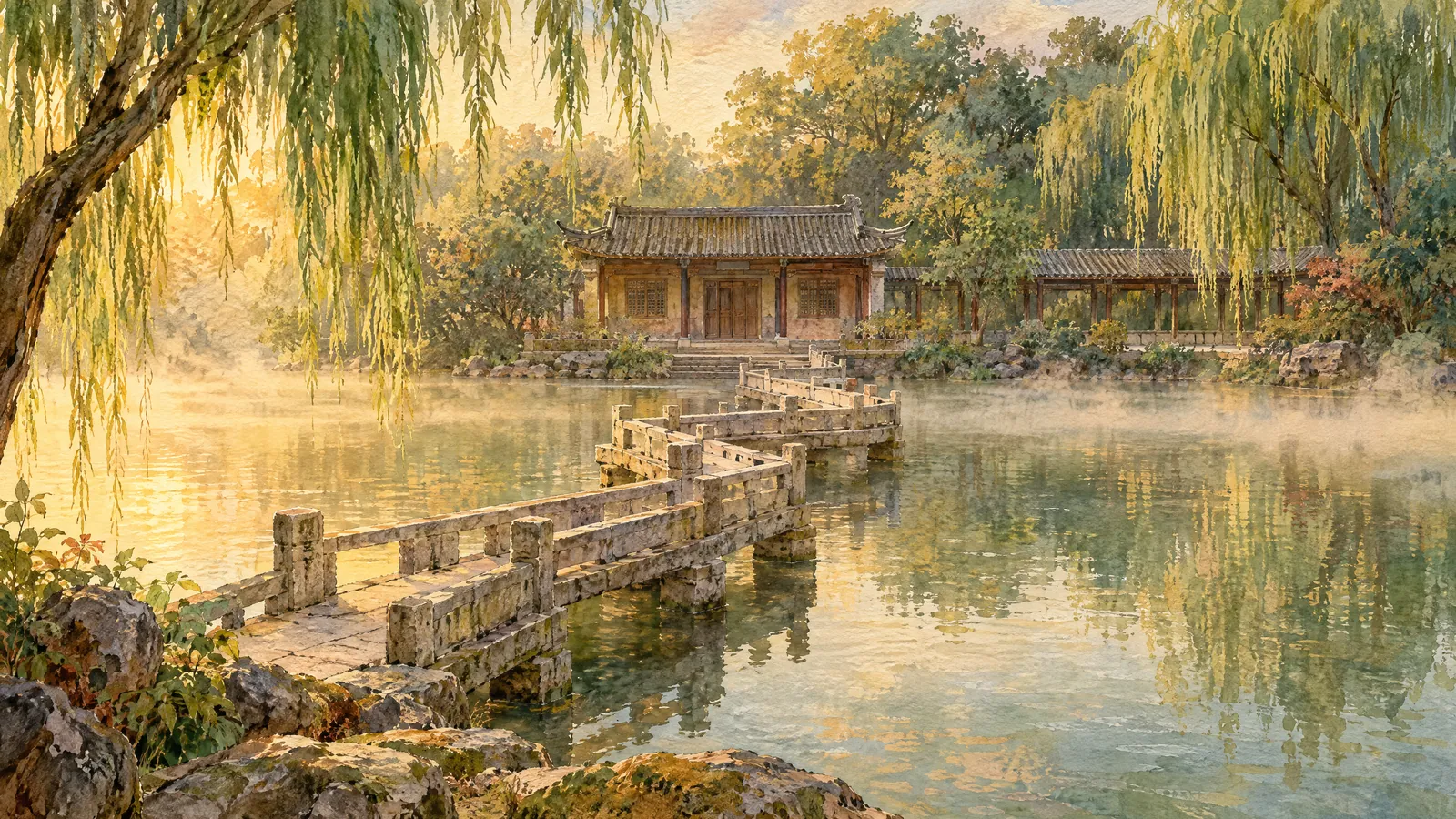
Sanyuan Pagoda, 三元塔. Near the old south gate rises a Ming dynasty brick pagoda. Chinese guidebooks date it 1613 to 1615 and give it 57 metres of height and 17 floors inside. The same guides say Guangdong protects it as a heritage site of the province, and that a local official pushed for it to lift the region’s learning. Its name has a story. It was first called Wenkui, roughly “top in letters”. Then, the story goes, builders digging its base found three snake eggs. They took them as a sign of sanyuan jidi (三元及第): coming first in all three rounds of the imperial exams, the tests that chose the empire’s officials. So it became the Sanyuan, the “Three Firsts”, Pagoda. The eggs are tradition.
Leizhou Museum, 雷州市博物馆. Leizhou City’s museum stands in the same park as the pagoda. It holds more than 8,000 objects, China Daily, a national newspaper, reported in September 2024. Its halls cover local history, folk customs and porcelain through the ages, and one is called Shigou Qiguan (石狗奇观), “Stone Dog Wonders”. Stone dogs keep watch at village gates all over the peninsula, not only here. This is where to meet them indoors, in a hall of their own. The stone dogs of Leizhou: what they guard and why tells their story.
Tianning Temple, 天宁寺. A Buddhist temple founded under the Tang dynasty, more than a thousand years ago, the guides and Jiemian say. How much of what stands today is that old, we do not know yet.
Qu Street, 曲街. The walk can end on a street that may feel familiar. Qu Street is a row of arcade shophouses, 骑楼: shops whose upper floors reach out over a covered walkway. A Melaka child knows the shape as the five-foot way. Jiemian calls the row Nanyang style. Nanyang, “the southern seas”, is the old Chinese name for Southeast Asia, Malaya included. Did money or builders from the Nanyang, Leizhou people abroad among them, shape Qu Street? Or is “Nanyang style” only a look? We do not know yet.
What we do not know yet
Three questions stay open.
Which story of the name came first. The Song geography’s many thunders, or Qinglei Mountain and its river? The mountain may have taken its name from the thunder long before the prefecture did. We do not know yet.
How far back Leizhou City was a seat. The Song record is clear for its own day. Its government’s history puts Han dynasty seats here too, and town walls in 355 BCE, on the word of a much later book. How far back the seat truly goes, we do not know yet.
Who shaped Qu Street. Nanyang money, Nanyang builders, or only a Nanyang look? If your family sent money home to Haikang, that may be part of the answer.
If you mean to go, read Going back: visiting Leizhou from Malaysia next. It starts with the hardest part, which comes before you book anything: finding your village. For the weather, mind the summer: typhoons come fairly often then, the Leizhou City government says. And if your family’s papers say Haikang (海康) or Leizhou (雷州), we would love to hear the village name, or a correction to anything on this page.