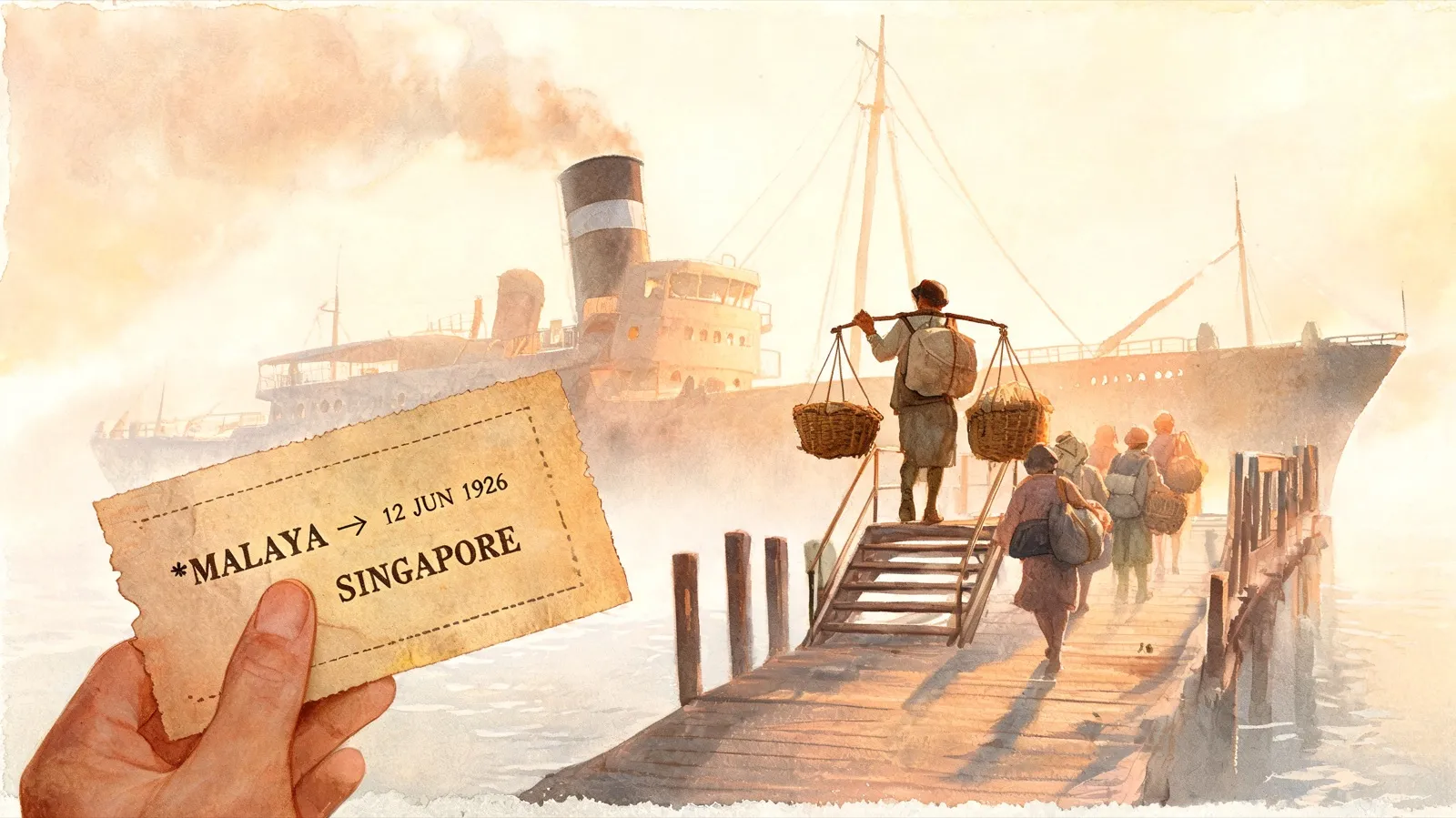
No one leaves a homeland lightly. To understand why a few thousand Min-speaking villagers left a thunder coast in Guangdong for a tin-and-rubber colony two thousand kilometres south, you have to hold two pressures in mind at once: what pushed them out, and what pulled them on.
Why they left
The Lui Chew sailed in the third and largest wave of Chinese emigration — the 下南洋, “going down to the South Seas” — that carried the vast majority of Southeast Asia’s Chinese abroad between the mid-19th and early 20th centuries.
At home, the late Qing was coming apart. The Opium Wars, the Taiping Rebellion, recurring famine and rural poverty pressed hardest on the coastal south — Guangdong, Fujian and Hainan. And then the door, long bolted shut, was opened: the Treaty of Nanjing in 1842 ended the old Qing prohibition on emigration, and a Qing subject could, for the first time, legally go abroad to work.
Go deeper → Why they left — the century of disorder and the 1842 treaty, in depth.
What pulled them south
On the far side of the sea, colonial Southeast Asia was desperate for hands. British Malaya needed labour for its tin mines and rubber estates, its docks and railways; the Straits Settlements — Singapore, Penang and Melaka — absorbed Chinese coolie labour by the boatload from the 1820s into the 1930s.
| Push — from China | Pull — to Malaya |
|---|---|
| Poverty and famine in the coastal south | Labour demand in tin, rubber and plantations |
| The Opium Wars and the Taiping Rebellion | The British Straits Settlements as open ports |
| Late-Qing civil war and disorder | Wages and work a home village could not offer |
| The 1842 legal opening to emigrate | Steamships that made the passage routine |
For the Qiong-Lei region specifically — Hainan and Leizhou — a final shock came late: the Japanese invasion of Hainan in 1937 drove another exodus from the very corner of the sea the Lui Chew came from.
Go deeper → The coolie trade — the labour machine, the credit-ticket system and the ten-day steamship passage.
Old guests and new
They did not cross as anonymous labour. Migration ran along lines of kin and home village, through a quiet machinery that explains why Malayan Chinese settled in tight dialect colonies rather than one undifferentiated mass.
An established migrant — a “old guest” (laokheh, 老客) — would house a newly arrived “new guest” (sinkheh, 新客) from his own village, lend him money, and find him work. Fellow townsmen clustered in the same streets and the same trades. The clan house, when there was one, formalised it. This is the same kinship that built the Melaka and Muar associations — and the reason a man stepping off the boat already had a name to ask for.
The bang system
Over that kinship sat the bang (帮) — the dialect-group guild. The bang steered each community into its own occupational niche and reserved those trades for its own: Hokkien in retail and finance, Cantonese in carpentry and tin, Hakka in smithing, and the Hainanese — with the smaller Lui Chew alongside them — in the service trades, the coffee shops, domestic work and cooking.
Because bang, dialect, kin network and clan house all overlapped, dialect identity hardened into a sociology. That is the mechanism by which “Lui Chew” survived as a distinct social identity in Malaya long after the founding sojourners had died — too small to dominate a trade, but tied tightly enough to keep its name.
Go deeper → The bang system — the dialect map of trades, the Muar proverb, and the one Lui Chew bang.
Small, late, and tight-knit
This is a story of a few thousand, not a multitude — which is exactly why it is worth telling before it is forgotten.
Theirs was never a mass migration. The Hainanese, the Lui Chew’s closest kin, were “practically the last to arrive” and made up only about three percent of Malaya’s Chinese — the 2001 census counted some 141,000 of them. The Lui Chew were documented as smaller still: a few thousand, arriving alongside the Hainanese in the late-19th-century rush and the spikes that followed.
Small, late, and tight-knit — that is the shape of the Lui Chew crossing. It is also why their record is thin and fading, and why the clan houses they built the moment they landed matter so much.
Go deeper → The dialect groups of Malaya — the full comparative map, from the 1645 Hokkien temple to the 1899 Lui Chew clan house.
What came next — the settling, the institutions, the slow turn from sojourner to citizen — is the story of Taking Root in Malaysia.