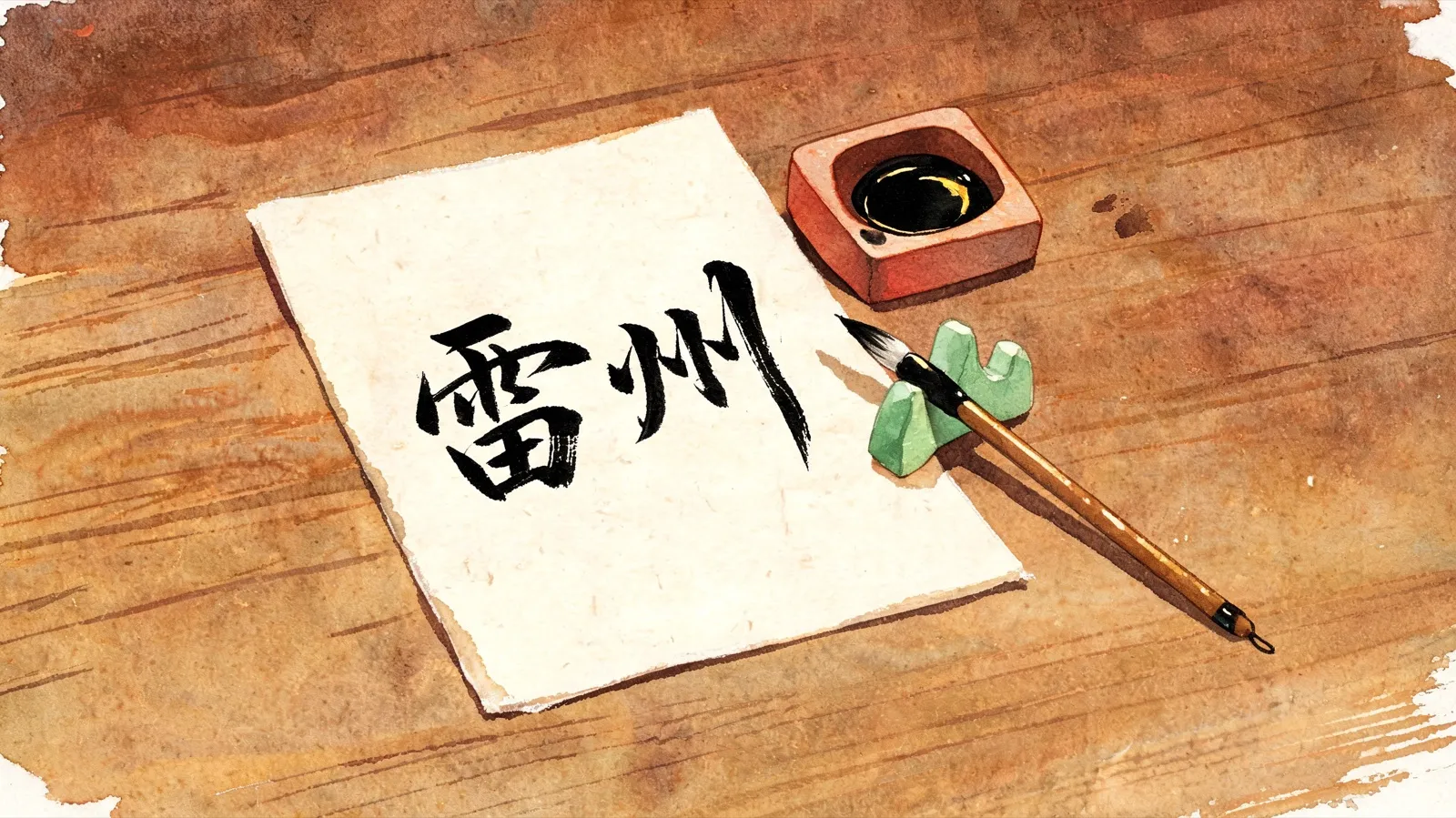
Every Lui Chew family in Malaysia carries a name that most Malaysians — and many descendants — cannot place. Here is the whole of it: what the name means, where it was made, and why it is spelled so many ways.
Thunder Prefecture
Lui Chew is 雷州: two characters, two words.
- 雷 — léi
- "Thunder." The character shows rain (雨) over a field (田) — the storm breaking over farmland.
- 州 — zhōu
- "Prefecture" — the classical Chinese administrative region, the same -zhou as in Guangzhou, Suzhou, Chaozhou (Teochew).
So the name means, plainly, “Thunder Prefecture” — and it is no poetic flourish. The Leizhou Peninsula is one of the most thunder-struck regions of China, and thunder runs through everything the region calls its own: its founding god is the Thunder Ancestor (雷祖), and Qing-era records describe a ritual year that “opened,” “thanked” and “sealed” the thunder in turn. A Lui Chew descendant in Melaka is, by name, a child of the thunder coast.
Lei (雷) is thunder. Zhou (州) is prefecture. If your family is Lui Chew, your name means thunder.
The naming: a petition in 634 CE
The name has a birth certificate. In 634 CE — the eighth year of the Zhenguan era of the Tang dynasty — the founding prefect of the region, Chen Wenyu (陈文玉), petitioned the Tang court to rename the existing prefecture of Donghezhou (东合州) to Leizhou, taking the new name from Qinglei Mountain (擎雷山, “thunder-bearing mountain”) and the Qinglei River south of the prefectural seat.
Chen Wenyu did more than rename a map. Famed for making peace among the Han settlers and the peninsula’s indigenous peoples, he was deified after his death as Lei Zu — the Thunder Ancestor himself — and his temple, first built in 642 CE, still stands in Leizhou city. The man who chose the name became the god of the place the name describes. Nearly fourteen centuries later, the name he filed with the Tang court is painted on a clan-house signboard on Jonker Street, Melaka.
One name, five spellings
All of the following are the same two characters, 雷州:
| Spelling | What it is | Where you will see it |
|---|---|---|
| Lui Chew | Older Malayan romanisation | Persatuan Lui Chew Johor; Malaysian community usage; this site |
| Luichew | The same, unspaced | Older Malaysian documents; luichew.com |
| Lui Chiu | Older Singaporean variant | The Lui Chiu Hoe Kuan (雷州会馆), Singapore, founded 1892 |
| Leizhou | Modern Hanyu Pinyin | Maps, scholarship, anything written since the 1980s about the China side |
| Lei Zhou | Pinyin, spaced | Informal modern usage |
The old spellings are pre-pinyin transcriptions: they record how British-Malayan clerks and the migrants themselves wrote the name down by ear, decades before Hanyu Pinyin was created in the 1950s — the same historical layer that gives Malaysia “Teochew” for Chaozhou and “Hokkien” for Fujian. They are not errors to be corrected; they are the community’s own written history.
How to say it
- In Mandarin
- léi zhōu — approximately "lay-JOH": first syllable rising in pitch, second high and level. The zh is the English "j" of "jaw," said with the tongue curled slightly back.
- In the old romanisation
- "loo-ee chew" — the spelling Lui Chew preserves how earlier generations heard the name in southern speech. It is how the Malaysian associations still say and write themselves.
- In Leizhou Min itself
- The dialect has its own reading of the name — but no published source available to this project documents its precise phonetics, so we do not guess at it here. Recording an elder saying "I am a Leizhou person" in the dialect is exactly the kind of contribution this site hopes for.
Why the old spelling matters
This site writes Lui Chew for the people in Malaysia and Leizhou for the homeland — a deliberate split. Pinyin is the correct modern spelling of the place; but the community in Malaysia named itself before pinyin existed, and its institutions carry that name still: Persatuan Lui Chew Johor on its registration papers, Lui Chiu Hoe Kuan over a Singapore doorway since 1892. To rename the community retroactively in pinyin would be to file the diaspora’s own century of records under a spelling it never used. The name Lui Chew — like the community it names — is a survival: a Tang-dynasty word for thunder, written down by ear on the Strait of Malacca, and never given up.
Sources for the 634 CE naming, Chen Wenyu and the thunder-ritual calendar are on the Sources & disclaimer page. Related terms are in the glossary.