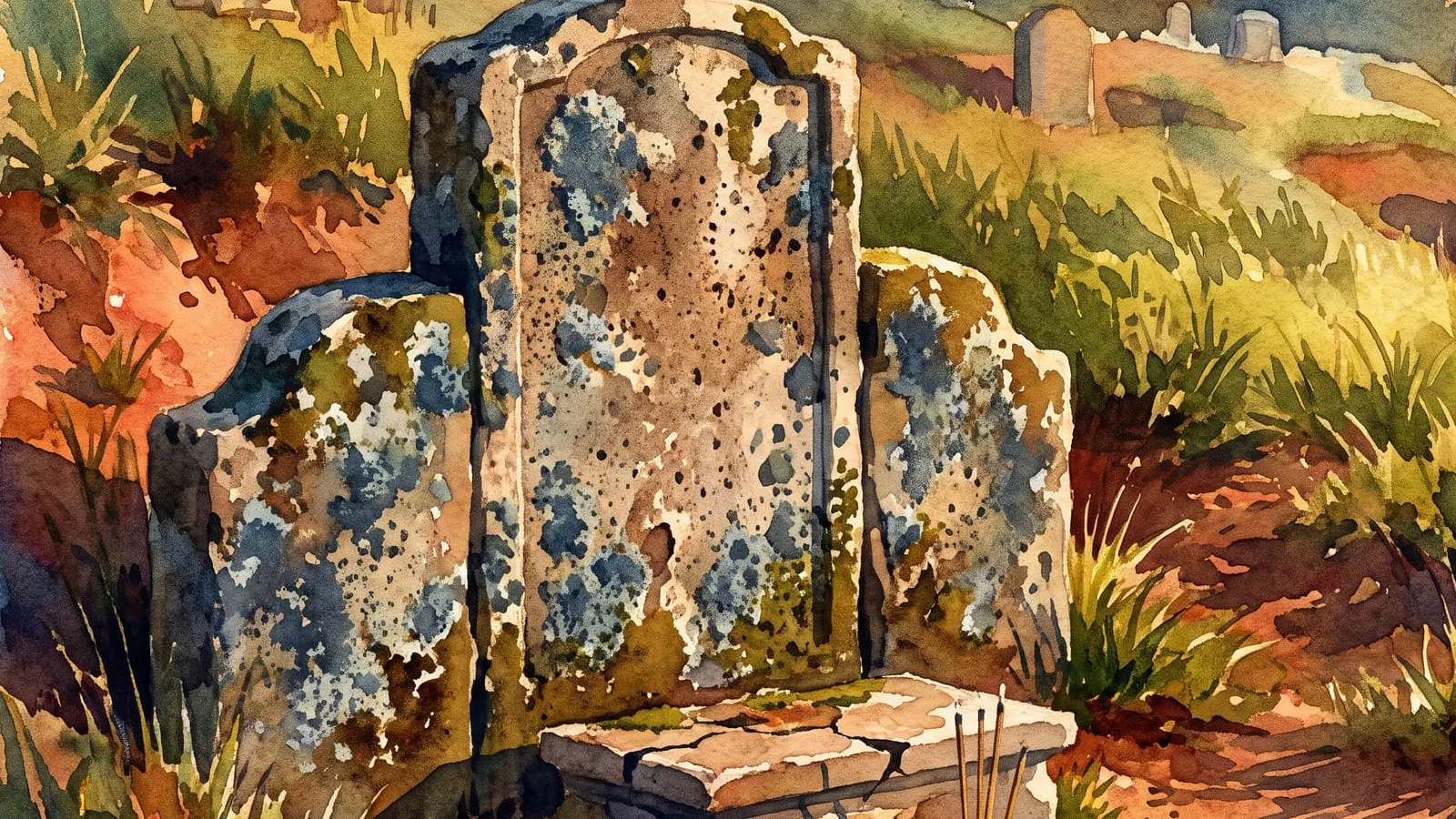
Somewhere on your family’s oldest gravestone, usually small and high up and easy to walk past, sits a short line of characters naming a place in China. That line is the jiguan (籍贯), the ancestral hometown: the place the family counts as its origin.
It is not where the person in the grave was born. It is not where they lived either. It is inherited down the father’s line, like a surname, so a man born in Melaka and buried in Melaka can carry a Leizhou county on his stone, and the convention is working correctly when it does.
So the line is a document, and our five-check identity test calls it the best single document this question has, if you read the county and not the prefecture. What it is not is a verdict. A prefecture name, meaning a city together with the counties around it, narrows your family to a region holding more than one language. A county name is much better and still not a village. And some of the names carved on old stones belong to units that no longer exist.
Finding the line, and photographing the whole stone
Our step-by-step tracing guide puts this first among six steps, and its instruction is short: the ancestral-hometown inscription, jiguan (籍贯) or zuji (祖籍), is usually in the top corner or the header of the stone, and you photograph it exactly rather than trusting a hurried transcription. Two things need adding to that.
The stone is not the only carved surface. A 2019 study of the Hokkien communal cemetery at Taiping, in Malaysia, worked from two of them: the main tablet, and the shoulder stones that flank it. If you photograph only the tablet, you may leave carved text out of the frame entirely. Shoot the tablet straight on, then the stones flanking it, where the descendants’ names are often carved and where a whole generation of the family can appear in one image.
Strong side-light is the trick. Worn characters that vanish in flat midday sun come back when the light rakes across them. Which means going early or late in the day rather than at noon.
Why this line is not a birthplace
It is tempting to read this line as a place of birth. That reading will send a family in the wrong direction, and two independent records say why.
The Taiping study is one. Reading the inscriptions of that cemetery from the late nineteenth century onward, it found the place name still emphasising the origin of the father’s line, and increasingly working as a badge of which group or clan a family belonged to. Not the life of the person buried there. The origin of the line they belonged to.
The modern Chinese state is the other, and it is the clearer of the two because it keeps both facts side by side and calls them different things. Since July 1996, China has kept place of birth and jiguan (籍贯) as two separate numbered entries, on two different household registration documents: items 11 and 15 on the permanent-residence register, which runs to 34 entries in all, and items 10 and 12 in the household booklet, which runs to 28. Same person, same records, two different questions.
If the state’s own version of the line stops at a county, a stone that stops there is not an incomplete record. Going deeper is our job, and it is why the tracing guide runs to six steps rather than one.
The key: what each name actually proves
Read the right-hand column first. It is where the names stop being equal.
| If the line reads | What the name is | What it proves |
|---|---|---|
| 雷州 Leizhou | The old prefecture, named in 634 CE, and also today's Leizhou City | Lui Chew, at region level. Keep looking for an older stone |
| 海康 Haikang | The county from the Sui dynasty until 1994, with a gap from 1958 to 1961. Today it is Leizhou City | County level, Leizhou-speaking. The single most useful thing to find |
| 遂溪 Suixi · 徐闻 Xuwen | The other two historic counties of the peninsula, both still counties today | County level, Leizhou-speaking. Same weight as Haikang |
| 麻章 Mazhang · 东海岛 Donghai Island · southern 廉江 Lianjiang | Also named by the Leizhou City government as Leizhou-speaking | Leizhou-speaking. Outside the three historic counties, so do not read them as a no |
| 湛江 Zhanjiang | The prefecture-level city above all of these, with nine county-level divisions under it: the counties, county-level cities and city districts directly beneath it | Undecided. The prefecture holds more than one language. Find an older stone |
| 赤坎 Chikan · 霞山 Xiashan · 坡头 Potou · 吴川 Wuchuan | Zhanjiang divisions absent from the government's Leizhou-speaking list | Undecided, not a no. Other reference sources place Leizhou speech in parts of each |
| Any name carrying 琼 Qiong, or 文昌 Wenchang | Hainan Island, across the strait | Points to Hainanese, the Lui Chew's closest kin. See below |
| A county name plus further characters | A township, a district or a village | The prize. This is what the whole six-step search is for |
The reason Zhanjiang (湛江) sits at “undecided” is worth a paragraph, because it is the row that looks like a confirmation and is not. Zhanjiang is a prefecture-level city, the tier above a county. The Leizhou City People’s Government’s page on the local language names where Leizhou is spoken as Leizhou City, Suixi County, Xuwen County, Mazhang District, Donghai Island, the southern part of Lianjiang City and southeastern Guangxi, and then closes with 等地 (deng di), “and other places”. The same portal’s footer lists nine county-level people’s governments under Zhanjiang. Cantonese and Hakka speakers turn up inside that county alone, on the same government’s account of Leizhou City, so the prefecture is not one language wide. The language page’s own sentence about where Leizhou is spoken also declines to draw a boundary anyone could be placed outside.
Even a clean county is evidence, and evidence is not a certificate. Inside Leizhou City itself, the government’s account of the city records that Leizhou is spoken by more than about 91 per cent of the population, with a small number speaking Cantonese or Hakka, and it names the towns where. A hometown on the peninsula makes a Lui Chew family very likely. It does not make one certain.
Why an old stone names a place no map has
Here is the trap that costs families time. A descendant reads Haikang (海康) off a stone, searches for it, and finds nothing, because Haikang county stopped existing in 1994. The names on the line were correct when they were carved. The map moved underneath them.
The Leizhou City government publishes the whole sequence in its own history of the city, so the ladder can be dated precisely.
- Haikang (海康), the county
- First established under the Sui dynasty. It was abolished in November 1958, restored in March 1961, and abolished for good on 26 April 1994, when Leizhou City was established in its place with the approval of the State Council, China's cabinet. Haikang and Leizhou City are the same ground under two names.
- Leizhou (雷州), the region
- The name dates from 634 CE, when Chen Wenyu, the prefect of the day, petitioned the court to have the prefecture renamed. By 758 it administered Haikang, Suixi and Xuwen together. Two family stones reading Leizhou (雷州) and Haikang (海康) are agreeing with each other at two different scales, not naming two origins.
- Leizhou Prefecture (雷州府)
- From 1368 the unit was a prefecture, fu (府), and the Qing kept the Ming arrangement, so Haikang county sat inside Leizhou Prefecture from 1368 until the prefecture system was abolished in 1913.
- Zhanjiang (湛江)
- The newest name of the four and the largest. This ground came under a Zhanjiang prefecture in 1956, and Haikang county came under the newly organised Zhanjiang City in 1983. Zhanjiang is a twentieth-century name over an old place.
Dates on the stone move under your feet in the same way. The Taiping study found the calendar shifting across a century from imperial reign years, to years of the Republic, to the Western calendar, with the traditional sixty-year cycle kept alongside all three. So a date on a family stone is not necessarily a year you can read off directly.
The names that point across the strait
The Leizhou Peninsula and Hainan Island face each other across a narrow strait, their languages are close kin, and this is where the two family histories get mixed up. The place names are the cleanest way to tell them apart, because their county names share nothing at all.
Set the two official lists side by side. The Leizhou portal’s footer links nine county-level people’s governments under Zhanjiang: Chikan, Xiashan, Mazhang, Potou, Leizhou, Lianjiang, Wuchuan, Suixi and Xuwen. Hainan’s county-level divisions, as the provincial government listed them at December 2022, include Wenchang, Qionghai, Wanning, Wuzhishan, Dongfang, Ding’an, Tunchang, Chengmai, Lingao, Qiongshan and Qiongzhong.
Not one name appears on both lists. And the character 琼 (Qiong) runs through the Hainan side, in Qionghai, Qiongshan and Qiongzhong, while none of the nine Zhanjiang divisions carries it. So a Qiong (琼) name on the line points across the strait.
Qiongzhou (琼州) needs a note of its own, because our own gravestone key lists it among the Hainan names and it appears nowhere on the province’s current divisions. It is an older name for the island region: the Leizhou government’s own account of the 1920s names Qiong(zhou), 琼(州), among eight regions of the south held together under one command in 1923, with Lei(zhou), 雷(州), among them.
Finding Hainan on the stone is a finding about ancestry, not a demotion. Our own comparison calls the two sibling peoples, clearly cousins, with coastlines a narrow strait apart. So if the stone points to Wenchang, the useful next step is the comparison of the two peoples rather than a second look at this key.
What a county still leaves you
A county on the stone is the good outcome, and it is worth being clear-eyed about what it has and has not achieved. Leizhou City, which is what Haikang county became, is made up of three subdistricts, which are its urban wards, and eighteen towns, and its government counts 475 village and community committees, the official groupings, and 2,276 natural villages, the settlements themselves, inside those subdistricts and towns.
So a county-level line has narrowed the search from a whole region to one of a few thousand villages. That is enormous progress and it is not an address. Steps two through five of the tracing guide exist to close that last gap: the elders first, because they are the only step with a deadline, then the household papers, the association rolls and the surname registry.
Where to go looking for stones, in Malaysia: Melaka’s Lui Chew kept no burial ground of their own, so their dead most likely lie, unindexed and unsurveyed, among the more than 12,500 graves at Bukit Cina, in use since 1685. It is the optional extension at the end of our Melaka heritage walk. In Muar, the association keeps its own yi shan (义山), a community cemetery, and it is the only Lui Chew owned burial ground documented anywhere.
What we don't know yet
Frequently asked questions
What is the jiguan (籍贯) line on a Chinese gravestone? It is the ancestral-hometown inscription, usually carved small in the top corner or the header of the stone. The line names the place in China the family counts as its origin, inherited down the father’s line. It is not a record of where the person buried there was born or lived.
My family’s stone says Haikang. I cannot find it on a map. Why? Haikang county was abolished on 26 April 1994, when Leizhou City was established in its place. The two names describe the same ground. Search for Leizhou City, or its Chinese name, 雷州市.
The stone says Zhanjiang. Does that make us Lui Chew? Not on its own, and it does not rule it out either. Zhanjiang is a prefecture-level city holding nine county-level divisions, and the Leizhou City government’s own list of Leizhou-speaking places covers only some of them, ending with “and other places”. Look for an older stone carrying a county.
How do I tell a Leizhou place name from a Hainan one? Their county-level names share nothing. Zhanjiang’s divisions are Chikan, Xiashan, Mazhang, Potou, Leizhou, Lianjiang, Wuchuan, Suixi and Xuwen. Hainan’s include Wenchang, Qionghai, Wanning, Ding’an, Chengmai, Lingao and Qiongshan, and any name carrying the character Qiong (琼) points to the island. Below county level the names do repeat: both regions have a Longmen (龙门) and a Baisha (白沙), so a township name only decides the question with a county beside it.
Is the jiguan (籍贯) the same as the place of birth? No, and China’s own household registration documents keep them as two separate entries. The Wuhan city police, citing the ministry’s 1995 notice, say the jiguan (籍贯) is filled in from a person’s paternal grandfather’s place of residence, down to county level in rural areas.
The line has more characters than just a county. What are they? That is the best possible result. Below a county the line can carry a township, a district or a village, and a village name is what the whole search is for, because mainland lineage books and village elders are organised village by village. Photograph it exactly and take it to step six of the tracing guide.
Sources for this page: the Leizhou City People's Government pages on the local language and on the city itself, for the Leizhou-speaking places, the nine Zhanjiang divisions, the 91 per cent figure, the Haikang and Leizhou City naming history and the village counts; Peter Kang (康培德), "Persistence or Localization? A Preliminary Inquiry into the Hokkien Tombstone Inscriptions of Taiping, Malaysia", 季風亞洲研究 9 (2019), for the Taiping cemetery findings on shoulder stones, ancestral origin and dating; the Ministry of Public Security's 1995 notice on household registration forms, as published by the Guangdong provincial government, for the two separate entries; the Wuhan Municipal Public Security Bureau's published reply of 29 December 2021, for the grandfather rule; the Hainan Provincial People's Government's list of administrative divisions; the Baidu Baike entry for 雷州话 (the Leizhou language) and the Chinese Wikipedia entry for 雷州民系 (the Leizhou people), for the district-level distribution in the note above; and our own tracing guide, Melaka heritage walk, comparison, five-check identity test and glossary pages. This site is independent and is not affiliated with any clan association or government body. Figures are stated as of August 2026.