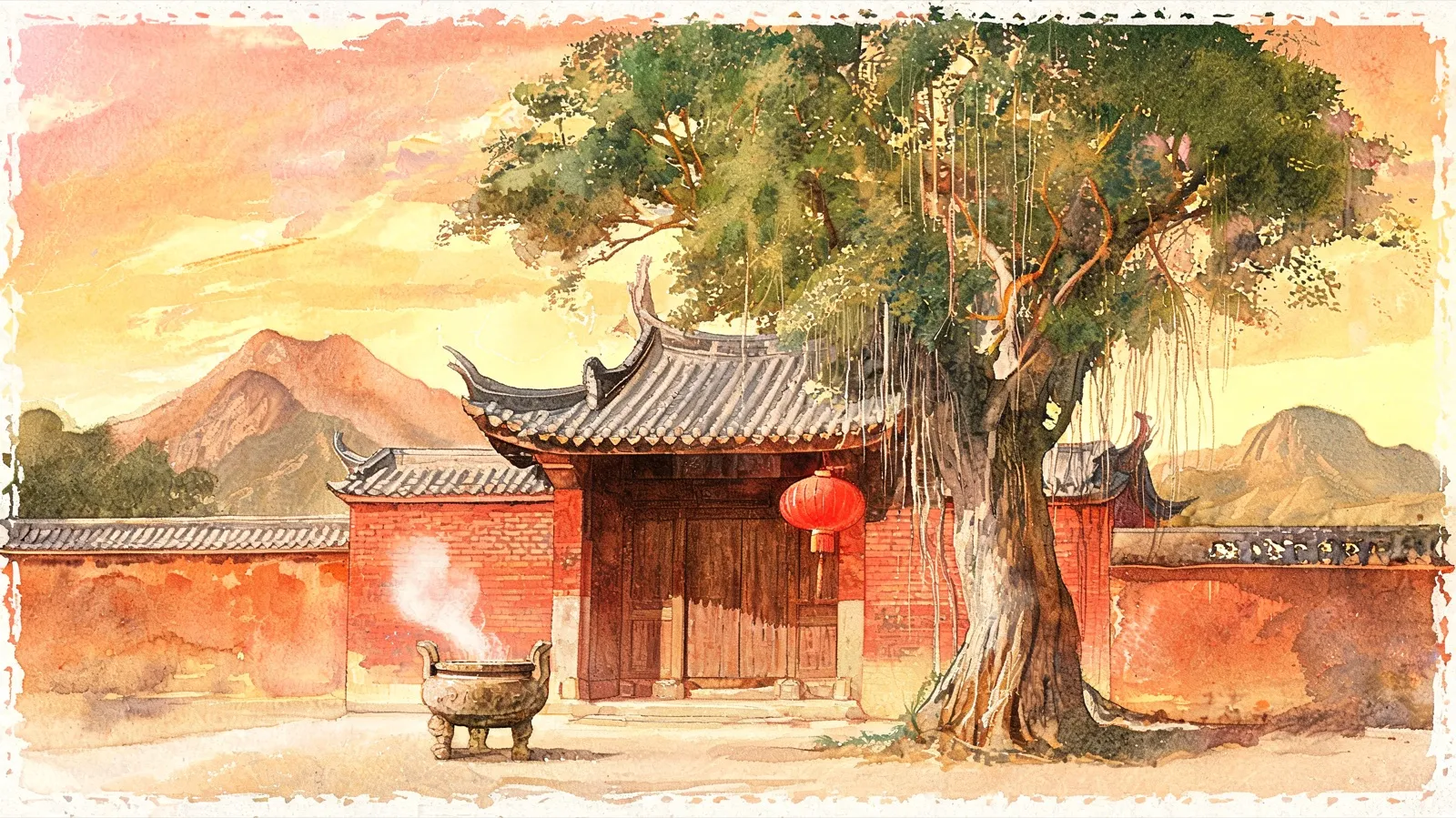
Every diaspora story starts somewhere specific. For the Lui Chew it starts on a tongue of red volcanic land that reaches off the bottom of the Chinese mainland toward Hainan — hot, humid, sea-girt on three sides, and named, of all things, for thunder.
A peninsula named for thunder
The Leizhou Peninsula (雷州半岛) reaches about 140 km south from the southwestern corner of Guangdong, curving like a tongue between two bays, separated from Hainan Island only by the narrow Qiongzhou Strait. Its parent city today is Zhanjiang (湛江); the old prefecture gathered three counties that still frame the homeland — Haikang (海康, now Leizhou city itself), Suixi (遂溪) and Xuwen (徐闻) at the very tip, where the ferry still crosses to Hainan.
- Where
- The southernmost tip of mainland China — southwestern Guangdong, within Zhanjiang
- The old prefecture
- Leizhou (雷州府): Haikang, Suixi and Xuwen counties
- The land
- Volcanic-soiled, sub-tropical, sea-girt on three sides — sugarcane, pineapple, mango, and a deep fishing tradition
- The strait
- The Qiongzhou Strait, just wide enough to keep Leizhou and Hainan two peoples rather than one
- An ancient gateway
- Xuwen, at the very tip, was one of China's earliest Maritime Silk Road departure ports — Han-dynasty ships set sail from here after 111 BCE toward Southeast and South Asia
A Min island inside Cantonese Guangdong
Here is the fact that explains everything else: the Lui Chew are not native Cantonese. They are a Min-Chinese people, set down in Guangdong by sea. At the end of the Southern Song, around 1279, families from Putian in Fujian fled the Mongol advance southward along the coast — and the bulk of that displaced population is recorded as escaping by sea to Leizhou, drawn by a coastline that pointed south and a Min tongue already spoken there.
So the peninsula became a Min enclave inside Cantonese Guangdong — and the same Putian out-migration that stocked Leizhou also peopled Hainan Island. That shared origin is exactly why the Lui Chew and the Hainanese are cousins: two branches of one Min migration, neighbours across a strait, speaking related but separate tongues.
A Min people inside Cantonese Guangdong — cousins to the Hainanese across the strait.
A frontier of scholars
The name came in the Tang. In 634 CE the founding prefect Chen Wenyu (陈文玉) petitioned the court to rename the prefecture Leizhou (雷州), after the Qinglei (“raising-thunder”) mountain and river to its south. He was remembered for keeping peace among the Han and the peninsula’s indigenous peoples — and, after his death, was deified as the thunder god himself.
For all its frontier reputation, Leizhou was no cultural backwater. Sitting at the empire’s southern margin, it became a place of honourable exile for Song-dynasty statesmen, who brought the learning and the “correct speech” of the Central Plains with them:
- The former chancellor Kou Zhun (寇准), demoted to Leizhou around 1022, taught the locals and died there.
- Su Che (苏辙) was exiled to Leizhou in 1097; his more famous brother Su Shi (Su Dongpo) passed through to reunite with him on the way to deeper exile in Hainan.
- The poet Qin Guan (秦观) was banished here near the end of his life.
These four and six others are honoured as Leizhou’s Ten Worthies (雷州十贤): also Wang Yansou (王岩叟 — remarkably, banished posthumously; his tablet placed in the shrine though he never visited in life), Ren Boyu (任伯雨), and four Southern Song officials — most notably Li Gang (李纲, 1083–1140), the Grand Chancellor of 1127 who argued for armed resistance against the Jurchen Jin; plus Zhao Ding, Li Guang and Hu Quan. The shrine’s stele inscription was composed by Song patriot Wen Tianxiang; it was established in 1273 by military commander Yu Yinglong. The schools these exiles seeded turned the prefecture into a “land of scholars,” with its own academies and a tally of imperial-examination graduates remarkable for so remote a coast.
The exile tradition continued into the Ming. Tang Xianzu (汤显祖, 1550–1616) — China’s greatest playwright, author of The Peony Pavilion (牡丹亭), whose style has been compared to Shakespeare’s — was demoted to Xuwen County as a minor clerical officer in 1591 after writing bold memorials to Emperor Wanli. Local tradition holds that during his time at the peninsula’s tip he built the Guisheng Academy (贵生书院 — “Academy for Valuing Life”) to teach the people. He died in 1616, the same year as Shakespeare. Tang is not among the Song-era Ten Worthies; he represents a Ming coda to the same pattern — difficult men sent to the edge of the empire, who chose to give something while they were there.
Lei Zu and the stone dogs
The peninsula’s signature deity is Lei Zu (雷祖), the Thunder Ancestor — and remarkably, he was a real man: Chen Wenyu, the Tang prefect, deified by a grateful people. His ancestral hall in Leizhou city was first raised in 642 CE.
Older still are the stone dogs (石狗). Perhaps ten thousand carved granite dogs survive across the peninsula — at village gates, road junctions, water inlets, temple fronts and graves — sometimes called the terracotta warriors of the south. The cult descends from the dog-totem worship of the indigenous Baiyue peoples, layered over centuries into a guardian-deity belief. Locals still drape the dogs in red cloth and leave tea, incense and food on the 1st and 15th of the lunar month.
Go deeper: the 2,000-year story of the Leizhou stone dogs →
Go deeper: the Ten Worthies — Song-dynasty exiles who made Leizhou a land of scholars →
Binding the year together is Nianli (年例, “the annual routine”) — a village-by-village folk festival of the Spring-Festival season, each village hosting its neighbours on a fixed lunar date with deity processions, lion and dragon dances, opera and great communal feasts.
Song, opera and thunder rites
A coast named for thunder kept its own performing arts, several now recognised as national heritage:
- Leizhou song (雷州歌) — folk verse sung in the dialect, which Ming–Qing literati raised from oral to written form, and which gave rise to the sung-dialogue Guniang Ge (姑娘歌).
- Lei opera (雷剧) — the regional opera grown from Leizhou song, with troupes traceable to the early 1800s; inscribed as national intangible heritage in 2011.
- The thunder rites — old gazetteers record three annual thunder-god ceremonies on the peninsula: "opening the thunder" in spring, "thanking the thunder" in summer, and "sealing the thunder" in autumn, each with its great thunder-drums. The Leizhou drum-changing rite was once ranked first among the legendary "Four Wonders Under Heaven."
Leizhou today
The peninsula the Lui Chew left was a poor coast of coolie ships. The one their descendants visit now is something else entirely. The very name Zhanjiang dates only from 1945, when the French leased territory of Guangzhouwan — a corner of the peninsula held by France since 1899 — was returned to China. Modern Zhanjiang calls itself “Guangdong’s number-one agricultural city”: it is China’s largest pineapple base — the famous “pineapple sea” of Xuwen — and a major grower of sugarcane and tropical fruit.
Go deeper: Guangzhouwan — the 46 years a corner of the homeland was French →
The coastal economy runs deeper than prawns. The historic Haikang heartland — now Leizhou city itself — once operated 24 pearl cultivation farms; the pearl-farming tradition sits alongside the prawn, lobster, abalone, crab and seafood fisheries that have made Zhanjiang Guangdong’s leading marine producer for over two decades.
This thriving coast was not always so. Within living memory, the peninsula was battered by typhoons and wind erosion — a landscape of sand and scrub. In the 1960s a ~330 km Leizhou Youth Canal (雷州青年运河) was dug for irrigation, backed by a coastal windbreak forest stretching 600+ li along both shorelines. That mass transformation turned eroded scrubland into the sugarcane fields, rice paddies and pineapple rows the peninsula is known for today.
Heavy industry has come too. On the shore stand the Baosteel Zhanjiang works and the BASF Verbund site — a chemical complex of roughly nine billion euros, one of the largest foreign investments in China, which began producing from its core in late 2025, making Zhanjiang one of BASF’s largest production bases worldwide.
And the homeland tie now runs both ways. In the tradition of every qiaoxiang — the home region of an overseas community — Leizhou has reached back out to its diaspora. The first World Leizhou Peninsula Friendship Conference, held in Zhanjiang in 2018, gathered overseas associations from Italy to Australia to Malaysia, the Melaka Leizhou Association among them. The one-way passage of the coolie ships has become a conversation.