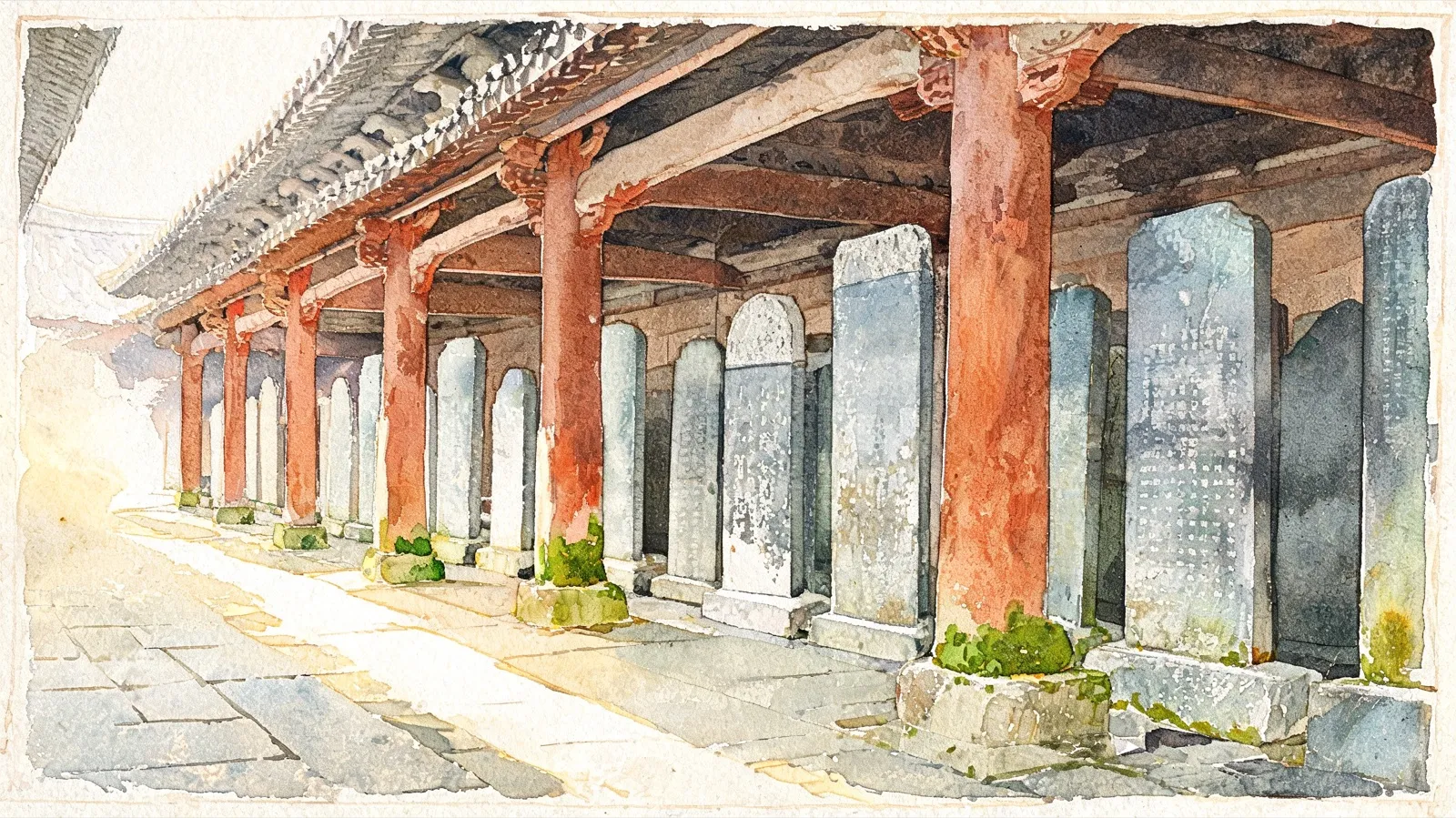
The Leizhou Peninsula has carried, since the Song dynasty, a reputation that surprises people who expect a frontier backwater: it was, in the old accounts, a land of scholars. That reputation was not native — it was given, by men who were sent there against their will.
Why scholars came to the edge
In the imperial system, exile to the far south was a measured punishment. The prefectures of Guangdong and Hainan sat at the empire’s meridional limit — beyond the pale of the capital, far from the court factions and the careers that defined a mandarin’s life. A chancellor fallen from grace, a censor who had argued too boldly against the emperor, a poet too sharp-tongued about power — these men were not executed; they were sent away, to places from which a return was uncertain and slow.
Leizhou, separated from Hainan by only the narrow Qiongzhou Strait, was one of those places. And the men who came found a small but attentive local population, and chose — rather than merely waiting out their sentence — to teach.
The cumulative effect of ten high officials doing so, across the Northern and Southern Song, was profound. They brought the classical learning, the standard pronunciation of the Central Plains, and the culture of the academy to a peninsula that would remember them for a millennium.
The ten, one by one
The group divides into Northern Song and Southern Song — and one, Wang Yansou, who never came at all.
- Northern Song
- Kou Zhun · Su Shi · Su Zhe · Qin Guan · Wang Yansou · Ren Boyu
- Southern Song
- Li Gang · Zhao Ding · Li Guang · Hu Quan
- The shrine
- Ten Worthies Shrine (十贤祠), Leizhou West Lake — established 1273
- The stele
- Composed by Wen Tianxiang
The Northern Song six
- Kou Zhun (寇准, 961–1023) — A former Chancellor of the realm who had negotiated the Chanyuan Treaty. Demoted and sent to Leizhou around 1022, he taught the locals and died there the following year. He is honoured at the Kou Gong shrine (寇公祠).
- Su Zhe (苏辙, 1039–1112) — The younger of the two great Su brothers, exiled to Leizhou in 1097 after the reformers' faction seized power. His more famous brother Su Shi passed through Leizhou to reunite with him before crossing to deeper exile in Hainan. A detail often confused: Su Zhe was exiled to Leizhou; Su Shi only passed through it.
- Su Shi / Su Dongpo (苏轼 / 苏东坡, 1037–1101) — Poet, calligrapher and one of the most beloved figures in Chinese literary history. He passed through Leizhou to reunite with his brother Su Zhe — a reunion and a farewell in the same visit, before he crossed the strait to Hainan.
- Qin Guan (秦观, 1049–1100) — A poet and follower of Su Shi, banished as the reformers purged their opponents; he died in exile.
- Wang Yansou (王岩叟, 1043–1093) — The one curiosity of the group: banished to Leizhou posthumously. His tablet was placed in the shrine in absentia — a uniquely Chinese form of posthumous disgrace, reflecting the intensity with which Tang factional vendettas were pursued even beyond death.
- Ren Boyu (任伯雨, 1059–1122) — A censor known for frank remonstrance, exiled south in the same purge as Qin Guan.
The Southern Song four
- Li Gang (李纲, 1083–1140) — Grand Chancellor in 1127, in the catastrophic year of the Jin invasion that ended the Northern Song. He argued for armed resistance rather than capitulation, was briefly appointed chancellor, and was then ousted and eventually exiled south. A tragic figure: he was right about resisting, and punished for it.
- Zhao Ding (赵鼎, 1085–1147) — Another Grand Chancellor who opposed appeasement of the Jin. Exiled south, he died — according to tradition — by fasting in protest rather than submit.
- Li Guang (李光, 1078–1159) — A statesman and proponent of resistance to the Jin, exiled south for opposing the peace faction.
- Hu Quan (胡铨, 1102–1180) — A censor who famously memorialised the emperor demanding the heads of the pro-peace ministers; instead of their heads, he lost his position and was exiled.
The shrine — 1273
The Shrine of Ten Worthies was established in 1273 — near the end of the Song dynasty, as the Mongol forces were closing in. Its founder was a Song military commander, Yu Yinglong (余应龙), who chose to honour these ten scholars in a monument just as the dynasty that had exiled them was about to fall.
The commemorative stele was composed by Wen Tianxiang (文天祥) — at the time one of the last Song officials still resisting the Mongols. He was captured in 1278 and executed in 1283 after refusing the offer of service under the new Yuan dynasty. His authorship of the Leizhou stele gives the shrine an extraordinary resonance: written by a man who would himself become a martyr for the same values — loyalty, learning, integrity under pressure — that the Ten Worthies represent.
A martyr's inscription, in a shrine to exiles — built ten years before the dynasty fell.
A Ming coda: Tang Xianzu
The pattern of the cultivated exile did not end with the Song. In 1591, more than three centuries after Wen Tianxiang’s stele, the Ming dynasty’s greatest playwright was sent to the peninsula’s southernmost tip.
Tang Xianzu (汤显祖, 1550–1616) had already written two major works when he submitted bold memorials criticising Emperor Wanli’s administration. He was stripped of his rank and sent as a minor clerical officer to Xuwen County — the furthest administrative post at the finger-tip of the Leizhou Peninsula, where the Qiongzhou Strait ferry crosses to Hainan.
He arrived in spring 1592. Local tradition holds that during his time there he built the Guisheng Academy (贵生书院 — “Academy for Valuing Life”), teaching the people of Xuwen. The name — valuing life as the highest principle — reflects the humanist philosophy that infuses The Peony Pavilion (牡丹亭), his masterpiece, completed after his return from exile in 1598.
Tang is not among the Ten Worthies — the shrine was already 318 years old when he arrived, and its membership was fixed to Song officials. He represents a Ming echo of the same pattern: a difficult man, sent to the end of the earth, who chose to give something there.
The legacy
What the Ten Worthies gave Leizhou is not measurable in buildings — most of those have not survived. What they gave is a self-conception. A peninsula that might have been merely the empire’s distant margin became, in the imagination of its people, a place that had been found worthy of the attention of chancellors and poets. The Song academies — seeded by these exiles — produced, over the subsequent dynasties, some 21 jinshi (imperial examination graduates), remarkable for a coast so far from the capital.
That pride — and the seriousness about learning it represents — is part of what the Lui Chew carried when they crossed the Qiongzhou Strait and the South China Sea. The diaspora’s founder figures in Malaysia — the men who built clan houses, funded scholarships and raised schools — were inheritors of a culture that had, for a thousand years, treated learning as the thing you do when you have nothing else.
Sources for the Ten Worthies, the shrine and Tang Xianzu are on the Sources & disclaimer page. If you are a Leizhou descendant with family stories connected to this tradition, a contribution is welcome.