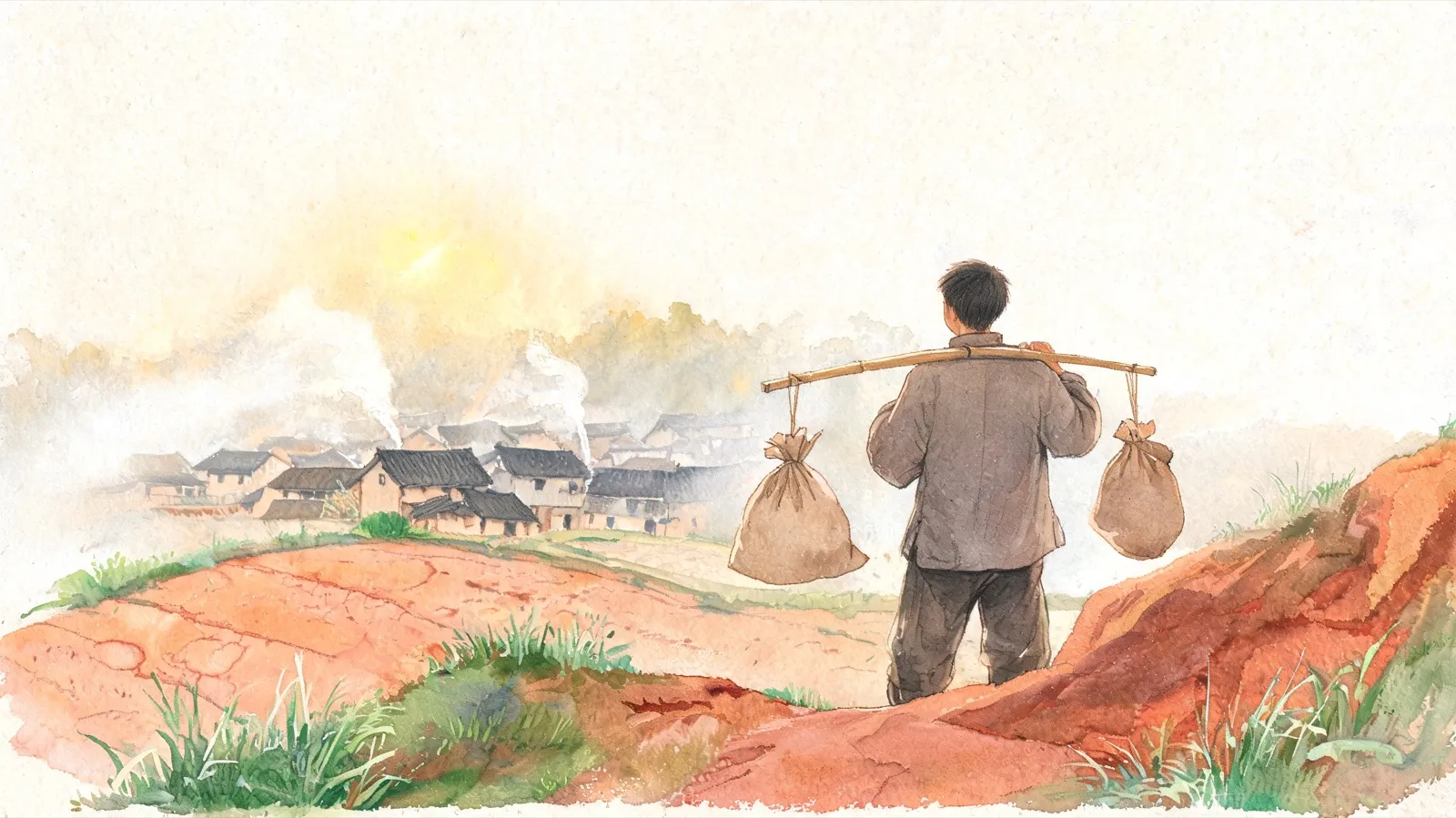
To understand why a few thousand villagers left a peninsula in Guangdong for a tin-and-rubber colony two thousand kilometres south, you have to picture the century they were living through. The crossing was not an adventure. It was, for most, an escape with a return ticket they never quite used.
A century of disorder
The mid-19th century broke open the Qing world, and South China took the worst of it. The First Opium War (1839–1842) ended in defeat, indemnity and the forced opening of the coast. A decade later the Taiping Rebellion (1850–1864) — among the deadliest conflicts in all of human history, with an estimated 20 to 30 million dead — tore through the southern provinces. Around and after it came further civil wars, local banditry, and the recurrent famine and rural poverty that pressed hardest on Guangdong, Fujian and Hainan.
For a farming family on a crowded coast, the arithmetic was stark: stay and risk starvation or conscription, or send a son to the South Seas to earn and remit. The pull of colonial Malaya — its hunger for labour — only worked because this push at home was so relentless.
It was not one disaster but a long century of them.
The legal key — 1842
None of this would have produced a mass migration without a change in the law. For most of the Qing dynasty, leaving the empire without sanction was forbidden — at times a capital offence — and overseas Chinese were officially regarded as having abandoned the realm.
The Treaty of Nanjing (1842), which ended the First Opium War, is the hinge. In its aftermath the old prohibition fell away and Qing subjects could, for the first time, legally work abroad. Every dialect group that poured into Southeast Asia in the following decades — the Lui Chew among the last of them — walked through that one door. The treaty is why the timeline of this whole story begins, for the diaspora, in the 1840s and not before.
Why the peninsula pushed
The Leizhou Peninsula was a particular kind of hard place to stay. It sits at the far southern tip of mainland China, a sea-girt, typhoon-exposed agrarian frontier — fertile in parts, but crowded, remote, and far from the centres of Qing prosperity. It was, in the language of the diaspora, a qiaoxiang (侨乡) in the making: an emigrant homeland whose surplus sons went abroad and whose villages came to depend on the money they sent back.
One honest caution belongs here. Leizhou-specific records of why individual families left are thin — far thinner than for the Hokkien or Cantonese. Much of what we can say about the Lui Chew push is reconstructed from the better-documented experience of their Hainanese kin across the narrow Qiongzhou Strait, whose migration system the Lui Chew shared. The two peoples left for the same reasons, by the same routes, at much the same time.
The five drivers
A peer-reviewed study of the Melaka Hainanese (Lee, Wong & Laxman, 2014) names five drivers of the migration. Because the Hainanese and Lui Chew share a homeland region and a migration system, the same five apply to the Lui Chew:
- 1. Poverty
- Hardship and scarcity in the home villages of the Qiong-Lei region.
- 2. The legal opening
- The Treaty of Nanjing (1842) made working abroad lawful.
- 3. Colonial labour demand
- Rubber, tin and plantation work in British Malaya and Singapore.
- 4. China's civil wars
- The Taiping Rebellion and the wider late-Qing collapse.
- 5. The 1937 invasion of Hainan
- The Japanese assault on the Qiong-Lei homeland triggered a further exodus.
The fifth driver matters for dating the community: it means the Lui Chew arrival was not a single 19th-century event but a stream that ran into the 1930s and 40s, with the wartime invasion of the homeland giving it one last push.
Small, late, last to leave
The same forces that emptied villages across South China reached the Qiong-Lei corner last. The Hainanese were “practically the last to arrive” in Malaya; the Lui Chew, smaller still, arrived alongside them. By the time they came, the most lucrative trades and the best-organised clan networks were already taken — which shaped everything about how they settled.
So the push answers two questions at once. It explains why they left: a century of disorder, unlocked by a treaty. And it foreshadows how they would live once they landed — small, late, tight-knit, and dependent on kinship to find a foothold. That is the story of the bang system and the coolie trade.
Sources for the historical events, the Treaty of Nanjing and the five-drivers framework are on the Sources & disclaimer page. Where the Lui Chew record is thin, this page says so rather than inventing detail; corrections and family memories are welcome on the Community board.