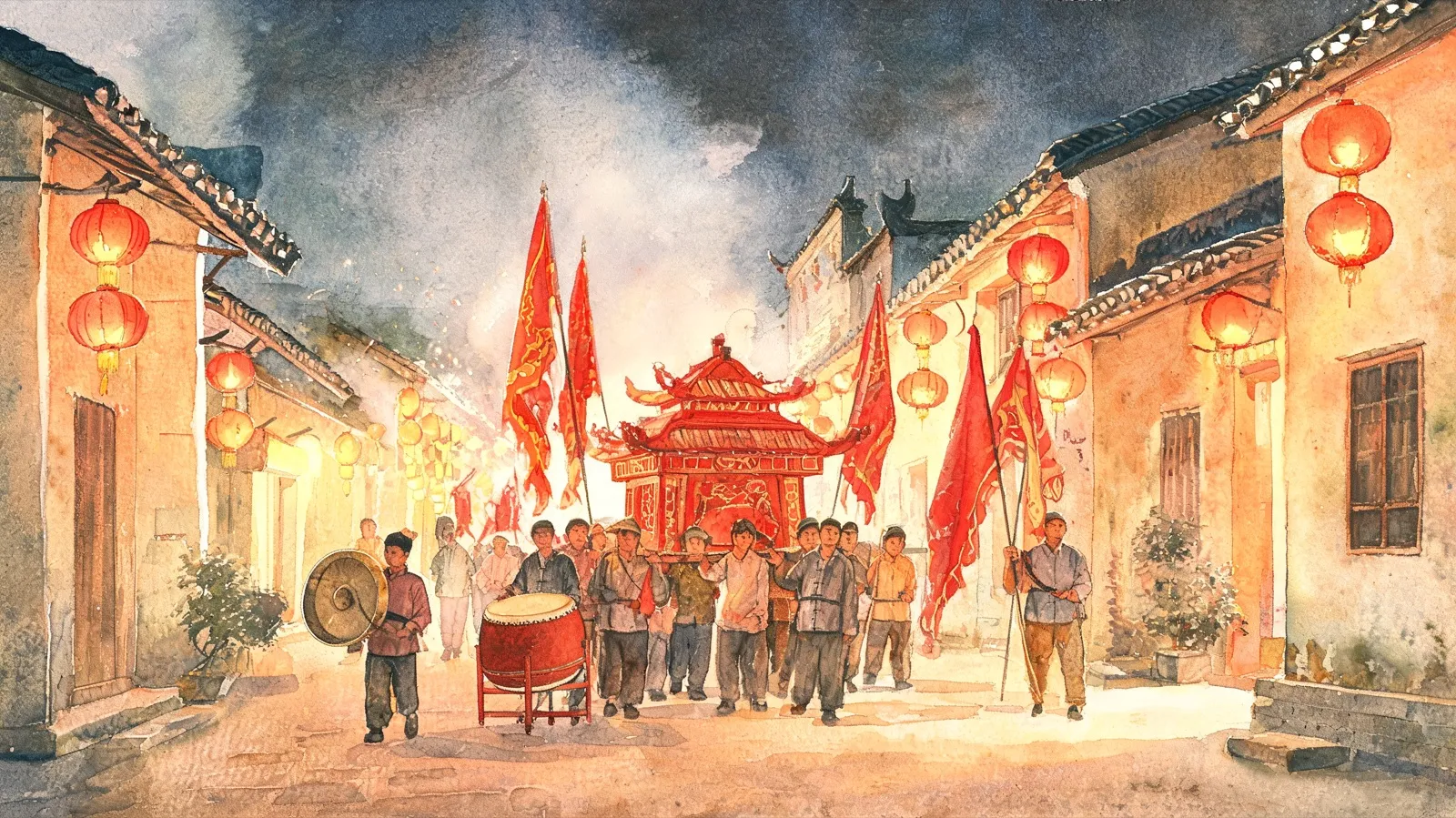
Culture is the part of a migration you cannot pack in a trunk. It travels in the mouth and the memory, and it changes on the way. For the Lui Chew — few, late, and dispersed — the question is not only what they brought, but how much of it a community this small could keep alive.
The tongue
At the heart of it is the dialect. Leizhou Min (雷州话, locally 黎话) is a branch of Min Chinese, close kin to Hainanese but not mutually understood with it. It keeps eight tones and the old final consonants of Middle Chinese — a conservative, Tang-era sound system that Mandarin lost long ago.
It is also the most fragile thing the Lui Chew carry. Overseas it is “extremely endangered,” spoken by only a few thousand, taught in no school, and giving way to Mandarin and English in every younger generation. The one peer-reviewed field study of the Malaysian dialect finds something poignant: its borrowings come not from Malay, the language all around it, but from Mandarin and Cantonese — the dominant Chinese tongues of Malaysian city life. The Lui Chew speak Malay as Malaysians, but their own tongue has stayed inside the Chinese world.
Go deeper: Leizhou Min — eight tones, Tang-dynasty consonants and the 2023 field study →
Go deeper: can a Lui Chew speaker understand Hainanese? A word-by-word test →
The gods that crossed
A clan house is also a temple, and which gods stand on its altar tells you what survived the journey. At the Melaka Leizhou Association the main deity is Guan Sheng Di Jun (关圣帝君, Guandi) — the universal patron of Chinese clan associations — with Guanyin, Tu Di Gong, and, distinctively, Bai Ma Lao Shi (白马老师, the “White Horse Master”), most likely a Min folk deity carried down from the community’s deep Fujian ancestry.
What is missing is as telling as what is present. The homeland’s own Thunder Ancestor (雷祖) — and the famous stone dogs — are absent from the Melaka altar. The god that made the crossing was the Min one, not the Leizhou one. Beneath the Leizhou name, the deepest layer of this identity is Min, from Fujian — and that is the layer that travelled.
Go deeper: who is Bai Ma Lao Shi, the White-Horse Master? →
Song, opera, and a modern anthem
A coast named for thunder kept a rich tradition of performance, all of it sung in the dialect:
- Leizhou song (雷州歌) — a folk-verse tradition more than five centuries old, built on a strict four-line, seven-character frame; national intangible heritage.
- Guniang Ge (姑娘歌) — its staged, improvised, female-led dialogue form, where singers compose verses on the spot to a rhyme set by their rival.
- Lei opera (雷剧) — the regional opera grown from that song, one of Guangdong's four major opera forms. In 2001 its lead actress won the Plum Blossom Award, Chinese opera's highest acting honour.
These need fluent audiences and trained troupes — which is why they are alive on the peninsula and largely silent in the diaspora. The most portable piece is the newest: a modern Leizhou-dialect song that speaks directly to a descendant’s longing.
A taste of home
Leizhou cooking is a light, sea-fed cuisine — “letting fresh ingredients speak” — of the same coastal zone as Hainan: Spanish mackerel and golden pomfret, oysters and squid, rice cakes, roast pork, fried shrimp cakes.
Its signature is the Leizhou great rice dumpling (大粽) — a glutinous-rice parcel far larger than the zongzi most Malaysians know, woven by hand from wild-pineapple leaves into the shape of ducks, birds, fish or pyramids, packed with pork, chicken, salted egg, lotus seed, mushroom and dried seafood, then steamed for hours and served with clear beef soup. Of all the homeland dishes, it is the one most able to travel — pineapple leaves grow throughout Malaysia, and the pork can be swapped — though a living Lui Chew da zong tradition in Melaka or Muar has not yet been confirmed.
What travelled, and what didn't
The honest map of Lui Chew culture is not a list of treasures but a ledger of which ones survived the crossing. A community of a few thousand could keep an institution alive; it could not keep a whole folk-religion and an opera season.
| Tradition | At home | Made the crossing? |
|---|---|---|
| Leizhou Min dialect | Endangered home speech | Yes — but barely; a few thousand speakers |
| The clan house, cemetery, welfare | Diaspora institution | Yes — the full toolkit, in Melaka and Muar |
| Bai Ma Lao Shi (a Min deity) | Min folk god | Yes — on the Melaka altar |
| Guandi worship | Universal clan patron | Yes |
| Lei Zu / Thunder Ancestor | The peninsula's signature god | No — absent overseas |
| The stone-dog cult | ~10,000 at home; National ICH | No — not documented in Malaysia |
| Nianli festival | Western-Guangdong folk festival | No — a generic New-Year gathering instead |
| Leizhou song & Lei opera | National ICH | No — needs troupes and fluent audiences |
| Leizhou great rice dumpling | Living food tradition | Possible, with adaptation — not yet confirmed |
The institution travelled; the spectacle largely stayed behind.
This is the quiet truth of a very small diaspora: what endures is not the festival or the opera but the clan house, the cemetery, the youth programme — and a remembered tongue in which the word for “cow” still keeps the soft Tang-dynasty sound the homeland has lost. Holding even that much, before it slips, is the work this project exists for.
The most useful thing a descendant can do is in Family & Roots: sit an elder down, and record the words while they are still spoken.