The Lui Chew were never a mass migration. Even the Hainanese — their closest kin — were only about three percent of Malaya’s Chinese, and the Lui Chew were smaller and later still. Yet a small people can leave a deep mark in one place, and theirs is written into the heritage core of Melaka and the dated minute-books of Muar.
Where the Lui Chew settled
Like most Malaysian Chinese, the Lui Chew settled along the west coast of the peninsula — in the Chinese-dense states of Perak, Selangor, Johor, Penang, Negeri Sembilan, Melaka and Pahang — drawn by the same colonial labour markets in tin and rubber that pulled every dialect group south.
The 1957 census, which broke the Chinese population down by mother tongue, listed Hokkien, Teochew, Cantonese, Hainanese and Hakka by name and lumped everyone else into “six other dialects.” Leizhou Min was one of those six — too small to be counted on its own, sometimes filed administratively next to the Hainanese. Three places, though, are clearly documented: the clan houses of Melaka, the oldest, and Muar, the most fully recorded — and Tiang Dua, a Melaka village that is not an institution at all but a settlement where Lui Chew families still live side by side.
Melaka — No. 97 Jonker Street
On Jonker Street (Jalan Hang Jebat; in Chinese 鸡场街, “chicken-market street”), in the heart of what is now a UNESCO World Heritage city, stands the Melaka Leizhou Association (马六甲雷州会馆). By its own tradition it was founded in 1899 — Qing Guangxu 25 — by migrants whose roots ran back to Zhanjiang on the Leizhou Peninsula.
It joined an ecosystem already a century deep: the Eng Choon, Teochew and Hokkien clan houses on the same street predate it by decades, and the Leizhou body modelled itself on them. Its motto reads 联络乡谊、传承文化、造福桑梓 — foster fellow-townsman ties, transmit the culture, benefit the homeland.
- Founded
- 1899 (Qing Guangxu 25), by Zhanjiang-origin migrants tradition
- Address
- 97 Jonker Street (Jalan Hang Jebat), Melaka — inside the UNESCO World Heritage core zone
- Members
- More than 1,000 registered permanent members; described in its own materials as the largest Leizhou association in Southeast Asia
- Continuity
- A council (理事会) and a formal Youth Section (青年部); past chairmen include the long-serving Deng Fuming (邓福明)
- Homeland ties
- Named among the overseas bodies at the first World Leizhou Peninsula Friendship Conference (Zhanjiang, 2018); hosted a Zhanjiang overseas-Chinese delegation in 2023
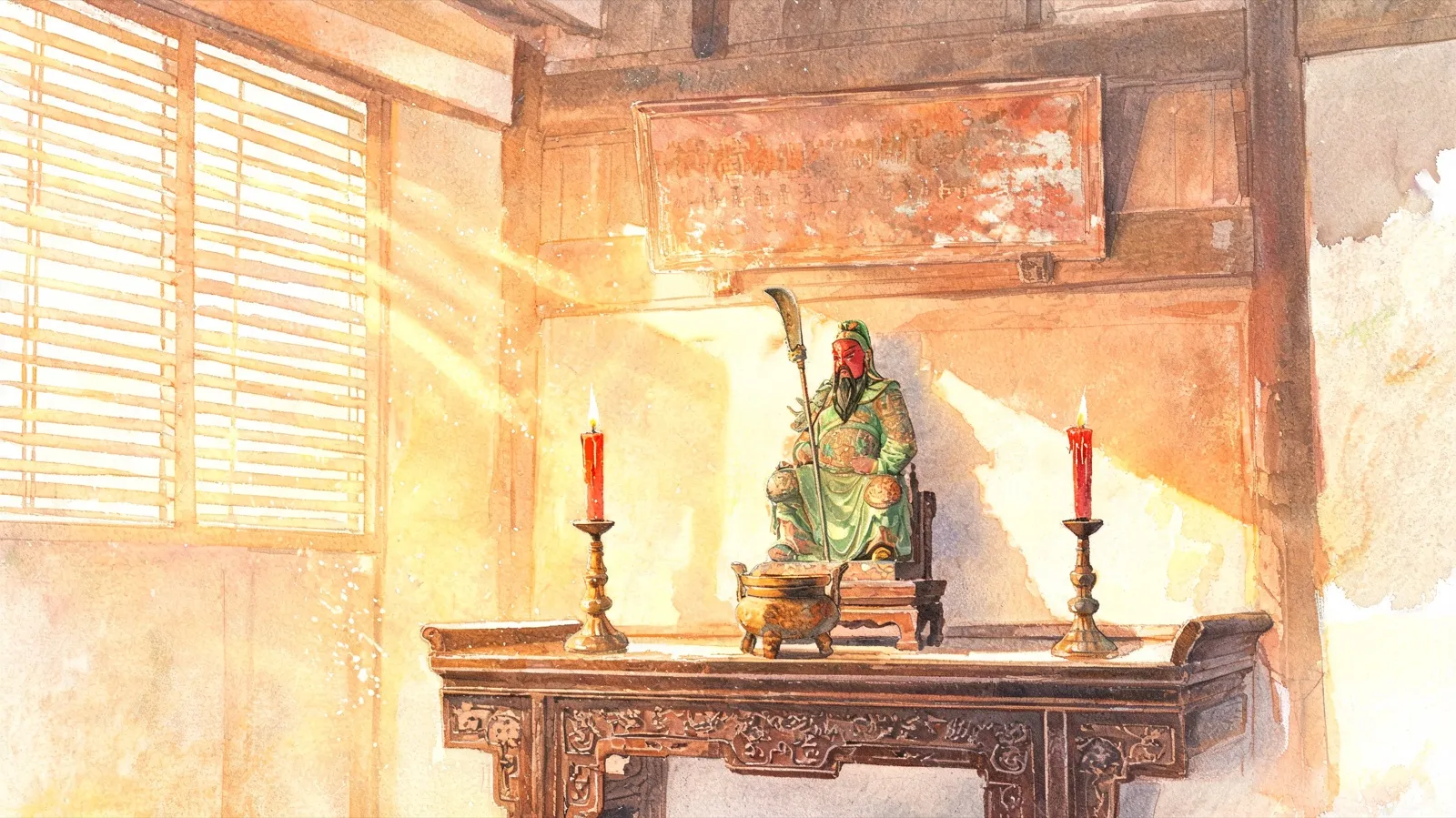
The clan house is also a working Guandi temple, open daily, its altar headed by Guan Sheng Di Jun (关圣帝君) with Guanyin, Tu Di Gong and — distinctively — Bai Ma Lao Shi (白马老师, “White Horse Master”), most likely a Min folk deity carried down from the community’s Fujian ancestry.
Go deeper: the Melaka Leizhou Association at 97 Jonker Street →
Or walk it: a self-guided Melaka heritage walk, told from the Lui Chew side →
Go deeper: Persatuan Lui Chew Johor — a hundred years in Muar, fully dated →
Muar — the fullest record
The fullest Lui Chew history in Malaysia belongs not to Melaka but to Muar, in Johor, where the community kept careful note of its own beginnings. Persatuan Lui Chew Johor has published a dated account of itself — a rare thing for so small a group — and it reads as a model of how a bang becomes an institution.
A Leizhou bang forms
The ex-Qing scholar Zheng Maolan (郑茂兰) organises a Leizhou bang (雷州帮) in Muar to lead, protect and mediate for fellow Lui Chew migrants.
The Muar Leizhou Association
The bang is reconstituted as a formal association. Early leaders include Chen Qixiang, Chen Shanqing (陈善庆) and Chen Qizhang. Zheng Maolan dies in 1924, before the hall is built.
A gift of land
The townsman Chen Yongzhu (陈永祝) donates a plot of more than 5,000 sq ft on Jalan Lima.
The clan house opens
A two-storey hall opens at No. 76 Jalan Lima — a shrine and meeting hall below, lodging rooms for Lui Chew sojourners above. Chen Shanqing is its first chairman.
New premises
After some eight years of fundraising, larger quarters open at Jalan Sisi; a key patron is Fu Zhitian (符之田).
Renamed Persatuan Lui Chew Johor
Under chairman Xu Yaquan (许亚权), annual dues and festival levies are abolished, all members made permanent, and scholarships added.
The Lui Chew Building
The old Jalan Lima site is rebuilt as a commercial tower, the 雷州大厦 — its rental income endowed to fund the community's welfare.
Today the Johor body carries the full mutual-aid toolkit of a Chinese clan association: a youth corps, a women’s group, a welfare fund, scholarships, and a community cemetery (义山). It counts its history from the bang of about 1913, and has marked its own centenary.
| Melaka | Muar (Johor) | |
|---|---|---|
| Beginnings | Founded 1899 (tradition) | Bang ~1913; association 1919 |
| Where | 97 Jonker Street, UNESCO core | Jalan Lima → Jalan Sisi, Muar |
| Best known for | Age, heritage setting, Guandi temple, 1,000+ members | Its own dated history, the Lui Chew Building, a community cemetery |
| Documentation | Community tradition + external sightings | The association's own published history |
| Status | Both active today. | |
Tiang Dua — the village
Melaka and Muar are institutions: clan houses with minute books, office-bearers and a street address. Tiang Dua (丁赖新村) is something else — a place where Lui Chew families simply live next door to one another.
It is a Chinese new village in Melaka Tengah, founded in 1949. The Chinese name 丁赖 is nothing more than the Malay Tiang Dua — “two pillars,” after the pair that marked its entrance — heard through a Hokkien ear. And by the account of the people who live there and of the one academic study devoted to it, it is the most heavily Leizhou settlement anywhere outside China.
How heavily is not settled. Sin Chew Daily put it at about half of some 400 residents in 2022; China Press, quoting the village head two years later, at 60–70% of roughly 430 people across 150 households. These are community estimates, not census returns, and the honest range is somewhere between half and two-thirds.
In 2024 Tiang Dua was chosen — ahead of Melaka’s twenty-three other new villages — as the state’s representative in Malaysia’s national bid to have its Chinese new villages inscribed as UNESCO heritage, on the strength of exactly this distinctiveness.
| Practice | Status |
|---|---|
| Leizhou Min spoken | Alive, and going. The third generation still speaks it; the fourth largely does not |
| 白马老师宫 — a White-Horse Master temple | Standing. A temple of its own, not a side altar — one of four in the village. The deity, and the puzzle |
| 威圣宫 | Standing |
| Leizhou white-cut chicken and pork (白切鸡/白切肉) | Still made at festivals |
| The great rice dumpling (大粽) | Not documented here |
| Stone dogs (石狗) | Not documented here |
| Leizhou opera (雷剧) | Not documented here |
| Thunder-Ancestor (雷祖) worship | Not documented here by that name |
That last block of blanks is worth sitting with. If the great rice dumpling is not made in the densest Lui Chew village outside China, the odds that it survives elsewhere in Malaysia are slim — and the open question this project has kept about it may already have its answer.
What a clan house actually did
A clan house was never just a building. It met the newcomer off the boat, gave him a bed, a meal, and a name to ask for.
For a man arriving alone from a village he might never see again, the huiguan (会馆) was a homeland in miniature. It received him off the boat and housed him — the upstairs rooms of the 1934 Muar hall were built precisely as lodging for sojourners. It found him work, lent him money, settled his quarrels, kept a shrine where he could burn incense to familiar gods, ran scholarships for his children, and, when the time came, buried him in its own ground. It held a scattered people together on the single fact of having come from the same place.
What they did for a living
There is no Lui Chew–specific trade roster in the public record — the community was too small to register as an occupational bloc. What evidence there is points to the service-sector niches of the wider Qiong-Lei (Hainan–Leizhou) migration: coffee shops (kopitiam) and food service, bakeries and the clothing trades, domestic service, small retail. Unlike the Hainanese, who turned coffee-shops and cooking into a signature (and gave Malaysia “Hainanese chicken rice”), the Lui Chew left no dish with their name on it.
By the post-independence decades their descendants, like other Malaysian Chinese, moved into the full breadth of professional and commercial life — but that step is not documented at the dialect-group level, and we will not invent it.
Remembered as builders, not celebrities
No nationally famous Malaysian is reliably documented as Lui Chew, and that absence is part of the honesty of this story. (The tycoon Robert Kuok is sometimes loosely called “southern Chinese,” but he is Fuzhou Min, not Leizhou.) The figures worth remembering are the community builders: Zheng Maolan, who first gathered the Lui Chew of Muar; Chen Shanqing and Chen Yongzhu, who gave the Johor association its land and its first hall; Fu Zhitian, who funded its second; and elders like Deng Fuming of Melaka who keep the clan houses alive today.
How the community changed
Three generations turned a transient bang into a settled, civic-minded community. Four shifts tell the arc:
- From sojourner to settler. In 1934 the Muar hall still kept lodging rooms upstairs — men were expected to come alone and many to return. By 1994 the Johor body had abolished dues and made every member permanent. The assumption had changed from "guest" to "citizen."
- From bang to civic association. A kin-protection network became a chartered non-profit with scholarships, a welfare fund and a cemetery.
- From dialect to memory. A community whose identity was its tongue became, in three generations, a Mandarin- and English-speaking one whose Leizhou identity now lives in institutional memory more than in daily speech.
- From homeland-facing to bilateral. The one-way passage of the coolie ships has become a two-way conversation — the World Leizhou Peninsula Friendship Conference, delegation exchanges, a visiting linguist recording the dialect. A transnational identity, in a 21st-century form.
The arc was not unbroken: the Japanese Occupation and the Sook Ching of 1942 fell across it, and the community's losses were never written down. Go deeper: the war years →
The associations today
Are the clan associations growing or shrinking? No public source gives a year-on-year membership figure for any Lui Chew body, so the honest answer is partial. What is documented: the Melaka body reports more than 1,000 permanent members; the Singapore Lui Chiu Hoe Kuan lists 197; Muar publishes no figure. The institutional trajectory — from a 1913 bang to a 2004 commercial building endowing its own welfare — is one of capacity built, not lost.
The wider context, though, is sobering. A 2026 study of Malaysian Chinese clan associations frames the whole sector as “under increasing pressure” — fewer dialect-speaking elders, more Mandarin- and English-dominant youth, more secular alternatives — with youth participation the single biggest lever for survival. The Lui Chew bodies respond as the sector does: permanent membership (Muar abolished annual dues in 1994), youth wings (Melaka’s 青年部, Muar’s 青年团), scholarships, and rental income that funds welfare without leaning on subscriptions.
What does a clan association actually do across a year? Drawing on the bodies’ own published material:
| When | What |
|---|---|
| Chinese New Year | The collective New-Year greeting (新春大团拜) — the big social gathering at Muar |
| 1st lunar month, day 17 | Bai Ma Lao Shi (白马老师) birthday — a focal temple day at Melaka |
| Qing Ming (~Apr) | Tomb-sweeping and ancestor commemoration |
| 5th lunar month, day 13 | Guandi (关圣帝君) birthday — the other big Melaka temple day |
| Mid-year | Scholarship awards; members' general meeting |
| Throughout | Welfare and cemetery assistance, youth- and women's-group activities, homeland delegation exchanges |