What the stone dog is
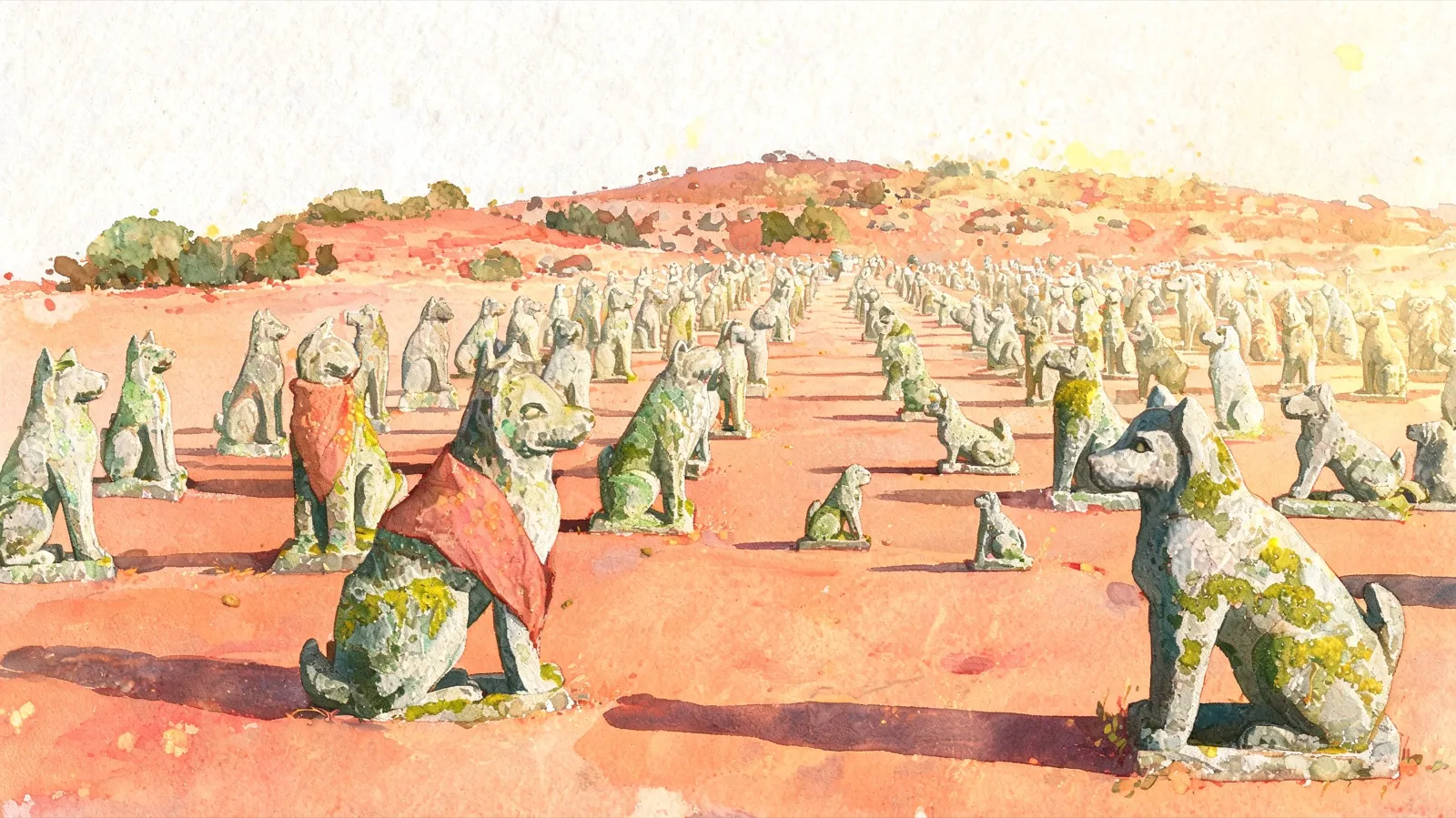
Across the Leizhou Peninsula, at the entrance to a village or the foot of a grave, you will find a squat figure of carved stone — a dog, sitting upright, often draped in a square of faded red cloth. These are the stone dogs (石狗), the guardian spirits of the thunder coast. They are not decoration and not quite statues: they are watched over, dressed, fed and prayed to, a living folk religion carved in basalt.
For this project they are also the emblem — the lone weathered stone dog of the home page is a real Leizhou guardian, the single object that best holds the whole story: rooted, tactile, and unmistakably of this one place.
Not a statue but a guardian — watched over, dressed in red, fed and prayed to.
A 2,000-year totem
The stone dog is far older than the Leizhou name itself. It begins with the Baiyue (百越) — the indigenous peoples of the far south, including the Li, Yao and Hlai, who revered the dog as a totem, in part for its reproductive vigour. Carved stone dogs on the peninsula date back to around 200 BCE, the Han dynasty.
Over the long centuries that followed, the totem changed meaning. Through the Song, Yuan and Ming dynasties the dog-totem belief absorbed Central-Plains Chinese influence and re-emerged as a guardian-deity cult, the figures gradually carved into more human-like forms. Later Ming and Qing layers added the protective motifs of Shi Gandang (石敢当) and the Bagua (八卦). The stone dog is, in effect, a 2,000-year palimpsest — an indigenous totem with successive layers of Chinese folk religion carved over it, exactly mirroring how the Leizhou people themselves are a Min-Chinese culture grown over a Baiyue frontier.
Ten thousand guardians
The sheer number is part of the wonder. Roughly 10,000 stone dogs are estimated to survive across the peninsula — and some estimates run as high as a million, scattered through villages, fields, roadsides and graveyards. They are sometimes called “the terracotta warriors of the south” (南方兵马俑), set beside Xi’an’s army in Chinese cultural rhetoric.
- The largest
- Over 2.5 m tall and more than 500 kg.
- The smallest
- Just 10 cm and half a kilo.
- The material
- Mostly volcanic basalt — a nod to the peninsula's geology — though at least one was carved from coral.
- The world's largest collection
- The Leizhou Museum holds roughly 1,000 of them under one roof.
In 2002 a dedicated Stone Dog Park was built on more than 13 hectares beside the Lei Zu Ancestral Hall, and in 2024 a national competition was held to give the stone dog a marketable cartoon mascot — a folk totem reaching for a modern afterlife.
A living cult, not a museum piece
What makes the stone dogs remarkable is that the cult is still alive. Locals drape the dogs in red cloth and leave offerings of tea, incense and food on the 1st and 15th of each lunar month, and especially during the Nianli (年例) festival — the region’s signature village-by-village celebration. A stone dog at a village gate is a working guardian, asked for protection and answered with care.
Why none crossed the sea
For all its power at home, the stone dog is — tellingly — absent from Malaysia. No public source documents a stone dog in any Malaysian Lui Chew context: not at the Melaka clan house, not in any household shrine on record. It is one of the clearest cases of a homeland tradition that simply stayed behind.
The reason is in the stone itself. The cult is bound to the peninsula’s specific landscape — its volcanic basalt, its village-gate geography, its particular dead. It is not a portable god like Guandi or Mazu, the deities that filled the altars of overseas-Chinese clan houses. So when the Lui Chew sailed for Malaya, the stone dog did not come with them; the one homeland strand that did travel was a Min folk deity, Bai Ma Lao Shi, on the Melaka altar. The stone dog stays on the thunder coast — which is, in its way, why it makes such a fitting emblem for a story about a people and the place they came from.
Sources for the stone-dog history, numbers and heritage status are on the Sources & disclaimer page. If you have seen a stone dog kept by a Lui Chew family overseas, that would be a genuinely new datum — tell us.