For most Malaysian families, “where are we from?” has a simple answer and a hard one. The simple one is a town in Malaysia. The hard one runs back across the Strait of Malacca to a specific village on a thunder-blasted peninsula — and for the Lui Chew, that thread is thin, late-recorded, and fading fast. This page gathers what survives, and how to follow it.
The Lui Chew surname registry
Pulling together every Lui Chew individual named across the association histories and one linguistic field study yields a sample of sixteen surnames — the documented Lui Chew families of Malaysia so far. Most come from Muar’s unusually detailed records; a few from Melaka and from a 2023 dialect study.
| Surname | Pinyin | Documented through |
|---|---|---|
| 郑 | Zheng | Zheng Maolan, who organised the first Leizhou bang in Muar (~1913) |
| 陈 | Chen | Chen Shanqing (first Muar chairman) and Chen Yongzhu (1925 land donor) — and the peninsula's own surname |
| 吴 | Wu | Muar elders; a named speaker in the 2023 field study |
| 杨 | Yang | Yang Yasheng, an early Muar elder |
| 庄 | Zhuang | Several early Muar elders |
| 符 | Fu | Fu Zhitian, patron of the 1969 Muar premises |
| 谢 | Xie | The Xie family; a clan scholarship is named after Xie Jufu |
| 许 | Xu | Xu Yaquan, who renamed the body Persatuan Lui Chew Johor in 1994 |
| 李 | Li | Early Muar elders |
| 王 | Wang | Wang Yasan, an early car-owner who drove for fundraising |
| 邱 | Qiu | An early Muar elder |
| 黄 | Huang | An early Muar elder |
| 蔡 | Cai | A former state official who opened the Lui Chew Building in 2004 |
| 潘 | Pan | The calligrapher who wrote the Lui Chew Building (雷州大厦) inscription |
| 邓 | Deng | Deng Fuming, past chairman of the Melaka association |
| 姜 | Jiang | Three Jiang named speakers in the 2023 field study — likely a Lui Chew Jiang lineage |
The Chen (陈) concentration is no accident: along the coastal Han belt that runs down to the Leizhou Peninsula, Chen is borne by roughly one person in eleven — and Lei Zu himself, the deified founding prefect, was Chen Wenyu. The three Jiang (姜) dialect-speakers recorded together in 2023 are the clearest hint of a single living lineage worth tracing.
Go deeper: each of the sixteen surnames — individual by individual →
Who they married
No source documents Lui Chew marriage patterns directly, but the structure is clear enough. The bang system and chain migration favoured dialect-group endogamy in the first two generations — men sent home for brides, or married within the small Lui Chew and neighbouring Hainanese circles. The Lui Chew were far too few and too late to form a Malay-marrying corridor like the early Hokkien Babas of Melaka.
By the third generation, as Mandarin became the common Chinese tongue, marriages most likely spread across the Chinese dialect groups — Hokkien, Cantonese, Hainanese, Teochew spouses — while intermarriage with Malay or Indian Malaysians stayed rare on demographic grounds. This mirrors the well-documented Hainanese pattern, their closest kin.
Names written in stone
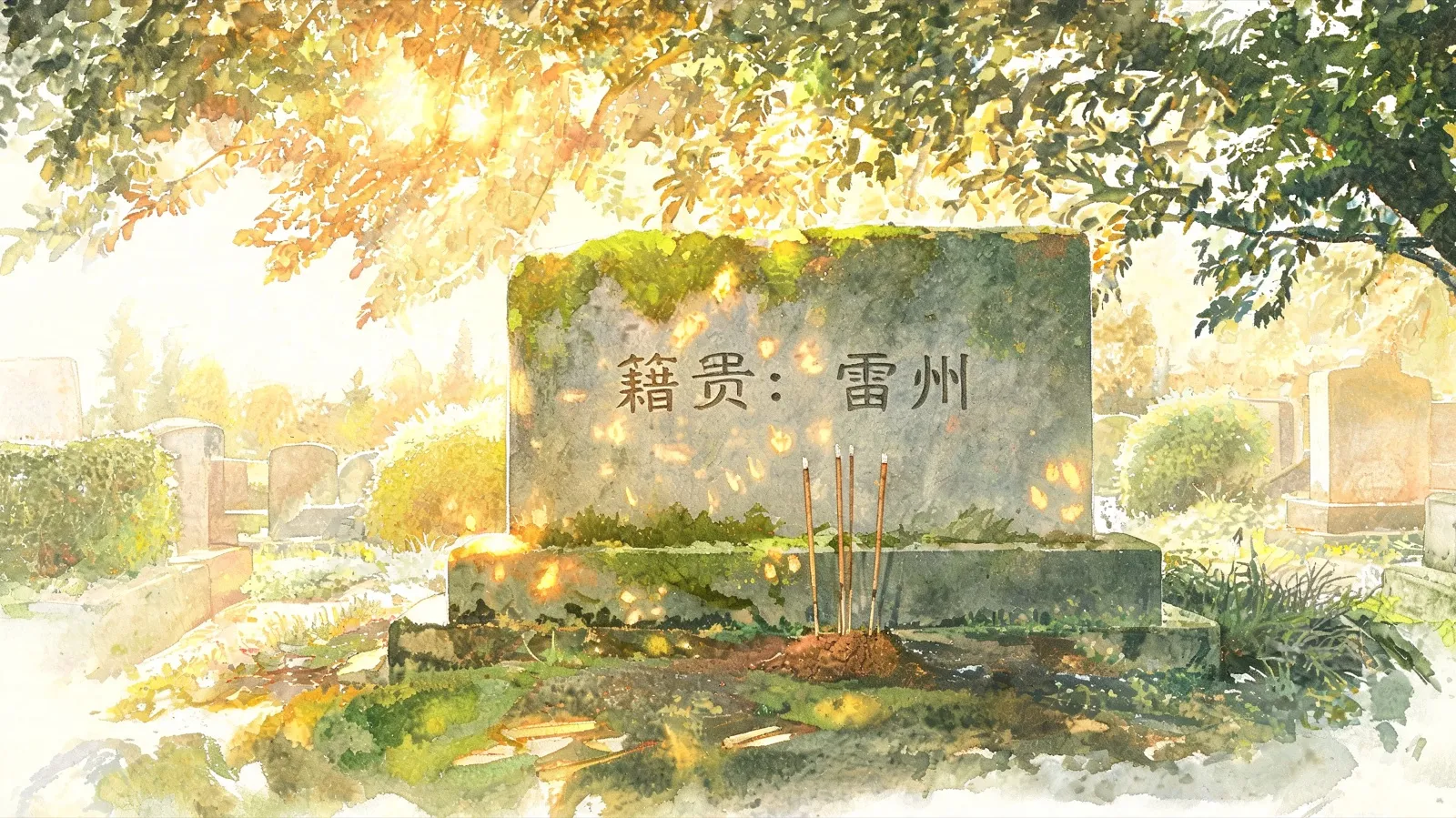
When a clansman did not return to China, he was buried here — and a Chinese gravestone is a genealogical document. It carves the ancestral hometown (籍贯 / 祖籍), the name, the dates, and the descendants who raised the stone. For a Lui Chew grave, the hometown line should read 雷州 (Leizhou), often with a county — Haikang (海康), Suixi (遂溪) or Xuwen (徐闻). A line reading 湛江 (Zhanjiang) is undecided rather than confirmed: the prefecture holds more than one language, so look for an older stone with a county. For what each of those names actually proves, county by county, and why some of them no longer appear on any map, see Reading the jiguan line.
Two grounds matter most:
- The Muar Lui Chew cemetery (义山). Persatuan Lui Chew Johor maintains its own community cemetery — the only Lui Chew–owned burial ground on record. Its location, size and grave roster have not been published; a survey of its inscriptions would be an irreplaceable primary source.
- Bukit Cina (三宝山), Melaka. The largest Chinese cemetery outside China — more than 12,500 graves over 250,000 m², designated in 1685, with stones reaching back to 1612 and famously defended from redevelopment in 1984. Melaka Lui Chew families, who kept no separate ground, were most likely buried here. A filter of its stones for Leizhou-county inscriptions, with Zhanjiang-origin stones kept as candidates, would surface Lui Chew burials across generations.
The letters home
A money-order folded inside a letter — and, often, the only words a family back home would have for years.
Qiaopi (侨批) were the combined remittances and letters that migrants sent to relatives in China. When the sender could not write, a professional letter-writer who shared his dialect did it for him — so the letters carry dialect-specific words and turns of phrase. They were inscribed on the UNESCO Memory of the World Register in 2013, recognised as a global documentary heritage of the Chinese diaspora.
No Lui Chew qiaopi archive has yet been catalogued — and the reason may run deeper than a gap in the record. Qiaopi was a regional institution, not a universal one. Scholarly surveys that enumerate the separate remittance networks of southern China name six — Cantonese, Hakka-Dongjiang, Chaoshan, Hainan, Minnan and Guangxi — and Leizhou is not among them. Hainan, the Lui Chew’s closest linguistic kin across the strait, had its first qiaopi house by 1882 and some fifty-five by the late 1930s; no comparable Leizhou network appears anywhere in the published record.
No source states outright that Leizhou had none. But none records that it did — and a homeland whose modern story is dominated by returnees coming back rather than remittances going out may simply never have built one. If even one family’s letters survive — in a drawer in Muar, or in the Zhanjiang Municipal Archives — they would be rarer than we first supposed, not less remarkable. They are still worth asking elders about by name.
The vanishing archive
The most urgent archive is also the most fragile: living memory. The Lui Chew arrived a century ago, which means the third- and fourth-generation descendants alive today heard the founding stories directly from elders — and those elders are now in their seventies and eighties. The dialect is “extremely endangered”; the memory it carries is too.
A recorded conversation with an elder can preserve what no document holds: the exact village left behind, the ship and the port of arrival, what the first generation did for a living, which gods and dishes and songs the household kept, the marriages that shaped it, and the heirlooms — photographs, ancestor tablets, deeds, a qiaopi — still in a cupboard somewhere. The academic model already exists: the 2014 study of Melaka Hainanese families recorded interviews alongside video of festivals and family businesses. The same can be done for the Lui Chew, with the two associations as the starting roll.
How to trace your own Lui Chew roots
A practical order of work, from what is in your own home outward to the archives — and for the full step-by-step version, with the gravestone-reading table, the elder-interview questions and the archive contacts, see the dedicated guide: How to trace your Lui Chew ancestry.
- 1 · Start with the gravestone. Find the family graves and read the jiguan / zuji (籍贯 / 祖籍) line. 雷州 (Leizhou), or a Leizhou county (海康 · 遂溪 · 徐闻, Haikang · Suixi · Xuwen), is your confirmation; 湛江 (Zhanjiang) on its own is undecided. Photograph every stone, including the descendants' names.
- 2 · Ask the elders now — and record it. Sit with the oldest relatives while you can. Ask for the home village, the migration story, occupations, language at home, and the names of anyone who "kept in touch with China."
- 3 · Check the association rolls. The Melaka Leizhou Association and Persatuan Lui Chew Johor hold membership records spanning generations. Your family name may be in them.
- 4 · Follow the surname cluster. Use the registry above as leads — Chen (陈), Jiang (姜), Zheng (郑), Fu (符), Xu (许) and Xie (谢) are the best-documented starting points.
- 5 · Hunt for letters and heirlooms. Qiaopi (侨批), ancestor tablets, old deeds, business ledgers and photographs all carry names, dates and places of origin.
- 6 · Cross the strait. With a hometown in hand, the Zhanjiang Municipal Archives, the Guangdong Provincial Archives and the relevant county genealogies (族谱) are where a Malaysian thread reconnects with its homeland one. Planning the trip itself is a guide of its own — and it begins by asking whether you have got far enough through steps 1 to 5 to make the journey worth taking.