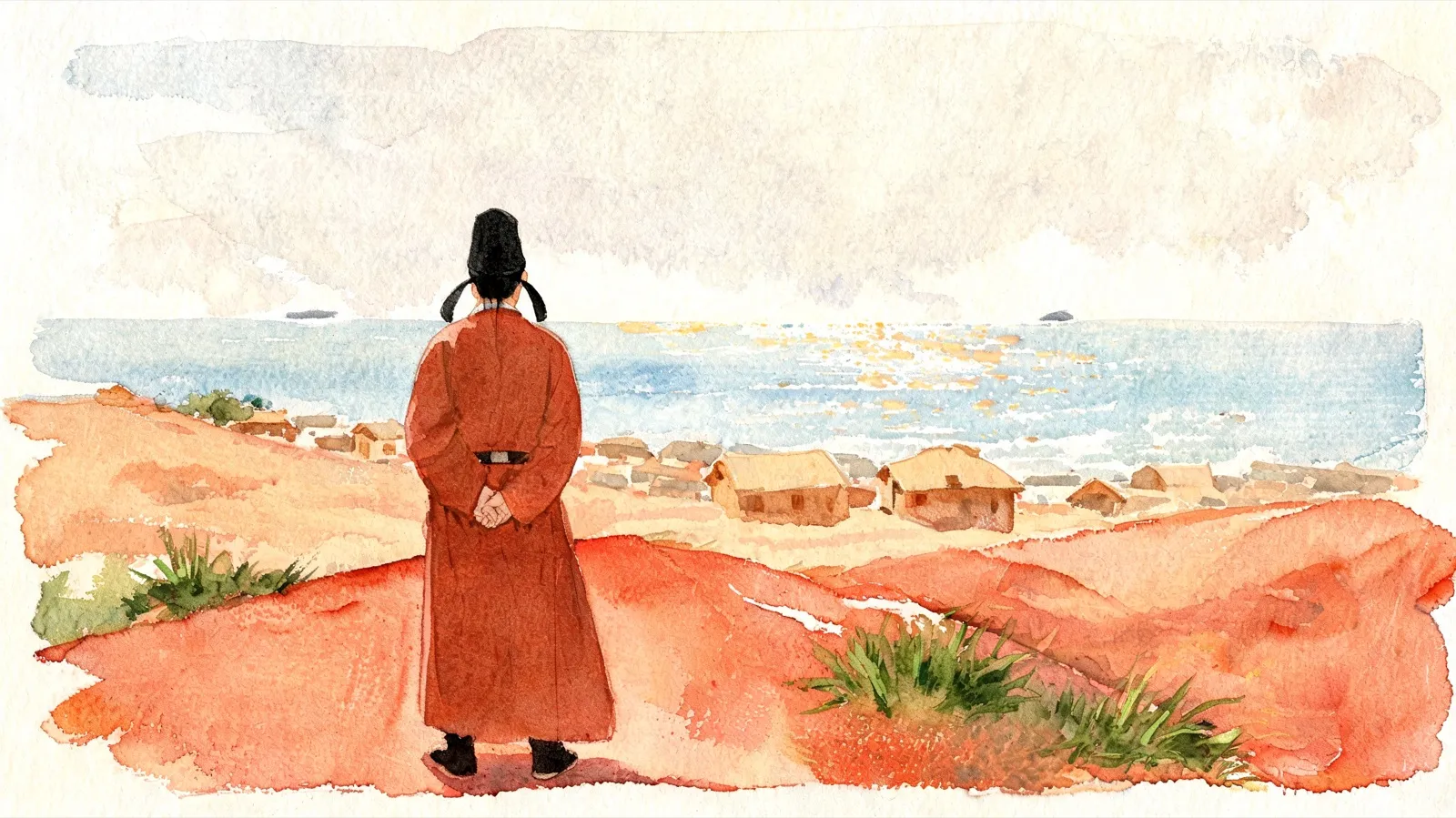
Every people has a founding figure; very few have one with a personnel file. This page is about the Tang official whose administrative record became a religion — and why that religion, unlike his people, never left the peninsula.
The man: Chen Wenyu
Chen Wenyu (陈文玉, 570–638 CE) was a Tang-dynasty official with a career that can be dated like any bureaucrat’s:
Takes office
Appointed prefect of Donghezhou (东合州) — the far-southern frontier prefecture at the empire's edge — in the fifth year of the Zhenguan era.
Names the land
Petitions the Tang court to rename the prefecture Leizhou (雷州, "thunder prefecture"), after the Qinglei Mountain and River south of the seat. The name has stood for nearly 1,400 years.
Makes the peace
His documented achievement: pacifying and mediating the conflicts among the Han settlers and the peninsula's indigenous Yao, Dong, Lao, Miao and Li peoples — patient field administration on a frontier the empire barely held.
Dies in office's shadow
Chen Wenyu dies. What happens next is what makes him unique.
The god: Lei Zu
What happened next: his own people made him a god. The grateful population deified the dead prefect as Lei Zu (雷祖) — the Thunder Ancestor — fusing the historical peacemaker with the region’s oldest force. The peninsula is one of the most thunder-struck places in China; its people had worshipped thunder long before the Tang. In Chen Wenyu, the thunder got a face, a name and a biography — and the region’s civic founder got the sky.
The man who named the thunder coast became the thunder itself.
This is what makes Lei Zu genuinely unusual in Chinese religion. Deified officials exist — Guandi was a general, Mazu a fisherman’s daughter — but they became universal gods, worshipped far from home by people with no tie to them. Lei Zu never universalised. He is the god of this place: a real local prefect who became, in the popular religion of his own people, the god of the region he administered — the founder-ancestor of the thunder coast, and by extension of everyone who calls it home.
The temple: standing since 642
Four years after his death — in 642 CE — his people built his temple: the Leizu Ancestral Hall (雷祖祠) in what is now Leizhou city. It has stood for some 1,384 years, and its honours compound like interest:
- "First Temple of Lingnan"
- The epithet (岭南第一庙) by which the hall is honoured across the far south.
- Thirty-plus steles
- The hall preserves more than thirty historical stone inscriptions — including calligraphy by Su Shi, left as the great poet passed through Leizhou into exile in 1097.
- An emperor's plaque
- The Qianlong Emperor personally inscribed a plaque for the hall: 盛世魁物 — "prosperous times nurture all things."
- National protection
- In 1996 the State Council inscribed the hall as a state-level Major Historical & Cultural Site (fourth batch) — the built-heritage designation, distinct from the intangible-heritage lists.
- Stone-dog neighbours
- In 2002 the Stone Dog Park — 13 hectares of the peninsula's older guardians — was laid out beside the hall: the two cults, totem and founder, side by side.
The living cult
Lei Zu is not a museum piece. Ritual-anthropology research documents a living “Lei Zu Patrol” (雷祖巡城) — a procession that carries the god through his territory and organises the Chen-family villages and their neighbours around the temple. The Chen connection is no accident: Chen Wenyu was himself a Chen, and Chen (陈) is the signature surname of the region — as it is, tellingly, the most common surname among the documented Lui Chew families of Malaysia. Beneath the patrol runs the peninsula’s older thunder liturgy, recorded by the Qing scholar Qu Dajun: “opening thunder” in the second month, “thanking thunder” in the sixth, “sealing thunder” in the eighth — a ritual year keyed to the sky, with the deified prefect at its centre.
The god who stayed home
Now the finding that earns this page its place on a diaspora site: Lei Zu did not cross the sea. The Melaka clan house — the community’s religious heart in Malaysia — holds no Lei Zu altar: its gods are Guandi, Guanyin and the Min folk deity Bai Ma Lao Shi. No Lei Zu temple has been located in any overseas Chinese community anywhere.
The absence has a logic. Lei Zu is a territorially-bounded founder-cult: his story is the peninsula’s origin story, his procession walks its villages, his temple anchors its geography. Gods like Guandi and Mazu are portable — patrons of virtues (loyalty, safe passage) that work anywhere. A founder is only a founder of somewhere. When a few thousand Lui Chew landed in a Malaya already furnished with Guandi and Mazu temples, they joined the altars that were there, kept one Min folk deity as their signature — and left the Thunder Ancestor with the land he founded. Of everything this site records about what travelled and what didn’t, Lei Zu is the cleanest case: the people crossed; their oldest god stayed to keep the coast.
Sources: the Chen Wenyu biography and 634 renaming (Leizhou municipal government), the temple's honours and steles, the Lei Zu Patrol research, and the Melaka deity roster are all cited on the Sources & disclaimer page.