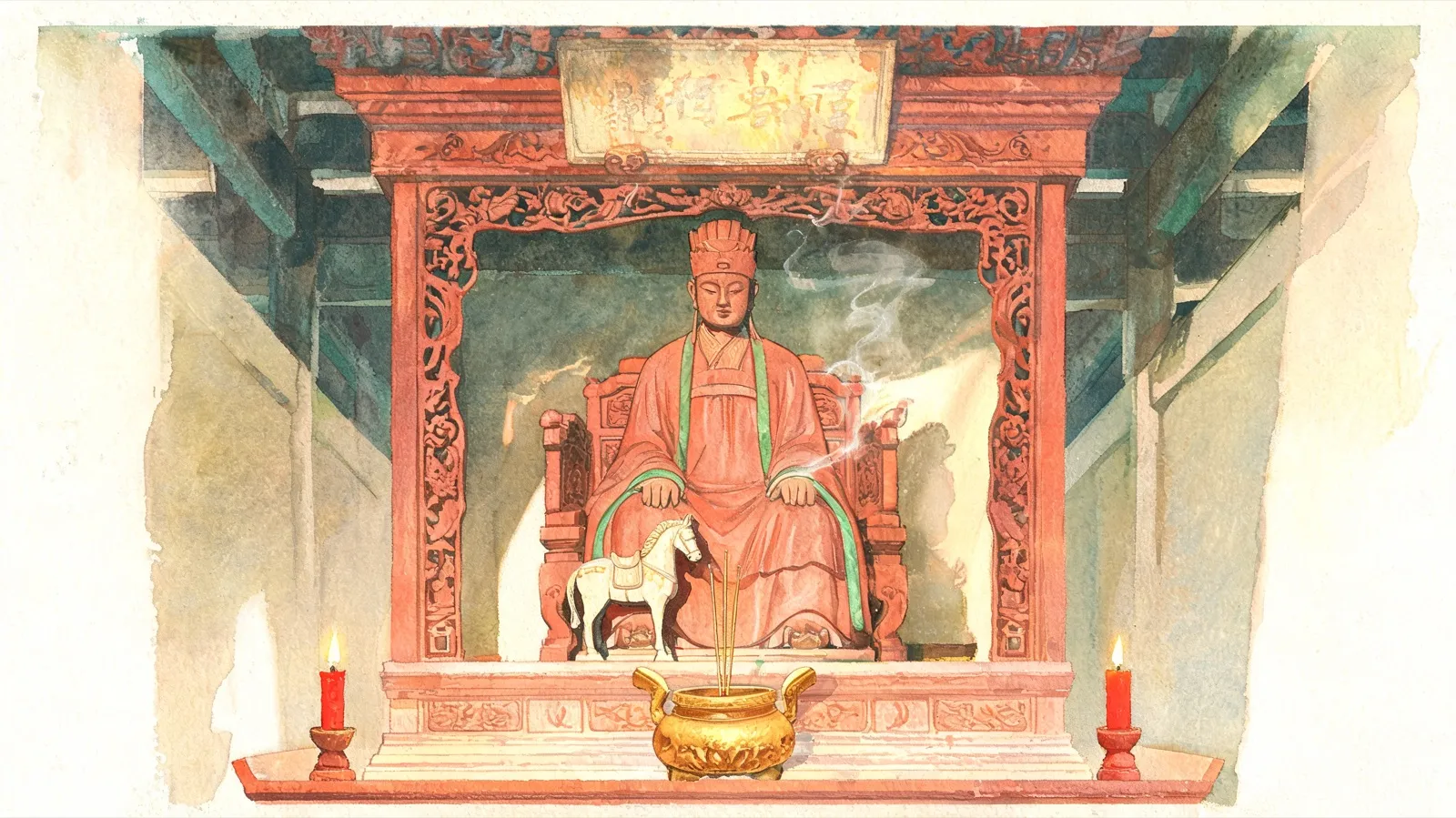
The altar at 97 Jonker Street
A clan house is also a temple, and the gods on its altar are a record of what survived the journey. The Melaka Lui Chew clan house — the Melaka Leizhou Association, at 97 Jonker Street inside the UNESCO World Heritage core — is, in everyday practice, a Guandi temple with Min folk-deity additions. Its documented roster reads:
| Altar | Deity | Who they are |
|---|---|---|
| Main | Guan Sheng Di Jun (关圣帝君) | Guandi / Guan Yu — the deified Three-Kingdoms general; patron of merchants, brotherhood and righteousness |
| Side | Guan Ping (关平) | Guan Yu's adopted son and standard-bearer |
| Side | Zhou Cang (周仓) | Guan Yu's attendant general |
| Side | Guanyin (观音) & Thousand-Armed Guanyin (千手观音) | The bodhisattva of compassion |
| Side | Bai Ma Lao Shi (白马老师) | The "White Horse Master" — a Min folk deity (this page) |
| Side | Tu Di Gong (土地公) | The Earth Deity — god of locality and household |
This is a very ordinary altar for a Chinese clan association in Southeast Asia — Guandi is the single most common patron of kinship-and-brotherhood bodies across the region — with one quiet exception. The exception is Bai Ma Lao Shi.
A generic clan-temple altar, with one bright Min thread running through it.
Who is the White-Horse Master?
“Bai Ma Lao Shi” — literally White Horse (白马) plus an honorific, Master (老师) — is the Melaka community’s name for a deity that almost no English-language source explains. The most likely identification traces him to Bai Ma San Lang (白马三郎, the “White Horse Third Young Master”), a folk deity of the Fuzhou region of Fujian, where two origin stories circulate:
- The prince who slew the eel. In the older story, Bai Ma San Lang is the third son of King Ying of the Min-Yue kingdom (闽越国王郢), a southern-Chinese realm of the 2nd century BCE. He died killing a giant eel that was preying on his people, and his grateful subjects deified him.
- The king on the white horse. A second tradition attaches the title to Wang Shenzhi (王审知), founder of the Min Kingdom in the late Tang and Five Dynasties era, whom his troops nicknamed for the white horse he rode into battle.
Either way, the figure is a Min folk deity of Fuzhou origin — Bai Ma worship is still documented in Daoist temples in modern Fuzhou. The “white horse” in the Jonker Street name is the thread that ties the Melaka altar to that Min tradition.
The Min thread — a deity that echoes the language
Here is why this small side altar matters out of all proportion to its size. The Lui Chew are not, at their deepest layer, a Cantonese-Guangdong people. They descend from Min migrants out of Fujian — especially around Putian (莆田) — who settled the Leizhou Peninsula in the late Song. Their language, Leizhou Min, is a branch of Min Chinese. Beneath the Leizhou name, the oldest layer of this identity is Min, from Fujian.
So a Min folk deity on the Lui Chew altar in Melaka is the religious echo of the linguistic finding. The same Min ancestry that gave the Lui Chew a Min tongue also, it seems, gave them a Min god — and it was that deity, not the homeland’s own, that travelled with them across the sea.
Why not Lei Zu?
The most revealing thing about this altar is who is absent from it. The homeland’s great god — Lei Zu (雷祖), the Thunder-Ancestor, the deified Tang prefect Chen Wenyu who gave Leizhou its name — is not worshipped in Melaka. Neither are the peninsula’s famous stone dogs. There are good reasons the signature homeland cult stayed behind:
- Lei Zu is a place, not just a god. Chen Wenyu is specifically the founding prefect of Leizhou prefecture; his cult is anchored to the Leizu Ancestral Hall and to particular peninsula villages, even to a "Lei Zu Patrol" that organises the local clans. Such tightly localised founder-cults rarely transplant overseas — no Lei Zu temple is documented in any overseas-Chinese community.
- The migration was small and late. A community of a few thousand, arriving in a late-19th-century Malaya where Guandi and Mazu temples already filled the patron-deity role, would not have built a separate Lei Zu temple.
- The clan house already did the job. Guandi for brotherhood, Guanyin for compassion, Tu Di Gong for the locality, Bai Ma Lao Shi for the Min connection — the religious needs were met, and the gap Lei Zu would have filled was small.
The honest shape of the story, then, is this: the Lui Chew did not transplant their homeland's god. They joined the broad Chinese-Malaysian Guandi tradition and kept one signature Min deity — the white horse from Fujian — as their distinctive thread.
A second white horse — and a complication
The Jonker Street altar is not the only one. Some forty minutes away, in the Melaka village of Tiang Dua (丁赖新村) — founded in 1949 and described by its own historians as the most heavily Lui Chew settlement anywhere outside China — there stands a 白马老师宫: a White-Horse Master temple. Not a side altar in a clan house. A building of his own, one of four temples in a village of some four hundred people.
That is a substantial finding on its own. It means the deity did not merely survive as one figure among several on an association roster in a heritage-zone shophouse — in the countryside he was given a house. The Lui Chew religious record in Malaysia has a rural chapter as well as an urban one, and the rural chapter is the more devoted of the two.
But it also complicates everything argued above. Reporting on the village in 2022, Sin Chew Daily describes the White-Horse Master as a deity peculiar to Leizhou Daoist practice — not a Fujianese one. If that is right, the identification set out on this page is wrong, and the more interesting story is the opposite of the one told here: not a Min god carried from Fujian, but a genuinely Leizhou god that did make the crossing after all.
What we know, and what we don't
Sources for the altar roster, the festival dates and the Min Bai Ma tradition are on the Sources & disclaimer page. If you know this altar — or have heard the custodian tell the story — a correction or a contribution is exactly what would make this page better.