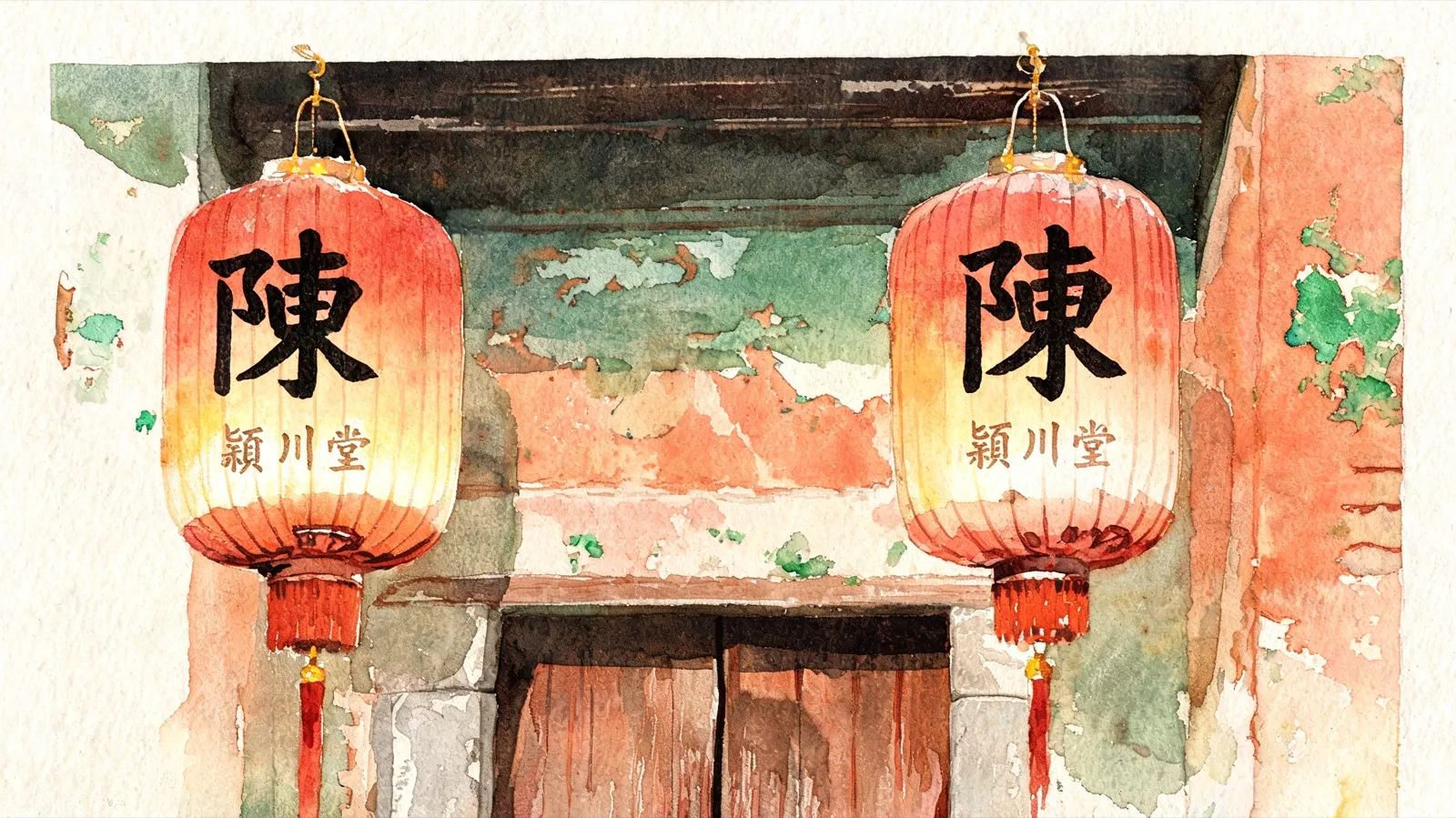
The sixteen documented surnames
Pulling together every Lui Chew individual named across the Muar and Melaka association records, plus the five speakers named in a 2023 linguistic field study, yields a sample of sixteen surnames.
| Surname | Pinyin | Primary documentation |
|---|---|---|
| 郑 | Zheng | Zheng Maolan (郑茂兰) — ex-Qing scholar who organised the first Leizhou bang in Muar c.1913; died 11 July 1924. One of the founding generation. |
| 陈 | Chen | Chen Shanqing (陈善庆) — first chairman of the 1934 Muar clan house. Chen Yongzhu (陈永祝) — donated land in 1925. Multiple further Chen elders across Muar records. Also the surname of Lei Zu (Chen Wenyu, 陈文玉). |
| 吴 | Wu | Several early Muar elders; also Wu Huijin (吴慧瑾), one of the five speakers named in Chen Limao's 2023 field study. |
| 杨 | Yang | Yang Yasheng (杨亚升), an early Muar elder documented in the association history. |
| 庄 | Zhuang | Zhuang Yabiao (庄亚标), Zhuang Xiaochun (庄孝纯), Zhuang Yawu (庄亚乌) — a cluster of early Muar elders, suggesting a Zhuang family lineage. |
| 符 | Fu | Fu Zhitian (符之田) — key patron of the 1969 Muar premises purchase. |
| 谢 | Xie | Xie Jufu (谢居富) — honoured in the Muar association's named hardship scholarship (Xie Jufu Hardship Scholarship). Several other Xie elders documented. |
| 许 | Xu | Xu Yaquan (许亚权) — chairman who renamed the body Persatuan Lui Chew Johor in 1994. Several further Xu family members in Muar records. |
| 李 | Li | Early Muar elders; Li Changwu (李昌五) documented in the association history. |
| 王 | Wang | Wang Yasan (王亚三) — an early automobile owner in Muar who drove for community fundraising. |
| 邱 | Qiu | Qiu Zichen (邱子臣), documented as an early Muar elder. |
| 黄 | Huang | Huang Yuping (黄裕聘), documented in the Muar association history. |
| 蔡 | Cai | A former Johor state senior official who opened the Lui Chew Building (雷州大厦) in 2004. |
| 潘 | Pan | Pan Yongming (潘永明) — the calligrapher who wrote the Lui Chew Building (雷州大厦) inscription on the Muar building. |
| 邓 | Deng | Deng Fuming (邓福明) — documented as a past chairman of the Melaka Leizhou Association. One of the few Melaka-specific surnames on record. |
| 姜 | Jiang | Jiang Guangwu (姜光武), Jiang Guangfu (姜光福) and Jiang Yuxian (姜玉贤) — three of the five speakers named in Chen Limao's 2023 field study. Three Jiang speakers named together strongly suggests a coherent living lineage. |
How to read this list
Chen (陈) — the peninsula's own surname
The Chen surname (陈) has the deepest resonance of any Lui Chew family name. Along the coastal Han belt that runs from Zhejiang south to the Leizhou Peninsula, Chen is borne by roughly one person in eleven to thirteen — a frequency that makes it a leading surname throughout the entire southern Chinese zone from which the Lui Chew come.
But in the specific context of Leizhou, Chen carries an additional dimension. Lei Zu — the Thunder-Ancestor, the deified founding prefect of Leizhou, the deity whose name is on the clan-house altar of every Leizhou association across Southeast Asia — was, in his historical life, Chen Wenyu (陈文玉, 570–638 CE). He petitioned the Tang court to rename the prefecture “Leizhou” in 634 CE, served as its founding magistrate, and was deified posthumously.
That the surname of the community’s cultural founder is also one of its most common surnames is no coincidence — Chen families of the Leizhou region have lived in the shadow of that heritage for fourteen centuries.
In Malaysian records, Chen appears across both Muar and Melaka, with multiple documented individuals across generations: founding-era donors (Chen Yongzhu, 1925), first chairmen (Chen Shanqing, 1934), and unnamed further members. It is the single best-documented Lui Chew surname in Malaysia.
Jiang (姜) — the named speakers
The Jiang surname (姜) has a different kind of significance: it is the surname of three of the five named speakers in the only peer-reviewed field study of Malaysian Leizhou Min.
When linguist Chen Limao conducted three rounds of fieldwork in Malaysia for her 2023 study, she named five speakers, followed by “etc.”. Three of them share the surname Jiang: Jiang Guangwu (姜光武), Jiang Guangfu (姜光福) and Jiang Yuxian (姜玉贤). The family grouping — two first names sharing the character 光 (guangwu / guangfu) suggest possible brothers; Jiang Yuxian may be another generation or branch — implies a single Lui Chew Jiang lineage whose members are still fluent dialect speakers.
This makes the Jiang family of Malaysia the most specifically documentable Lui Chew lineage in the existing public record — not the most prominent, but the one whose members have been named, whose language has been recorded in academic publications, and whose dialect competence is established beyond family tradition. If a gravestone survey or oral-history programme were to start from a single family name, Jiang would be the most tractable entry point.
Zheng (郑) — the founding organiser
Zheng Maolan (郑茂兰) is the single most historically important named individual in the Lui Chew Malaysian record. A former Qing scholar — the character of a man who had received a classical education and held status in the old imperial system — he was the one who, circa 1913, organised the dispersed Leizhou workers in Muar into a formal bang (方言行帮), the first institutional body of the Lui Chew community in Malaysia.
He died on 11 July 1924, a fact recorded in the Persatuan Lui Chew Johor’s own history — which suggests his name and role were carefully commemorated. The formal association that followed (registered 1934, premises 1934) built on his organisational work.
The Zheng surname is documented elsewhere in Muar’s early records through Zheng Bangsheng (郑邦圣). No Zheng family members have been documented in the Melaka records so far.
The other thirteen
The remaining thirteen surnames each carry at least one documented individual in the Muar or Melaka record:
- Wu (吴) — appears across Muar elder lists and in the 2023 field study (Wu Huijin). One of the highest-frequency surnames in the south Chinese coastal zone.
- Yang (杨) — Yang Yasheng, an early Muar elder. Documented once; the surname may appear in further records not yet surfaced.
- Zhuang (庄) — three early Muar elders sharing this surname, suggesting a Zhuang family cluster in the founding generation.
- Fu (符) — Fu Zhitian, the 1969 Muar patron. Fu is also the second most common surname in the Leizhou-Hainan zone (after Chen), making it a strong candidate for further Lui Chew families not yet on record.
- Xie (谢) — Xie Jufu, honoured in a named scholarship, and several other Xie figures. The scholarship suggests this was a family of standing in the community.
- Xu (许) — Xu Yaquan, who gave the Muar body its current formal name in 1994, plus Xu Mingri and Xu Guangwei in the records. A documented multi-generation Xu presence.
- Li (李) — Li Changwu and early Muar elders. Li is one of the most common surnames in China; its appearance in Lui Chew records does not in itself confirm a specific Li family line.
- Wang (王) — Wang Yasan, whose automobile gave the community its first fundraising vehicle. Wang is another of the most common Chinese surnames.
- Qiu (邱) — Qiu Zichen, early Muar elder. Less common than Chen or Li; a Qiu family in the Lui Chew record is a more specific lead.
- Huang (黄) — Huang Yuping, Muar elder. Common across the southern coastal belt.
- Cai (蔡) — a former state official, documented by role rather than by a confirmed romanisation of the character (the record shows a variant spelling). Common in southern Fujian and Guangdong.
- Pan (潘) — Pan Yongming, the calligrapher. The calligraphy of the Lui Chew Building inscription is itself a primary cultural artefact.
- Deng (邓) — Deng Fuming, Melaka association chairman. The most specifically Melaka-linked surname on the list; his family may hold Melaka-specific records not yet in the public domain.
Surnames in stone
The most important repository of Lui Chew surnames in Malaysia is neither the association records nor the academic field studies — it is the graveyards. Chinese tombstones routinely carve the ancestral hometown (籍贯 / 祖籍), the family name, the dates of birth and death, and the names of the descendants who raised the stone. For a Lui Chew grave, the hometown line should read 雷州 (Leizhou) or a peninsula county — 海康 (Haikang), 遂溪 (Suixi), 徐闻 (Xuwen). A line reading 湛江 (Zhanjiang) is undecided rather than confirmed: the prefecture holds more than one language.
Two grounds are the primary targets:
- The Muar Lui Chew cemetery (义山) — maintained by Persatuan Lui Chew Johor. Its specific location, size and grave roster have not been published; a systematic survey of its inscriptions would be an irreplaceable primary source for Lui Chew family history, almost certainly surfacing surnames not yet in this registry.
- Bukit Cina (三宝山), Melaka — the largest Chinese cemetery outside China (over 12,500 graves, designated 1685, oldest stones from 1612). The Melaka Lui Chew, who kept no separate burial ground, were most likely interred here. Filtering its stones for Leizhou-county (雷州) inscriptions, with Zhanjiang (湛江) stones kept as candidates, would surface Lui Chew families across several generations.
A gravestone is a genealogical document carved in stone. A surname on a stone at Bukit Cina, with a Leizhou hometown, is a primary source no library can replicate.