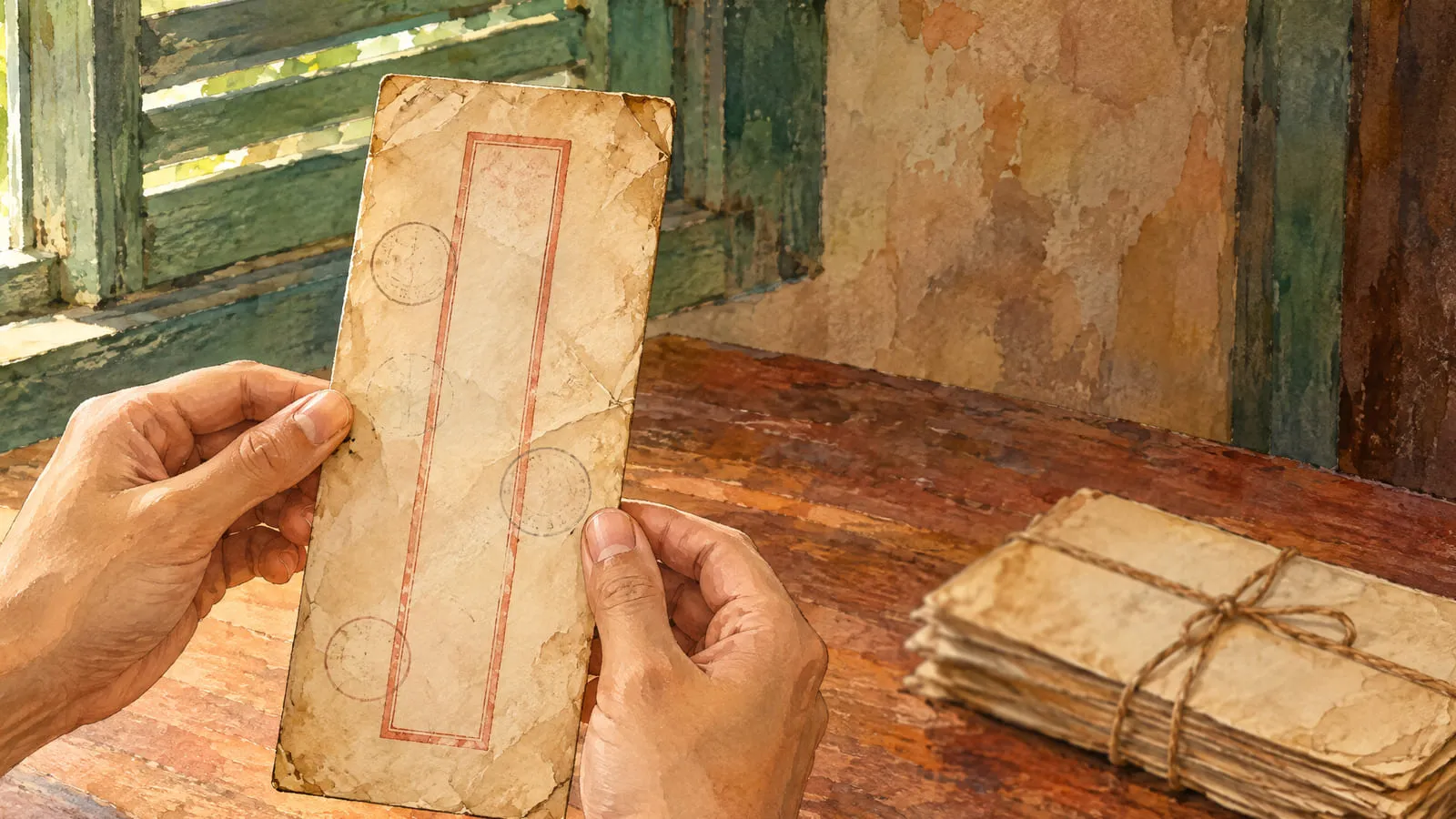
Did the Lui Chew, a small people from the far southwest of Guangdong province in China, send qiaopi home? We don’t know yet. Qiaopi (侨批) were the letters Chinese migrants sent home with money travelling alongside. None of the collections on this page is known to hold a Lui Chew qiaopi. So if one survives, our best guess is that it waits among a family’s papers in China, and that a family in Malaysia is more likely to hold the reply that came back. The end of this page shows how to tell what yours is.
Lui Chew is the older Malayan and Singaporean spelling of Leizhou (雷州), the peninsula they came from. Most Chinese who came south to Singapore came alone, some left family in the home village, and they sent money home regularly. That is documented for the Chinese of Singapore as a whole. That the Lui Chew did the same is a fair guess, not a record. So the question splits into three: did they send qiaopi, through whom, and where would any that survive be now?
What is a qiaopi?
A qiaopi is a letter and a remittance in one. A remittance is money sent to someone far away, and a qiaopi carried the money and the family news together. The two halves of the word say so: “qiao” means emigrants and “pi” means letters. They were also called yinxin (银信), a letter with money, the name used in the Wuyi area of Guangdong.
Many of the men who sent them could not read or write. In Singapore they paid professional letter writers to put their words on paper, and the same writers were often asked to read letters aloud as well. So a qiaopi in a grandfather’s name may not be in his hand, and the voice in it may be partly the letter writer’s.
Qiaopi are documented heritage, not family lore. In 2012 they were added to the Asia-Pacific Memory of the World Register, and in 2013 to the International Memory of the World Register. Both registers list documentary heritage, old papers and records kept for what they tell us about the past: one register for Asia and the Pacific, one for the whole world. The entry is called “Qiaopi and Yinxin”.
How did a qiaopi travel from Malaya to China?
Hand to hand, and later through shops that did the work of a post office and a bank at once. That is the documented story for the groups whose records survive, told here as it ran through Singapore.
At first a migrant gave his money and his letter to someone he knew from his home place who was sailing back. Then came the shui ke (水客), travelling traders who carried goods by sailing ship between China and the lands overseas, and took money and letters home for migrants on the way. Shui ke were already doing this in the 17th century. A shui ke’s job was not finished when he handed over the money. He had to bring the family’s reply back to the sender.
Next came the remittance houses, minxinju (民信局), also called yinxinju (银信局). The early houses worked much like the shui ke, with one difference: a house used what it knew of the trade to send the letters and money with people it could trust. By 1887 Singapore had 49 of them. Because of where it sits, qiaopi from the lands around it were often sent on through Singapore, and that made the island their hub in Southeast Asia.
The houses were split by dialect group, the community each one served. A 2012 article in BiblioAsia, published by Singapore’s National Library Board, sorts the island’s houses into five such groups: Hokkien, Teochew, Qiongzhou (Hainanese), Cantonese and Hakka. A 1967 qiaopi shows one of those links at work. It is held by Singapore’s Sun Yat Sen Nanyang Memorial Hall, whose collection the National Heritage Board lists online. It went from a sender at Robertson Quay, in Singapore, to Swatow, a port in China. It travelled through a remittance house tied straight into Swatow’s remittance network.
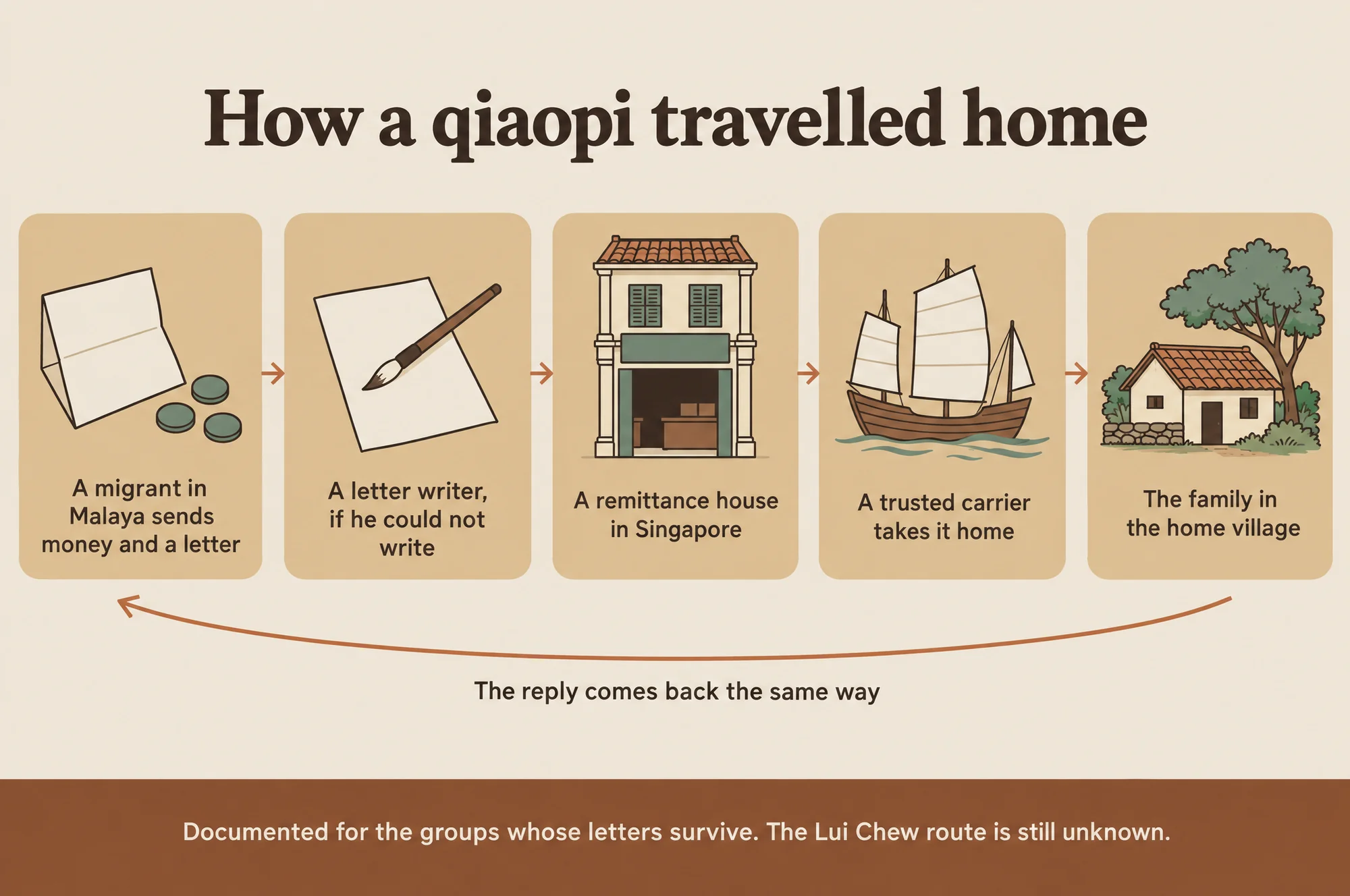
Read the route as words
How a qiaopi travelled home
- A migrant in Malaya sends money and a letter
- A letter writer, if he could not write
- A remittance house in Singapore
- A trusted carrier takes it home
- The family in the home village
The reply comes back the same way.
Documented for the groups whose letters survive. The Lui Chew route is still unknown.
Did the Lui Chew send qiaopi home?
The sources on this page cannot settle that yet. Here is where the record stands, and the questions still open.
What the record shows. Leizhou is not one of the five groups in that list of Singapore’s remittance houses. The Koh Seow Chuan Collection is a set of qiaopi held by Singapore’s National Library. They were written mainly by Teochew men, migrants to Singapore from the Chaozhou area of China, between the 1950s and the 1970s. The two Memorial Hall envelopes on this page both went to Swatow. And we don’t know yet of any archive that lists a set of Lui Chew qiaopi, or a single one that names Leizhou.
What that does not show. No record is not the same as no letters. The Lui Chew were a small group. If they sent qiaopi with no remittance house of their own, they had to send them some other way. That is our reasoning. Three routes are possible, and each one is still a question:
- A Hainanese house? Qiongzhou houses, serving the Hainanese, are on that list. The Lui Chew and the Hainanese come from coastlines a narrow strait apart, and the linguist Hou Jingyi puts their two languages together in one Qiong-Lei (琼雷) group: Qiong for Hainan, Lei for Leizhou. So a Hainanese house is a fair guess. Our page on how close the Lui Chew and the Hainanese really are sets out what the two peoples share and where they part.
- A fellow villager going home? Before the houses, that is how the trade began. A qiaopi sent this way would carry no house’s name at all, which would also make it harder to recognise today.
- Guangzhouwan? From the late 1890s to 1945, France held Guangzhouwan (广州湾), a leased stretch of the Guangdong coast that is now the city of Zhanjiang. A territory that close to Leizhou, under a foreign flag, is an obvious place to wonder about. But we don’t know yet of any record that ties it to a remittance house or a single qiaopi. Our page on the French years of Guangzhouwan tells what is known of the territory itself.
Where are qiaopi kept today?
In archives and libraries in China and Singapore, and in family homes. The big collections are well documented. None of them is known to us to hold a Lui Chew qiaopi, and none has been shown not to.
| Where | What it holds | For a Lui Chew family |
|---|---|---|
| The Guangdong Provincial Archives and the Fujian Provincial Archives | The keepers named in the Memory of the World entry, which counts over 160,000 qiaopi preserved in the two provinces | Leizhou is in Guangdong, but the entry gives no count of how many of those qiaopi, if any, went to the Leizhou Peninsula |
| The National Library, Singapore: the Koh Seow Chuan Collection | Qiaopi written mainly by Teochew men in Singapore, from the 1950s to the 1970s | A good place to see what real ones say |
| The Sun Yat Sen Nanyang Memorial Hall, Singapore, with records on the National Heritage Board's Roots website | Qiaopi and their envelopes sent from Singapore, each with its own record | A close look at the envelopes themselves, for the checklist below |
| Arkib Negara Malaysia, the National Archives of Malaysia | Malaysia's national records. Whether any of them are qiaopi, we don't know yet | Ask in its research room before assuming it holds none |
| Your family's own cupboards, tins and drawers | Whatever survived | Our best guess for where a reply from Leizhou, or a qiaopi that came back, might turn up |
One point about direction matters here. A qiaopi going out from Malaya went to the family in China, so if it survives, it is most likely over there, unless it found its way back. What came back to Malaya was the reply. So in a Malaysian home, the paper most likely to be waiting is a letter from the village, not a qiaopi sent to it. That follows from how the trade worked.
How can you tell if a family letter is a qiaopi?
Compare it with real ones. Envelopes sent from Singapore and kept in the Memorial Hall’s collection show the marks to look for, and you can check them at the kitchen table in a few minutes, in this order.
- Look at the shape. One empty envelope from a Singapore remittance house measures 15.7 by 7.7 centimetres: about twice as long as it is wide.
- Look for print as well as handwriting. These envelopes carry three kinds of marking: printing, handwriting, and stamping, which means marks pressed on with an inked stamp.
- Look for a shop's name. The record for that same empty envelope names the Singapore remittance house that sent it, Xiang Ji Bao Hao (祥记宝号). So check yours for a business name: in our view, one is a good sign that a remittance house handled it.
- Read the places. The 1967 qiaopi names the sender's street by its old local Chinese name, hou ba yao (后巴窑), "back swamp", for Robertson Quay. On a Lui Chew letter, look for Leizhou (雷州) or one of the peninsula's three old counties: Haikang (海康), Suixi (遂溪) or Xuwen (徐闻).
- Check which way it travelled. A letter that came from a village in China to Malaya may be a reply to a qiaopi, the half of the exchange most likely to have stayed with a family here.
- Photograph it, then put it back. Photograph the front, the back and anything inside, then keep the original safe, just as you found it.
None of these marks proves a qiaopi alone, and a letter with none of them can still be one, especially one carried home by hand. If the place names on yours are hard to read, our guide to reading the jiguan line on a family grave, the line that names a family’s ancestral place, walks through the same Leizhou county names as they appear on stone.
What we don't know yet
Almost everything about the Lui Chew side of this story is still open.
Whether any Lui Chew qiaopi survive. Not one is listed in an archive that we know of, in Malaysia, Singapore or China.
Who carried them. A Hainanese house, a fellow villager, a route through Guangzhouwan, or something nobody has thought of yet.
What the big archives hold. The provincial archives of Guangdong and Fujian keep a great many qiaopi, and their register entry does not sort them by home district. One from Leizhou could be among them, unread for what it is.
A single family’s envelope could answer more of this than any archive search. That is the part only you can do.
Next, go back to the Family and Roots guide, where step 4 is to search the cupboards, and work through it with an older relative beside you. And if your family has a letter or envelope that travelled between Malaya and Leizhou, photograph it, keep the original safe, and share its story with us, or send a correction to anything on this page. We would love to see it.