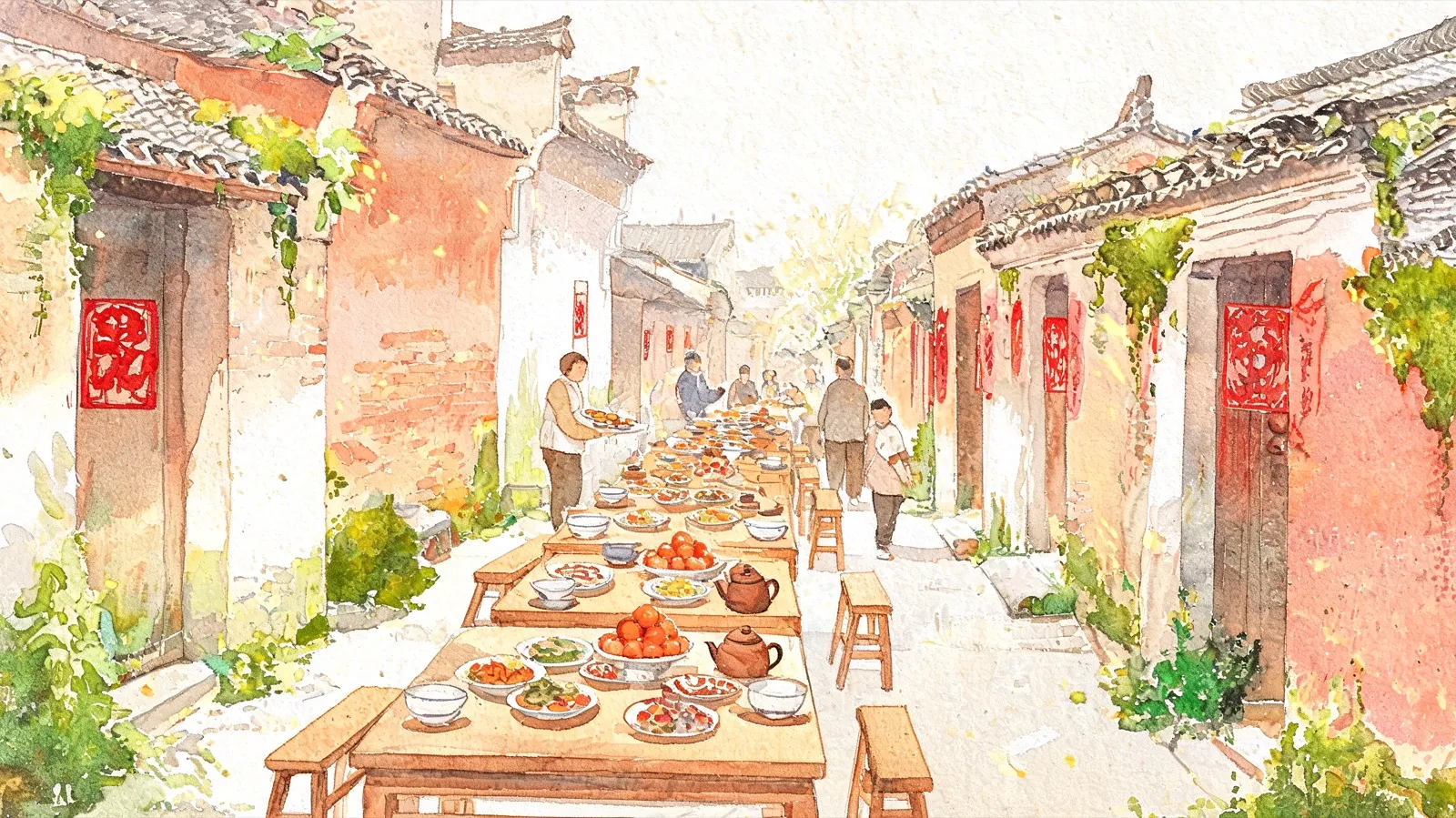
Ask someone from western Guangdong to name the biggest day of their village’s year and the answer is often not Chinese New Year. It is Nianli — the one day a year when their village feeds everyone.
The annual routine
Nianli (年例) means, literally, “the annual routine” — the thing done once a year, every year, by custom. It is the signature communal festival of western Guangdong (粤西): the region of Zhanjiang and Maoming that includes the Leizhou Peninsula, spilling over into the Beiliu district of neighbouring Guangxi.
The local saying sets the scale: 年例大过年 — “Nianli is bigger than the New Year.” Chinese New Year is a family festival, celebrated behind every door at once. Nianli is the opposite: one village’s public day, when the temple gods come out, the opera stage goes up, and every household in the hosting village lays on an open banquet for relatives, friends, friends-of-friends and passing strangers. Traffic around a hosting village can jam solid by late afternoon.
New Year is every family's festival at once. Nianli is one village's day to feed the world.
A rolling calendar
What makes Nianli structurally unlike any national festival is that it is staggered. Each village — or each temple-and-lineage cluster within one — keeps its own fixed date, mostly falling in the first two lunar months and concentrated in the fortnight around the Lantern Festival. A few villages fix their date by divination each year; some hold a second, post-harvest “autumn Nianli” (翻秋年例).
The consequence is a rolling season: for weeks, somewhere nearby, some village is at festival. You feast at your cousins’ village on their date; they feast at yours on yours. The staggering turns a village rite into a regional web of mutual hosting — which is precisely what a society of small, scattered farming villages needed the festival to be.
A Nianli in three acts
A full Nianli runs one to three days and is traditionally organised in three phases, coordinated by a rotating village host (the 年例头, “Nianli head”) with costs shared among households:
| Phase | What happens |
|---|---|
| Opening (起年例) | Village elders formally invite the temple deities out of the shrine and seat their images in ceremonial palanquins. |
| The day itself (正年例) | The gods are carried in procession around the village bounds (游神, "touring the territory"), trailed by drums, lion and dragon dances, martial-arts troupes and float parades. Households set out offering tables with the "three sacrifices" — chicken, pork, fish — for blessing as the gods pass. Then the village eats: flowing open-door banquets (食年例, "eating the Nianli"), where the more guests a family feeds, the more auspicious its year — followed by opera, puppet shows and performances late into the night (睇年例, "watching the Nianli"). |
| Closing (年例尾) | The deities are returned to the temple. In some villages a paper boat, symbolically loaded with the year's misfortunes, is burned or sent off to carry the bad luck away. |
Origins and listings
Where did it come from? The written trail begins late: Qing-dynasty county gazetteers of the region record the custom under the name “Nianli” by the 19th century, describing villagers performing nuo exorcism processions (乡傩) door to door and “singing local songs” in the first months of the year. Beneath the banquets, the festival’s oldest layer is that exorcism-and-thanksgiving rite: drive out the old year’s demons, thank the gods, secure the new season — which is why the gods’ tour of the village bounds, not the feast, is the ritual core.
Nianli has since become a case study in what scholars call the “heritagisation” of ritual — a folk rite reframed as official cultural heritage. Its formal status today is provincial: the Maoming and Wuchuan Nianli traditions are inscribed on Guangdong’s provincial intangible-cultural-heritage list, and Beiliu’s on Guangxi’s. Unlike the stone dogs, Leizhou song and Lei opera, it carries no national listing — a detail this site keeps straight because the temptation to round every listing up to “national” is exactly the kind of small inflation a reference site must resist.
Nianli on the peninsula
On the Leizhou Peninsula the festival wears local dress. Field researchers in Leizhou’s Qishui township have documented three-day deity-procession Nianli celebrations under the rite. And the peninsula’s most distinctive guardians join in: on Nianli days (as on the 1st and 15th of each lunar month), villagers drape the stone dogs in red and set tea, incense and food before them — the ancient totem cult folded into the festival calendar.
The peninsula also keeps an older, thunder-specific ritual year alongside Nianli: the Qing scholar Qu Dajun recorded three annual thunder-god rites — “opening thunder” in the second month, “thanking thunder” in the sixth, “sealing thunder” in the eighth — each with great thunder-drum ceremonies. Nianli is the region-wide festival; the thunder rites are the Leizhou-specific layer beneath it.
A festival that survived the twentieth century
Nianli’s modern history is a study in resilience. The festival was suppressed during the Cultural Revolution as feudal superstition, and revived only after the reform era began. It has since weathered a different pressure: urbanisation — with much of rural western Guangdong working away in the cities, some villages struggle to muster a festival, and the banquet culture draws periodic criticism for extravagance and one-upmanship. The COVID years 2020–2022 silenced it entirely. It came back. A rite that has outlived Qing gazetteers, revolution and pandemic is not fragile — in the homeland.
Did it cross the sea?
Here is the question this site exists to ask — and the honest answer is no, not in any documented form. Public sources record no Nianli observance by the Lui Chew of Melaka, Muar, or anywhere in Malaysia, at any period. The nearest thing is the Muar association’s Lunar New Year collective greeting (团拜) — an annual communal gathering that is functionally analogous but generically Chinese-Malaysian, not a Nianli.
The absence fits a pattern documented across this site: what survived the crossing was the institutional toolkit — the huiguan, the cemetery, the scholarship fund — while the homeland’s folk-religion and festival complex (Nianli, the thunder rites, stone-dog veneration, Lei opera) did not transplant. A festival that requires a whole village — a temple, a procession route, dozens of host households, an opera troupe — was simply beyond the threshold of a community numbering a few thousand at its height. The Hainanese, ten times more numerous, kept temple festivals; the Lui Chew kept the clan house.
Sources: the Nianli record here draws on the county-gazetteer citations and festival ethnography summarised on the Sources & disclaimer page, including the academic study of Nianli's heritagisation in Zhanjiang and Chinese-language reference coverage of the festival's phases and listings. Terms — Nianli, huiguan — are in the glossary.