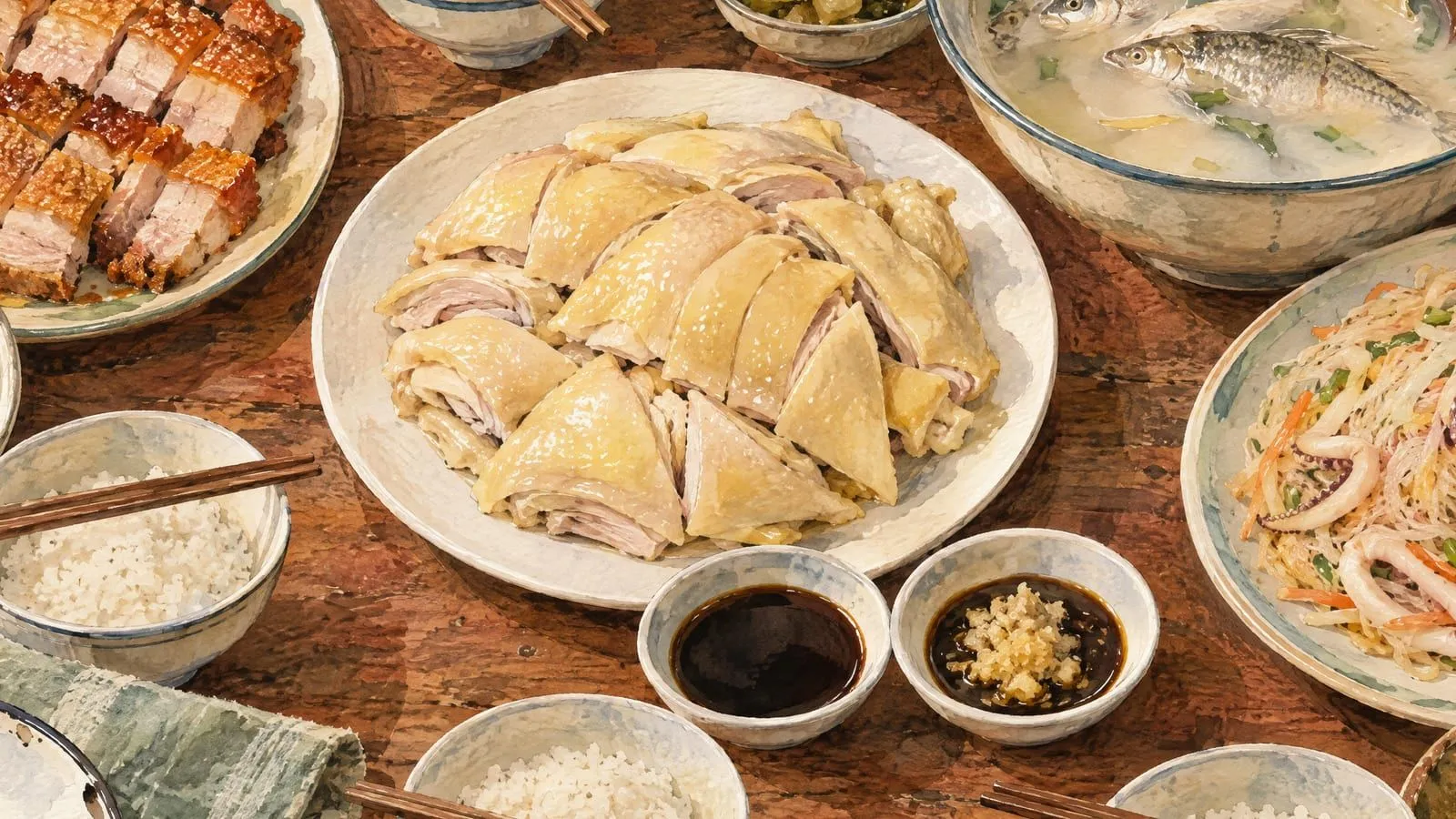
Leizhou food, 雷州菜, is the cooking of the Leizhou Peninsula at the far southern tip of mainland China. It is light, built on the sea, and cooked plain so the ingredient carries the taste: blanched, white-cut or boiled in clear water. Its best-known dish is white-cut chicken, steeped until just cooked and served with a dip of local sand ginger and soy. Roast pig, goat, mackerel fish balls and small-fish soup fill out the rest.
On a Malaysian Lui Chew table, one dish has a written line back to that peninsula: the white-cut chicken. In 2022 the head of Tiang Dua, a village on the edge of Melaka where about half the families are Lui Chew, told a newspaper that Lui Chew food is mostly white-cut, and that white-cut chicken is a must at every festival. For almost everything else your aunt might call “Lui Chew food”, the record is silent.
That silence is the most honest thing on this page, so we will keep pointing at it. Each dish below is marked as on the record or not known yet. What lives only in family kitchens, we call family tradition, and we say so.
Start at the table, not the menu
Most pages about Leizhou food start in a Zhanjiang restaurant and list ten dishes. We would rather start where you just were: an elder’s house after Qingming, or a clan dinner, with an aunt pointing at one plate and calling it Lui Chew food.
So here is the one Malaysian record we hold. On 3 April 2022, Sin Chew Daily’s Melaka pages ran a visit to Tiang Dua, 丁赖新村. The paper counted 140 households there, said about half the villagers are Lui Chew, and called it a village where our people live close together. The village head, Jiang Yuxian (蒋育贤), then 51, put the food in one breath:
雷州人的美食以白切为主,即白切鸡、白切肉,只要沾上酱油就可以吃
"Lui Chew food is mostly white-cut: white-cut chicken, white-cut pork. Dip it in soy sauce and it is ready to eat."
He gave the reason too. The ingredients have to be fresh, he said, and so at New Year and every festival his people must have white-cut chicken on the table. When friends from overseas or an official delegation from China come to the village, Tiang Dua lays on a few tables and serves them white-cut chicken.
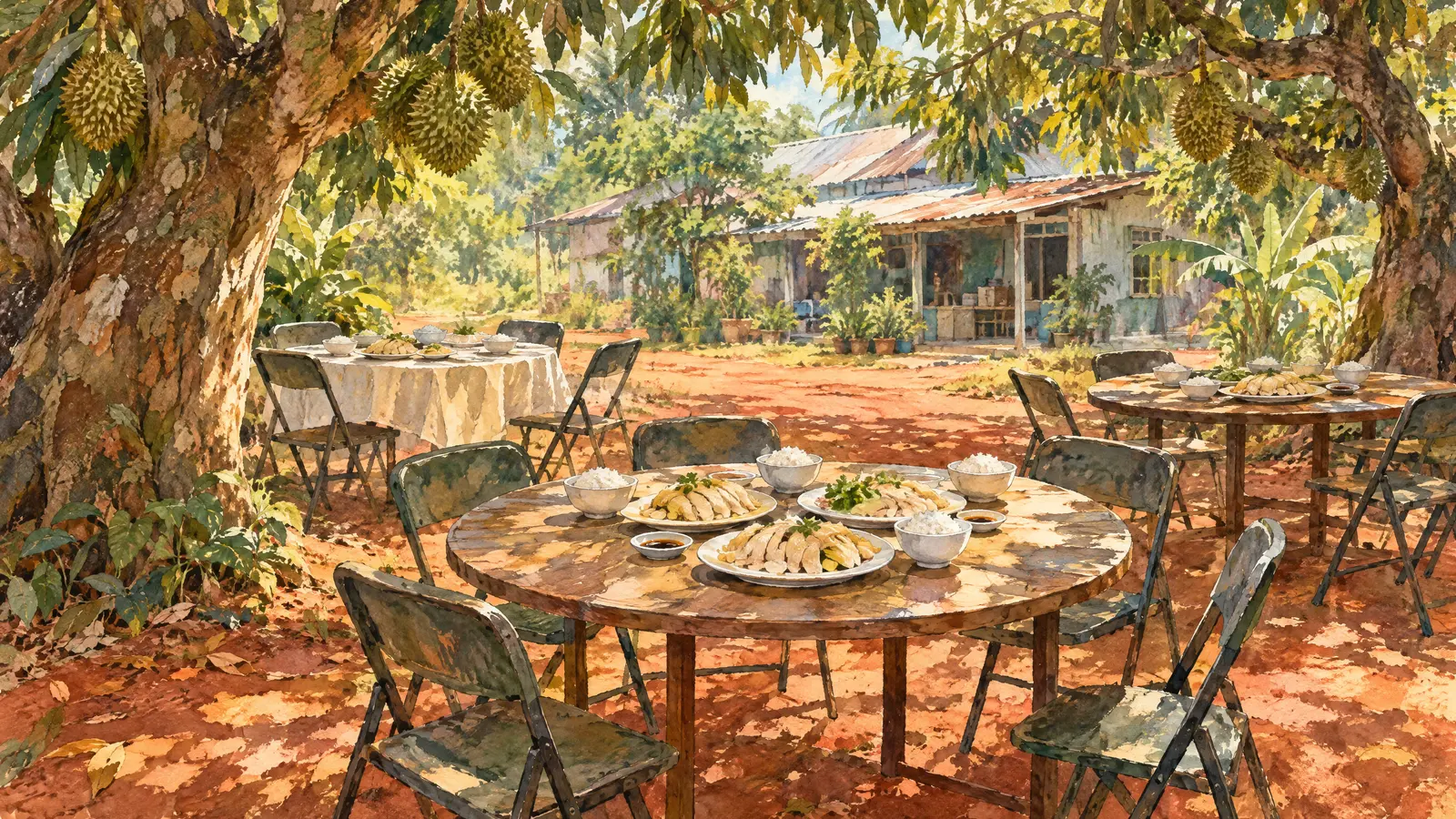
That is a real record, and it is worth saying what kind. It is one man, in one village, quoted once by a newspaper. It tells us what Tiang Dua’s Lui Chew say about their own table. It does not tell us what a family in Muar or Klang cooks, and it does not name Qingming or a clan dinner. “New Year and festivals” is as close as it gets. So on this page white-cut chicken is a Malaysian Lui Chew dish on the record, and every other dish waits for a second voice.
What the Leizhou Peninsula cooks
Now cross the water. The homeland side is far better written down, though mostly by tourism and food sites rather than by historians.
The peninsula is sea on three sides, and a Chinese consumer ranking site, maigoo (买购网), sums up its cooking in a line: 讲究清淡,突出原味, light, with the ingredient’s own taste up front. The usual methods, it says, are blanching (白灼), white-cutting (白切), and boiling in clear water (清水煲). White-cut means the meat is steeped in plain hot water until it is just cooked, cooled, cut up, and eaten with a dip on the side. Read that beside the Tiang Dua quote and the match is hard to miss.
The same site’s list of ten famous Leizhou dishes gives the homeland table some faces:
- Yingli roast pig (英利烧猪), first on the list, from Yingli town in Leizhou: a whole local pig of 40 to 60 kilograms, rubbed with five-spice, ginger, garlic and rice wine, the skin brushed with honey, then hung in an oven to roast.
- Zhanjiang white-cut chicken (湛江白切鸡), a Zhanjiang dish that the site says is just as popular in Leizhou. More on it below.
- Fried three shreds (炒三丝), which the site calls a must at a traditional Leizhou banquet: white radish, glass noodles, squid, dried shrimp and pork belly, cut fine and fried together.
- Mixed small-fish soup (杂鱼汤), made from whatever small fish the shallow-water nets bring up, stewed for two hours until the broth turns milky.
- Leizhou pickled mustard greens (雷州酸菜), salted in brine in a sealed jar for about ten days, eaten as a side or cooked into other dishes.
The list carries its own warning, 本榜单仅供参考, “for reference only”, and no named author. Treat it as a shop window, not an archive. Two of its top four dishes are dog meat. That is part of the homeland record, and we note it here once; it has no place on a Malaysian heritage page beyond that.
The Zhanjiang city government’s own portal adds a longer list under Zhanjiang food (湛江美食). It names Leizhou goat meat (雷州山羊肉), hand-beaten Spanish mackerel fish balls (手打马鲛鱼丸), rice cooked with gelou leaf (蛤蒌饭), a rice cake made with a field herb (田艾籺), Mazhang roast pig (麻章烧猪), and a “hundred-chicken feast” (百鸡宴), which it names and does not explain. Those are city-wide names, so not every one is from Leizhou itself. The goat is the one the city files under Leizhou’s own name.
Why so much sea and so little rice on that list? Britannica records the land side of it, without giving a reason: less rice is grown on the peninsula than in other parts of Guangdong, and the area is being built up as a national centre for tropical crops and aquaculture, which means farmed fish and seafood. Our page on the Leizhou Peninsula walks that land in full.
White-cut chicken: is it the same dish on both sides?
Yes and no, and the “no” is the interesting part.
On the homeland side, maigoo describes Zhanjiang white-cut chicken (湛江白切鸡) as a steeped chicken, cooked until just done and not falling apart, with nothing added so the bird keeps its own taste. It says the bird must be a local, fine-boned farm chicken, and that it usually comes with a small dish of soy sauce with sand ginger (沙姜酱油), a dip it calls particular to the area. Sand ginger, 沙姜, is a root of the ginger family, one of the four plants that go by the name galangal. In Malaysia the same plant is called cekur.
Here is the catch. White-cut chicken is not Leizhou’s alone. A China News Service feature of 9 April 2026 calls white-cut chicken (白切鸡) a classic of Cantonese cooking, dipped there in soy sauce with grated ginger. The same feature says that across Guangdong, families use chicken to honour the ancestors and the gods, at weddings and at shop openings, and that 无鸡不成宴, “no chicken, no feast”, became the iron rule of a southern Chinese banquet.
So a plate of white-cut chicken at a Malaysian feast does not, by itself, prove anything about Leizhou. By that report, chicken at a feast belongs to the whole of Guangdong, not to one peninsula. Our page on how the Lui Chew differ from the Hainanese records that it was the Hainanese, far more numerous, who made chicken rice famous here, while the Lui Chew never had a public signature dish.
What the Tiang Dua record adds is ownership. The village head did not say “we eat chicken like everyone else”. He said white-cut is how Lui Chew people cook, and the paper’s photo caption called Lui Chew white-cut chicken quite famous (相当闻名). That is a community claiming a dish as its own, which is exactly the kind of thing this site should write down.
The dip is where the two sides may part. The homeland source names sand-ginger soy. The Tiang Dua quote says only soy sauce. That may be shorthand, or it may be a real difference that grew up in Melaka. We do not know. If your family’s chicken comes with a saucer of sand ginger pounded into soy, that is a small fact this page would like to hold.
Nianli and Qingming: which feast days crossed?
The two feast days the question usually turns on had different fates.
Nianli, 年例, stayed home. It is the village festival of western Guangdong, when each village feeds everyone who comes. Our Nianli page describes households setting out offering tables with the three sacrifices, chicken, pork and fish, as the gods pass, and then the open-door banquet, “eating the Nianli” (食年例). It also records that no public source shows Nianli being kept by the Lui Chew of Melaka, Muar or anywhere in Malaysia. A Malaysian Lui Chew Nianli table is not on record, so the dishes of one cannot be either.
Qingming, 清明, is on the clan’s calendar. The written rules of the Lui Chew association in Muar set four rites a year on the lunar calendar, and one of them is 三月清明一次, Qingming in the third month. So the clan’s tie to that day is documented. What the rules do not say is what anyone cooked or offered. Neither does any other source we hold. Whatever your family cooks for Qingming is family tradition in the plain sense: kept in kitchens, not written down.
The clan dinner sits in the same place. The association’s records that we hold talk about rites, members and money, not menus. The Tiang Dua tables laid for visiting delegations are the nearest thing to a Lui Chew banquet in Malaysia that we know of on record, and the one dish named at them is white-cut chicken.
Dish by dish: where each one stands
Here is the table your aunt set, as far as the record lets us set it. The middle column is the peninsula, the next is Malaysia, and the last is our label.
| Dish | On the Leizhou Peninsula | In Malaysian Lui Chew homes | Our label |
|---|---|---|---|
| White-cut chicken (白切鸡) | The area's signature dish, served with sand-ginger soy (maigoo) | A must at every festival in Tiang Dua, served with soy sauce (Sin Chew Daily, 2022) | On the record, both sides |
| White-cut pork (白切肉) | White-cut named as a main way of cooking; the pork dish itself not named in our sources | Named beside the chicken in the Tiang Dua interview | On the record in Malaysia; the homeland link is the method, not the dish |
| Roast pig | Yingli roast pig, first on maigoo's list; Mazhang roast pig on the city's list | Not on record | Not known yet |
| Fried three shreds (炒三丝) | Called a must at a traditional Leizhou banquet (maigoo) | Not on record | Not known yet |
| Leizhou goat (雷州山羊肉) | On the Zhanjiang city government's food list | Not on record | Not known yet |
| Leizhou da zong (雷州大粽) | A big folded zongzi, boiled four to five hours, eaten with beef soup | Not on record; our da zong page asks the same question | Not known yet |
| Chicken, pork and fish as offerings | The three sacrifices on Nianli offering tables (our Nianli page) | Not on record for a Lui Chew Qingming or clan rite | Not known yet |
Two rows say “on the record”. Five do not. That ratio is the finding, and it is the reason this page ends with a question rather than a conclusion.
Did the farm change the table?
There is a fair suspicion behind the word “Lui Chew food”. Tiang Dua’s villagers live by farming, and the village is famous for durian. If the land changed, perhaps the cooking did too, and the dish a family calls Lui Chew is one the peninsula never knew.
The record gives a partial answer, and it cuts the other way.
The farm did change. The same 2022 Sin Chew Daily visit says Tiang Dua’s villagers farm for a living, that the early crops were rubber and oil palm, and that more than half have since replanted with durian. The village’s best-known durian goes by a local name, “Dream Lover” (梦中情人). The village head said it began as one of the village’s ordinary local durians, and got the name after it sold well in Klang more than ten years before. The village also grows seedless watermelon for export. The durian runs in families: The Star reported in August 2026 on a 22-year-old running a 5.6-hectare orchard in Tiang Dua that his grandfather started 35 years ago. That report does not say whether the family is Lui Chew.
But the one dish the village head named for festivals is not a farm dish. It is white-cut chicken, cooked the homeland way. No source we hold puts durian, or anything from the new orchards, on a Lui Chew feast table. So far the record points to a table that kept a homeland method while the fields around it changed crop. One quote is not a pattern, though, and a family whose festival table really did change with the farm would teach us more than any newspaper can.
What we do not know yet
Six things this page would answer if the record held them.
The dip. Sand-ginger soy on the peninsula, plain soy in the Tiang Dua quote. Which one is on your family’s table, and did anyone ever say why?
What goes on the Qingming offering. The Muar association’s rules fix the day. Nothing written says what is laid out at the grave, or cooked for the meal after.
Whether any Lui Chew family still makes a da zong. Our da zong page asked first and still has no answer from Malaysia.
Whether the banquet dishes crossed. Fried three shreds is called a must at a Leizhou banquet. Roast pig heads the homeland list. We have no record of either at a Lui Chew clan dinner in Melaka or Muar.
What the clan halls serve. The tables Tiang Dua lays for visitors are the only Lui Chew banquet in Malaysia we have a dish for. What the Melaka and Muar associations put out at their own dinners is not written down anywhere we know of.
What a hundred-chicken feast is. The Zhanjiang city portal names a hundred-chicken feast (百鸡宴) among its foods and gives no description. If someone from the peninsula can explain it, this page would carry the answer.
Next, read the one dish we have traced in full. Our page on Leizhou da zong follows a single homeland food from its leaf to its pot, and shows how much the record can and cannot say about one dumpling. And if your family is Lui Chew, tell us the dish your table always has at Nianli, Qingming or a clan dinner, or send a correction to anything on this page. Every row above that says “not known yet” is a row a reader can fill.
Sources for every claim on this page are listed on our sources page. In short: the Tiang Dua interview and its farm detail come from Sin Chew Daily's Melaka pages, 3 April 2022; the Tiang Dua orchard from The Star, 25 August 2026; the homeland dishes and cooking methods from maigoo.com's list of ten famous Leizhou dishes, a consumer ranking with no byline, and from the Zhanjiang city government's portal; the da zong from maigoo.com's list of Leizhou specialty products; the land and its crops from Britannica; white-cut chicken as a Cantonese classic, and chicken at Guangdong feasts, from a China News Service feature of 9 April 2026; sand ginger from English Wikipedia's entry on Kaempferia galanga; the Qingming rite from the constitution of the Lui Chew association in Muar. More on food and festival life sits on our Living Culture hub.