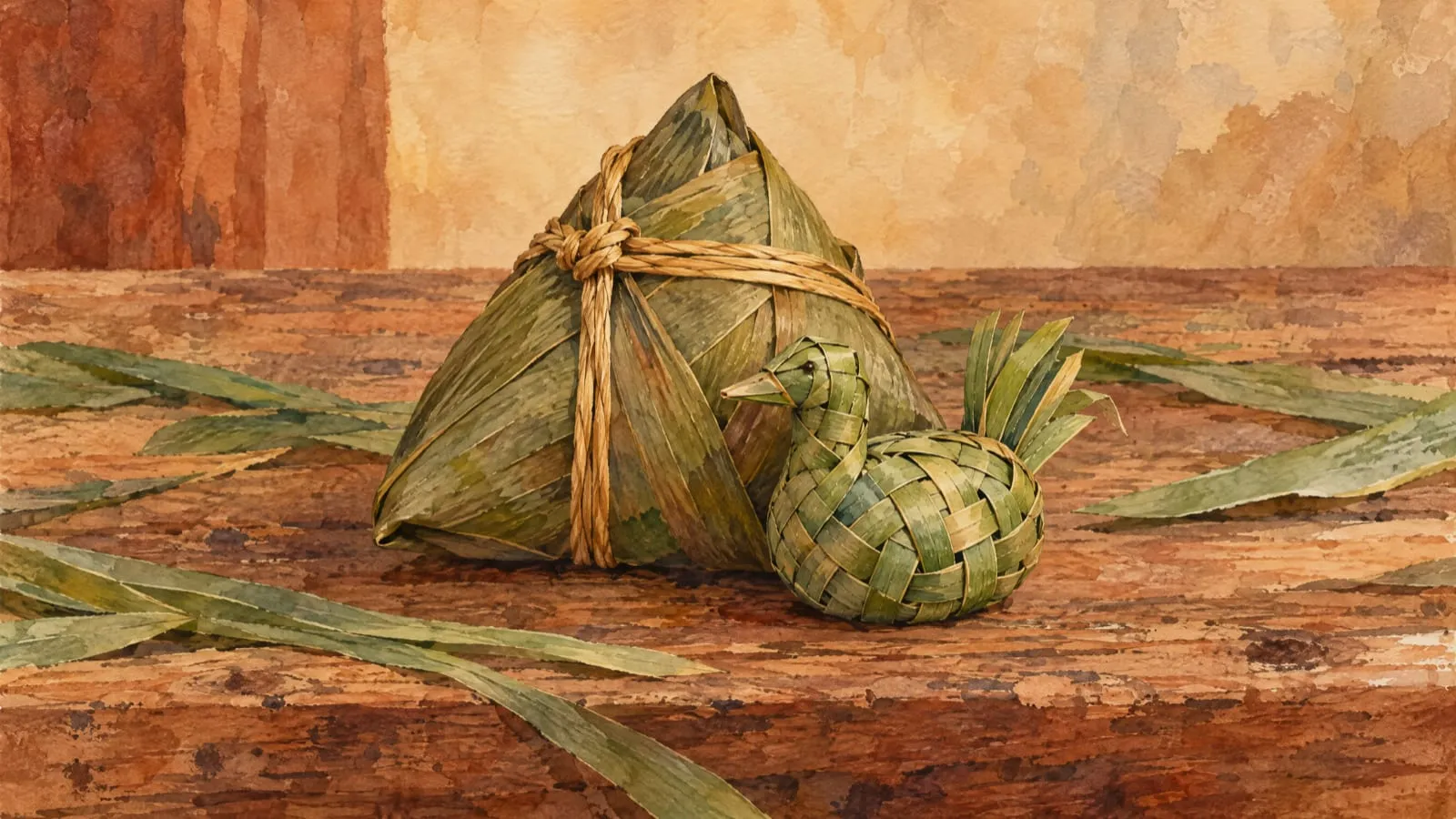
Leizhou da zong, 雷州大粽, is the big rice dumpling of the Leizhou Peninsula. A large, savoury, folded zongzi: glutinous rice for the skin, lotus seed, pork, red dates and mushroom for the filling, wrapped in a big leaf, tied with straw rope, boiled for four or five hours. Leizhou people eat it with a bowl of beef soup, which is why they also call it 牛肉大粽, the beef big zong.
There is a second Leizhou zongzi, well loved on the peninsula, and it is a different dish. The one English report we hold calls it Yana zongzi, in Latin letters, and gives no Chinese name for it. It is palm-sized and woven by hand from a screw-pine leaf into the shape of a duck. Same peninsula, often the same family table. Telling them apart matters, because the two were made for different reasons, and almost everything worth knowing about this food sits in the gap between them.
One thing to say at the top, because this brand is built on it: what follows separates what is on the record from what families say and from what nobody knows yet. There is more of the last kind here than we would like.
- 大粽 da zong
- "Big zongzi". The word on its own means a large one; Leizhou puts its own place name in front of it.
- 牛肉大粽 niurou da zong
- "Beef big zong". The same dish under the name of what it is eaten with.
- Yana zongzi
- The woven one, palm-sized and shaped like a duck. The English report we hold gives this name in Latin letters only, and gives no Chinese name for the dish.
- 露兜树 licu, the screw pine
- The tree the weaving leaf comes from, Pandanus tectorius. A 2019 survey of the leaves used to wrap zongzi across China lists it under that Chinese name. Not the fragrant leaf in a Malaysian kitchen.
Two zongzi, one peninsula, two names
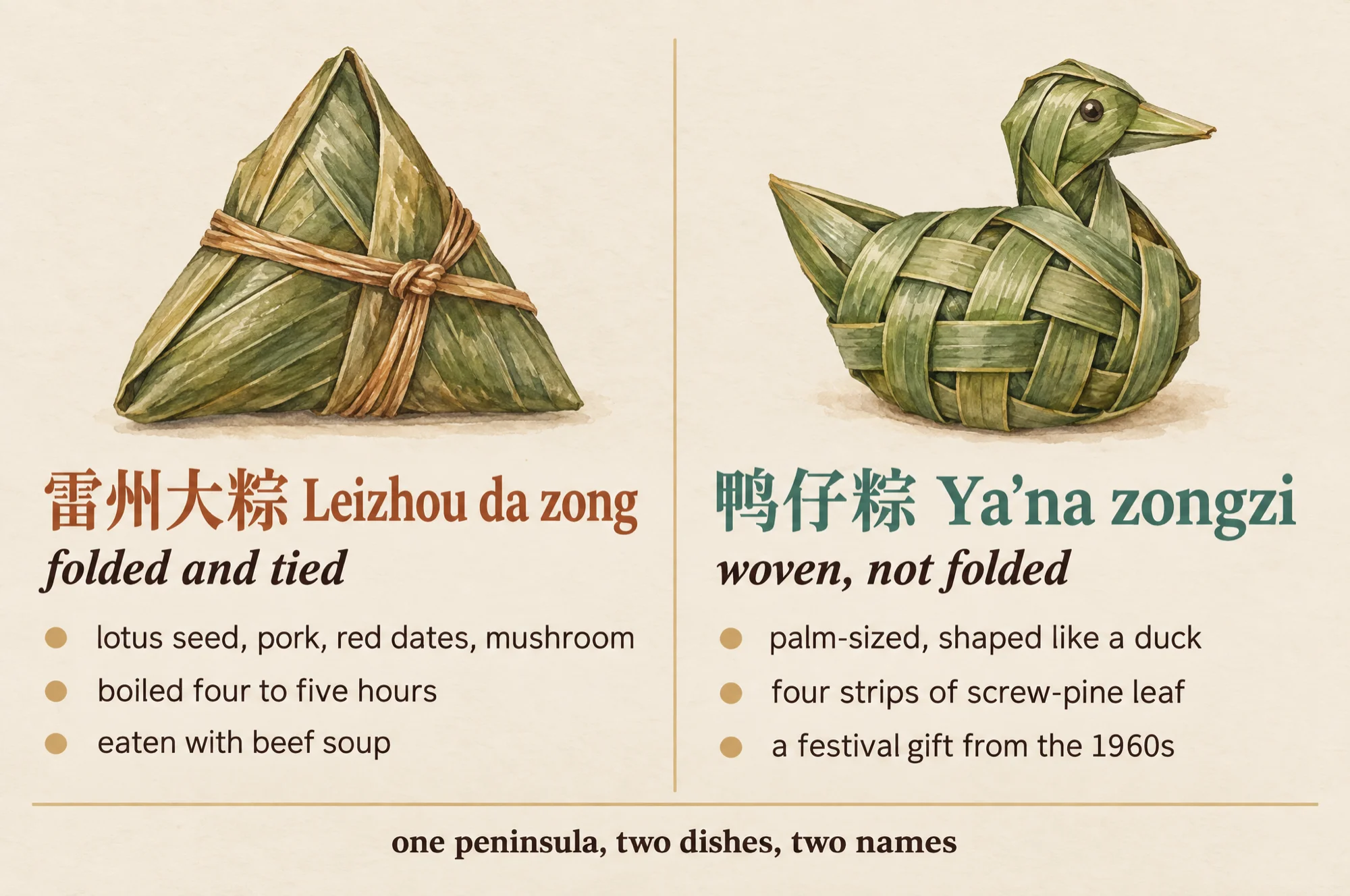
Read the two columns as words
雷州大粽 Leizhou da zong, folded and tied. Picture: a folded leaf parcel tied with rope.
- lotus seed, pork, red dates, mushroom
- boiled four to five hours
- eaten with beef soup
Yana zongzi, woven, not folded. Picture: a duck woven from leaf strips.
- palm-sized, shaped like a duck
- four strips of screw-pine leaf
- a festival gift from the 1960s
one peninsula, two dishes, two names
Start with the naming.
The best written account of 雷州大粽 we hold is a Chinese consumer shopping guide, published under the name Maigou (买购网), with no byline. Its list is called 雷州十大特产, the top ten Leizhou specialty products, and it puts the da zong (大粽) fifth of the ten. Its own two-line description of it is 用料足体形大, generous ingredients and a large body, and 鲜香入味, fresh and savoury down to the filling. The same entry calls the dish 历史悠久, long-standing, and a 岭南佳品, a fine product of Lingnan, the region south of the Nanling mountains that takes in Guangdong.
That is a shopkeeper’s description of a local food, not an archive. It is a thin basis for a page, and it is good enough to build one, provided we keep saying where it came from. The rest of the page does that at every step.
The duck-shaped zongzi comes from a different desk. It is written about in English by South, the news site at newsgd.com, in a report by Chen Wen dated 18 June 2026 called “Zhanjiang’s duck-shaped Zongzi: Licu weaving heritage and nostalgia”. That report calls it Yana Zongzi, in Latin letters, and never calls it Leizhou da zong (雷州大粽). The shopping guide’s Leizhou da zong (雷州大粽) entry never mentions a woven zongzi or a duck.
So there are two Leizhou zongzi, made for different reasons. The rest of this page takes them one at a time.
What is inside a Leizhou da zong
The whole recipe, as the shopping guide gives it, fits in one sentence. 以糯米为皮,莲子、猪肉、红枣、香菇等作馅,用海南大粽叶包裹,用草绳扎紧放进锅里,加水煮4-5个小时即熟. Glutinous rice for the skin. Lotus seed, pork, red dates and shiitake mushroom for the filling. Wrapped in what it calls a 海南大粽叶, a Hainan big-zong leaf. Tied tight with straw rope. Put in a pot with water, boiled four to five hours, and it is done.
Four or five hours of boiling is the load-bearing number on this page, and it is the one number the source actually gives. A zongzi that boils for four or five hours is not a quick job on the day. Our guess is that it is cooked the day before, in a pot that belongs to one family and is heavy when it comes off the fire. The source does not say, and we would rather flag that than pretend it does.
The filling is a sweet and savoury mixture rather than a single ingredient. Lotus seed is 莲子 lianzi. The size is another matter, because there is no size on the record.
On size, honestly: no source we hold gives a weight for a Leizhou da zong. The name says big. The shopping guide’s own gloss says 体形大, large in body. If your family’s answer was “about the size of your head” or “you needed both hands”, we would like that, and we would rather have it from a kitchen than from a listicle.
One big zongzi, then a bowl of beef soup: the guide says it fills you up and the soup cuts the richness.
The leaf is not the pandan in your kitchen
A Malaysian reader will ask this first, and the answer is a clear no.
The fragrant leaf you buy in a packet, the one that gives a whole dish its perfume, comes from Pandanus amaryllifolius. The Leizhou duck zongzi is woven from the leaf of the screw pine, which the South report names by its Latin name in the same breath: Pandanus tectorius. Both plants belong to the pandanus family, so they are relatives. One is the herb you cook with. The other is a tree, and its leaves have to be de-thorned before anyone cuts them into strips, which is the second step of the weave.
The licu leaf is not a Leizhou invention, and here the evidence is better than anything else on this page. A 2019 survey of the leaves used to wrap zongzi across China, published in the Journal of Ethnobiology and Ethnomedicine, recorded 57 plant species in use. Its tables list Pandanus tectorius, 露兜树, as a tree of the pandanus family, recorded in Guangdong and Hainan. Leizhou is one of the survey’s Guangdong sites. The study also records what local people told it about keeping: 26 species of leaf were said to be the reason a wrapped zongzi keeps, and the screw pine is among them.
Two things follow from that. The leaf is not a Leizhou secret: the survey records it as a zongzi leaf in Guangdong and Hainan. The weave is a different matter. The report calls the Yana zongzi a Dragon Boat Festival delicacy unique to Leizhou.
And the leaf of the big folded zongzi is still a question mark. The shopping guide calls it a 海南大粽叶, a Hainan big-zong leaf, and names no plant. It may be a relative of the licu leaf. It may not be. This page will not guess at one.
How a Yana zongzi gets woven
The duck-shaped zongzi is built rather than wrapped. The South report of 18 June 2026 lays out the method in a few lines, and the order matters.
- Harvest the licu leaves.
- Take the thorns off.
- Flatten the leaves.
- Cut them into strips of one even width.
- Interlace four slender strips into the body of the duck.
- Spoon in the glutinous rice and the filling, a layer at a time.
- Weave the duck's neck.
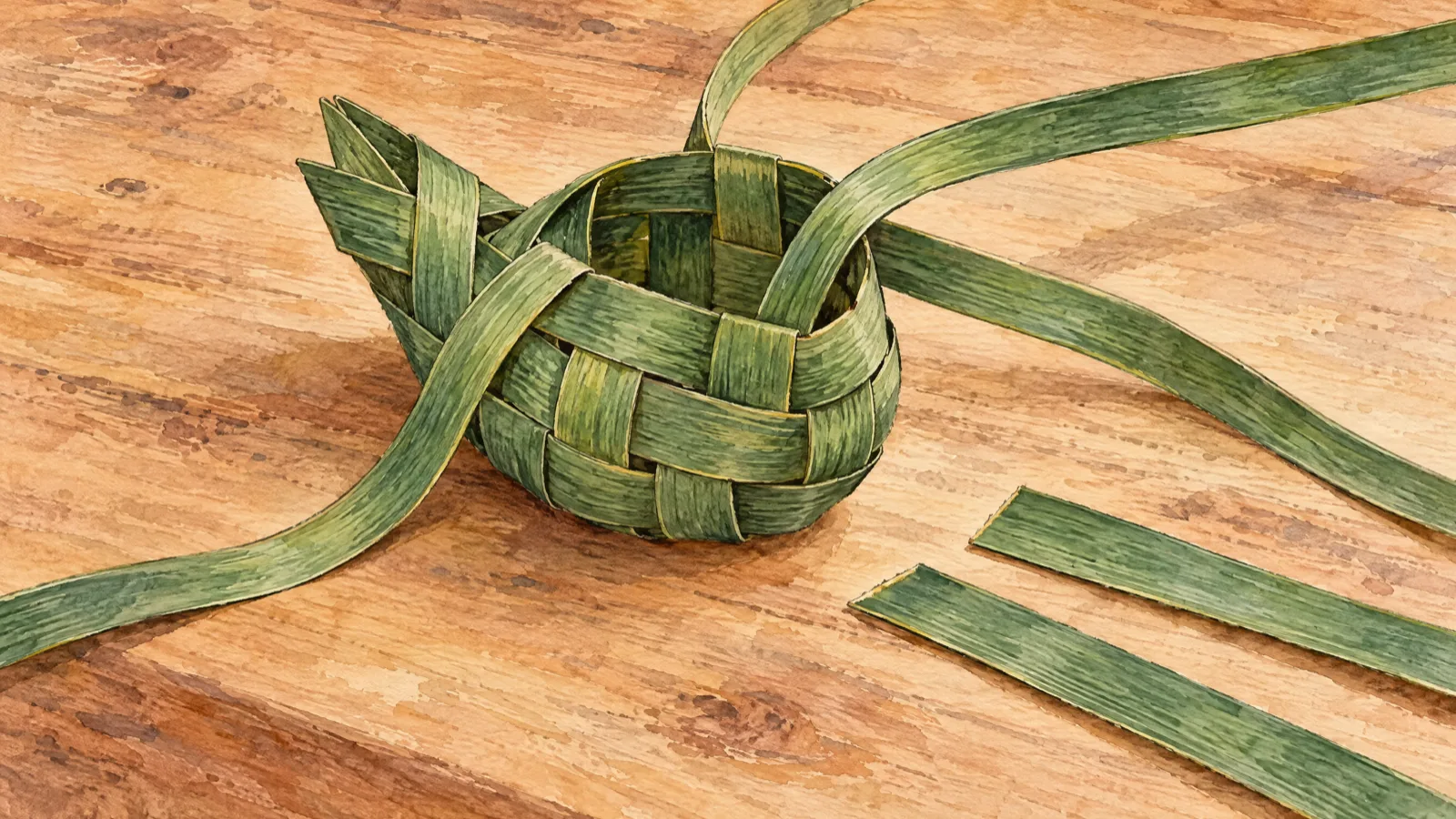
Four strips, woven rather than folded. The report sets it against zongzi wrapped by folding leaves, and says a well-packed one does not fall apart during cooking.
The filling is described only as generous. Marinated pork is the one ingredient named, in the account of what eating it is like. The report gives no quantities and no cooking time, so this page gives none either.
The other shapes are worth knowing about, because they show what the weave is for. Alongside the duck, artisans weave auspicious patterns: a rack for writing brushes, which stands for progress in study, and a fish basket, which stands for a harvest in every month of the year. Duck, brush rack, fish basket. None of them is food decoration. Each is a wish, told in leaf.
Where it came from. The report dates the custom to the 1960s and 1970s, when poultry meat was a rare treat for local families. Villagers skilled in weaving licu leaf wove rice dumplings into mother-duck shapes to delight the children at the festival. The report says the festival gift gave the dish its name, and that the name has been passed down through generations. It also says the custom of carrying a duck-shaped zongzi at 端午节, the Dragon Boat Festival, has spread widely across the peninsula.
Our reading, not the report’s: a scarcity food dressed itself as the thing it could not have, and the disguise has outlived the shortage by more than fifty years.
The four Leizhou zongzi
People say “Leizhou zongzi” the way they say “Singapore laksa”, and then everyone nods as if the same bowl were being discussed. Zhanjiang, the city the peninsula sits in, has at least four. Here they are side by side, with the record each one rests on.
| Dish | How it is made | What is in it | Where the record stands |
|---|---|---|---|
| 雷州大粽 Leizhou da zong | Folded, tied with straw rope, boiled four to five hours | Lotus seed, pork, red dates, shiitake mushroom, under a glutinous rice skin | One Chinese consumer shopping guide, no byline. No entry on any heritage register we searched |
| Yana zongzi | Woven by hand from four licu leaf strips into a duck, palm-sized | Glutinous rice and a filling the report calls generous; marinated pork named | South, the English news site at newsgd.com, 18 June 2026. No entry on any heritage register we searched |
| 海味粽子 Zhanjiang seafood zongzi | Folded in local zongzi leaves, the heat of the steam and the boil controlled | Abalone, dried scallop, dried shrimp | A self-published post reports the Zhanjiang city government listed it as city-level intangible heritage in December 2023. We have not matched that to a government page |
| Gelou zongzi (蛤蒌粽), a zongzi wrapped in gelou (蛤蒌) leaf | A Zhanjiang zongzi of its own, taught in public | Not described in any source we hold | China's national heritage site treats its making technique as an intangible heritage craft, at a level it does not state, and reports a provincial-funded Duanwu class on it in June 2023, taught by 陈乔鑫 Chen Qiaoxin, who has worked on the craft for over ten years |
Two dishes this page is about. A third has a reported listing we could not confirm from an official source. The fourth is treated by the national heritage site as a craft, at a level it does not state, and a teacher who has kept it alive for more than a decade.
Did it ever cross to the strait?
Here is the part we cannot answer, and it is the part a Malaysian reader most wants answered.
The weaving is not exotic this side of the water. Pandanus leaf was plaited in the Malay Peninsula well over a century ago, and a museum in Singapore holds the proof. Singapore’s National Heritage Board holds a rice bag from the late nineteenth century, made in the Malay Peninsula, plaited from pandanus leaves, with a row of openwork, small gaps left in the weave, along the bottom. It is 30 centimetres long and 19.5 wide, and it sits in the Asian Civilisations Museum’s collection, given by Alfred Dent Machado in 1897.
Read that against the Leizhou weave and something jumps out. A rice bag and a duck-shaped zongzi are the same craft: long, stiff leaves, cut and interlaced by hand, no thread and no loom. In Malaya it went into storage. On the Leizhou Peninsula it went into a festival, and somebody bent it into a bird.
What no page in our sources records, in English, Chinese or Malay, is a Lui Chew household doing either. If a family of ours in Melaka or Muar ever cut a pandanus leaf into strips and wove a duck, or a fish basket, or a rice bag for the kitchen, we have no page that shows it.
So the honest position is this. The plant and the craft are on both sides. The custom of weaving one into a festival dumpling is documented on one side. The gap in between is unrecorded, and the only person who can close it is someone whose grandmother did it.
What we do not know yet
Five things this page would have answered if the record held them.
The plant behind the big zongzi’s leaf. The shopping guide names a Hainan big-zong leaf (海南大粽叶) and stops. No species, no botanical record, nothing from a university. Anyone who knows which leaf is cut for the big folded zongzi in Leizhou can close this in one sentence.
How big it is. No weight appears in any source we hold. The name, and the shopping guide’s own “large in body” (体形大), are what we have. A kitchen measure beats a listicle, so if your family had a rule for it, we want the rule. Our thirty quick facts about the Lui Chew carry what the record does hold.
How it compares with the Hokkien, Cantonese and Nyonya zongzi you grew up with. No source of ours sets them side by side. What is on the record for the folded one: lotus seed, pork, red dates and shiitake mushroom inside a skin of glutinous rice, wrapped in a leaf and tied with straw rope. The rest of the comparison is yours to make, and we would rather ask than guess.
Whether either dish is protected. The one Leizhou-area zongzi with a reported heritage listing is the seafood one, and that listing reaches us through a self-published post rather than a government page. For the two dishes this page is about, our searches turned up no register entry at all. We would rather say that plainly than print a claim we cannot trace.
Whether the weave crossed. See the section above. Nobody has written it down, which is not the same as nobody did it.
Next, read about the land it comes from. Our page on the Leizhou Peninsula covers the red ground and the sea around it, which is where this whole page starts. Festival life on that peninsula has its own page here: nianli, the West Guangdong village festival that is bigger than New Year. And if your family ever wove one of these, or ate one in Malaysia, or can tell us what leaf the big zongzi is wrapped in, send us the story or the correction. A page that says what it does not know is only worth reading if the people who do know are welcome to say so.
Sources for every claim on this page are listed on our sources page. In short: the recipe and the names come from a Chinese consumer shopping guide with no byline; the duck-shaped zongzi comes from South, the English news site at newsgd.com, report by Chen Wen, 18 June 2026; the leaf evidence comes from Lin, Luo and colleagues, "Plant leaves for wrapping zongzi in China: an ethnobotanical study", Journal of Ethnobiology and Ethnomedicine 15:63, 2019, and the name of the fragrant kitchen pandan, Pandanus amaryllifolius, comes from English Wikipedia; the Malay rice bag is in the collection of Singapore's National Heritage Board; the gelou zongzi (蛤蒌粽) class is reported on China's national intangible cultural heritage site. More on food and festival life sits on our Living Culture hub.