
If your grandparent’s genealogy book, the family’s own record of its line, names Putian (莆田) as the first home, does that make your family Hokkien? No. Putian is a city in Fujian province, China, and a Putian start makes a family neither Hokkien nor Henghua. Hokkien and Henghua are the names Malaysia and Singapore use for two different Chinese groups from Fujian, each with its own speech. If your family is Lui Chew, the older Malayan spelling of Leizhou (雷州), its home before Malaya was the Leizhou Peninsula in southwest Guangdong province. Its speech is Leizhou Min, one of the Min languages, a family of Chinese languages.
Putian may still sit further back in your line. Whether it truly does is a separate question, and the honest answer comes in three piles. What the story says: Putian families fled south in the Southern Song, the last part of the Song dynasty, which fell in 1279. A dynasty is one family line of emperors. What the record shows: settlers from Fujian reached the peninsula over many centuries, people from Putian among them, and Putian’s own speech is a sister of Leizhou Min. What nobody can prove yet: how many Lui Chew families truly began in Putian. Let us sort them, one pile at a time.
Where is Putian, and what is it known for?
Putian is a coastal city in Fujian province, China, best known as the hometown of Mazu, 妈祖, the Chinese goddess of the sea. The city of Fuzhou lies to its north and the city of Quanzhou to its south.
To the east of Putian is Xinghua Bay, an inlet of the Taiwan Strait, the sea between Fujian and Taiwan. The Mulan River runs through Putian. Meizhou Island, just off Putian’s coast, is famous as Mazu’s legendary birthplace, and Putian’s Xianliang Mazu Temple draws pilgrims from across China and from Taiwan.
Putian has an older name, Xinghua, 兴化. Families overseas say it as Henghua or Hinghwa, and that is where the Henghua people of Malaysia and Singapore get their name.
What language do Putian people speak, and is it the same as Lui Chew?
Putian people speak Pu-Xian Min, 莆仙话, named after Putian and Xianyou County beside it. Pu-Xian Min is not the same as Lui Chew speech. The two are sister languages in the Min family.
Pu-Xian Min is also called Xinghua or Henghua speech. It sits between two other Min branches: Eastern Min, the speech of Fuzhou, and Southern Min, the speech of Quanzhou. It is closer to Southern Min. Hokkien is a Southern Min speech, so Pu-Xian Min is a near cousin of Hokkien, not Hokkien itself.
The split is an old one. Until 979, in the Song dynasty, Putian belonged to Quanzhou, and its people spoke a form of Southern Min. In 979 the Song government made Putian separate from Quanzhou. From then on its speech grew apart from the rest of Southern Min.
Leizhou Min, 雷州话, is the speech of the Leizhou Peninsula and of Lui Chew families overseas. The Leizhou City government calls Leizhou, Putian, Hainanese and Teochew speech “sister languages”. Hainanese is the speech of Hainan island, across the strait, and Teochew the speech of the Chaozhou area of eastern Guangdong.
The city government adds that the sisters have slowly grown apart, in words, sounds and grammar, from their mother and from each other. Its history of the city says Leizhou speech had taken its own shape by the Ming dynasty (1368 to 1644). By then it had features that set it apart from the Min of southern Fujian and of eastern Guangdong.
Does a Putian record make your family Hokkien?
No. Singapore’s National Library lists the Hokkiens, the Hainanese and the Henghuas as separate Chinese dialect groups. A dialect group is named for its speech and its home area in China.
In 19th- and early 20th-century Singapore, the Henghuas were known for the rickshaw and bicycle trades. A place named far back in a family book does not, on its own, move a family from one of these groups into another.
Here are the three groups side by side.
| Group | Home area in China | Speech |
|---|---|---|
| Hokkien | The Southern Min country of Fujian: Quanzhou, Zhangzhou and Xiamen (Amoy) | Hokkien, a Southern Min speech |
| Henghua | Putian and Xianyou, in Fujian between Fuzhou and Quanzhou | Pu-Xian Min, its own branch of Min, closer to Southern Min |
| Lui Chew | The Leizhou Peninsula, in southwest Guangdong | Leizhou Min, a sister of Pu-Xian Min, Hainanese and Teochew |
A family whose forebears reached the Leizhou Peninsula from Putian centuries ago, and spoke Leizhou Min when they sailed for Malaya, is Lui Chew. A five-check test helps you work out whether your own family is Lui Chew.
Did the Lui Chew come from Putian?
Some of the Lui Chew’s forebears did come from Putian. How many is the open part. Here are the three piles in turn.
What the story says. The Leizhou City government’s account of Leizhou speech tells it this way. Chinese from the Central Plains, the old heartland of north China, came south in several waves. They came under six dynasties in turn: the Qin, Han, Tang, Song, Yuan and Ming. Each wave stayed a while in Putian, then moved on to the peninsula. By this telling, the first wave came in the first years of the Qin, in 221 BCE. BCE means “before the Common Era”, the same years as BC.
Then in the Southern Song, from 1127 to 1279, war drove Putian forebears onto the peninsula in large numbers. The government calls this history, but its telling names no record behind it. So the Southern Song flight stays in the story pile: told and retold, and not yet tied to a record anyone can check.
What the record shows. Two government histories and one study give dates and places.
- The Leizhou City government’s own history says most Leizhou people’s forebears came from central and southern Fujian, between the Tang dynasty and the Qing, China’s last dynasty. That is many centuries of arrivals, and from a wide stretch of Fujian, not from one city.
- The Xuwen County government’s history names Putian outright. Xuwen County is the southern tip of the peninsula. Many people from Putian settled there at the end of the Yuan dynasty, the one before the Ming, and at the start of the Ming. More came again at the end of the Qing.
- A 2023 study in the Journal of Chinese Architecture and Urbanism, a scholarly journal on Chinese buildings and towns, gives a wider picture. It says Putian people from Fujian gradually became the main population of the peninsula. Others moved in with them. They came from Zhejiang, next to Fujian, and from Chaoshan, the Teochew-speaking corner of eastern Guangdong. They came from the parts of Guangdong where the Cantonese and the Hakka, two more Chinese groups, live, and from the inland provinces of Henan and Jiangxi.
So Putian settlers are on the record, at more than one date and beside many others. The record points to many arrivals over many centuries, not one flight in one year.
What nobody can prove yet. How many Lui Chew families truly began in Putian. We don’t know yet.
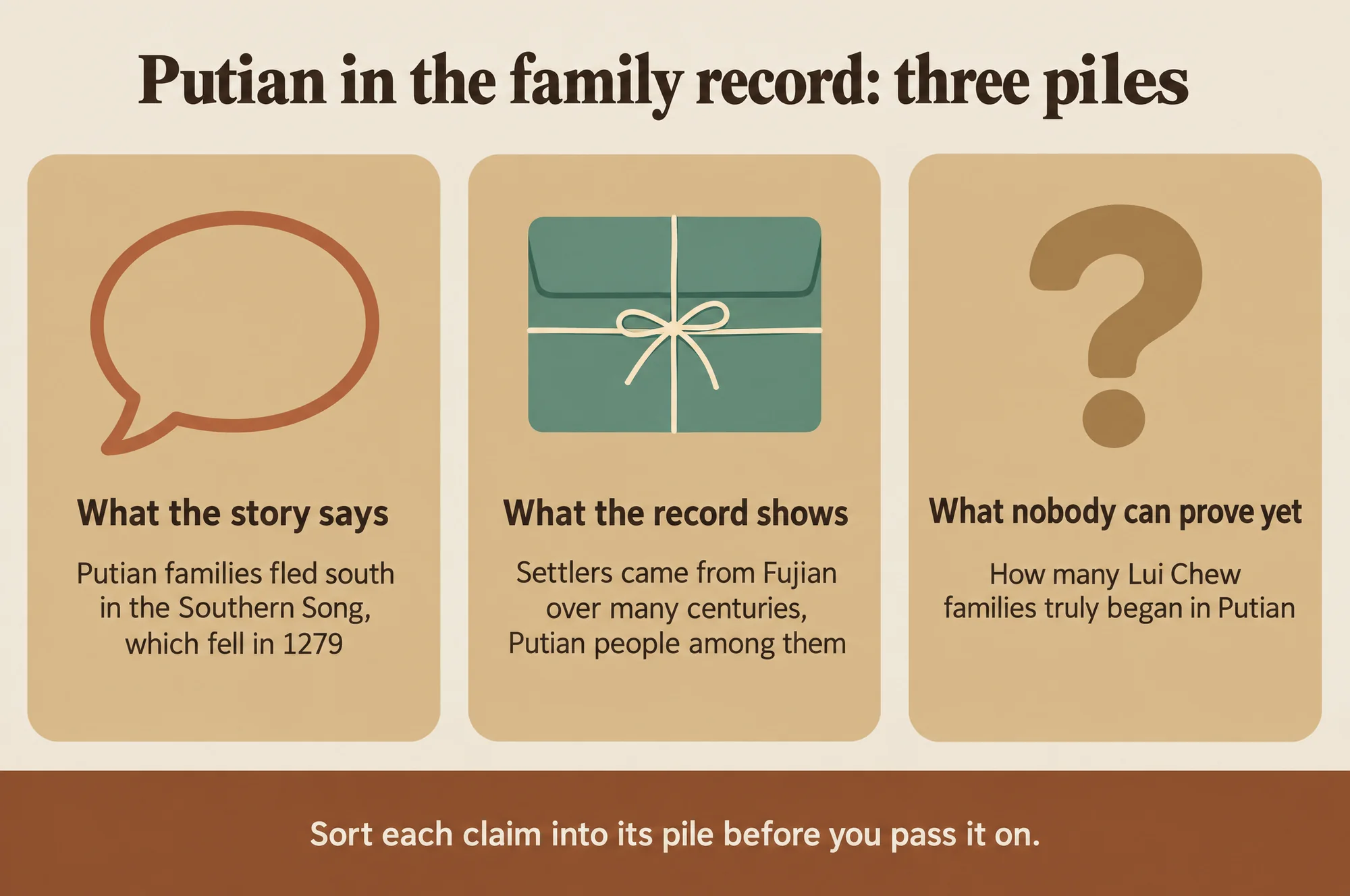
Read the three piles as words
Putian in the family record: three piles
- What the story says: Putian families fled south in the Southern Song, which fell in 1279
- What the record shows: Settlers came from Fujian over many centuries, Putian people among them
- What nobody can prove yet: How many Lui Chew families truly began in Putian
Sort each claim into its pile before you pass it on.
When did people from Putian move to the Leizhou Peninsula?
People from Putian reached the Leizhou Peninsula at more than one time. The firmest dates are all in Xuwen County: the end of the Yuan, the start of the Ming and the end of the Qing. The story adds earlier waves, in 221 BCE and in the Southern Song.
The table gives each date and who gives it. Read the first two rows as the story, and the rest as the record as it stands today.
| When | What is said | Who says it |
|---|---|---|
| 221 BCE, the first years of the Qin | A first wave of Putian forebears moves onto the peninsula | The story, as the Leizhou City government tells it |
| The Southern Song, 1127 to 1279 | War drives Putian forebears onto the peninsula in large numbers | The story, as the Leizhou City government tells it |
| The Tang to the Qing | Most Leizhou forebears come from central and southern Fujian | The Leizhou City government's history |
| By the Ming, 1368 to 1644 | Leizhou speech has taken its own shape | The Leizhou City government's history |
| The end of the Yuan and the start of the Ming | Many people from Putian settle in Xuwen | The Xuwen County government's history |
| The end of the Qing | More people from Putian settle in Xuwen | The Xuwen County government's history |
Xuwen’s dates are later than the story’s Southern Song, and they are not the only arrivals.
Why do so many records in Leizhou and Hainan name Putian?
Why so many Leizhou and Hainan family records name Putian has no settled answer yet. Some Leizhou families did come from Putian: the Xuwen County history records whole waves of them. But a record can be wrong.
The 2023 study notes that on the Leizhou Peninsula there are cases where forebears who came from Jiangxi province were wrongly recorded as coming from Putian.
One family, two books. The Gao family of Jiayang is one such case. Xuwen County’s local history book records that the Gao family came from Putian. The Gao family’s own genealogy says something else. It traces both of its branches to Yeru Village in Qingjiang County, Jiangxi. The southern branch’s forebear, Gao Liandeng, came to Leizhou to serve under the Ming and stayed. The northern branch’s forebear, Gao Han, was a high official of the Song from the same village, who later settled in Anhai, Jinjiang, in Fujian. Here the county’s book says Putian and the family’s own book says Jiangxi.
Historians who work with these books read them with care. David Faure, 科大卫, a historian at the Chinese University of Hong Kong, gave a lecture on genealogies with his colleague He Xi, 贺喜, in 2019. Faure said there that what a genealogy says is not wholly to be trusted. He added that writing a genealogy was often the very way a lineage, a family line that counts itself as one, came together.
A genealogy is not a book with a clear start and end, Faure said: it is an archive, a store of papers, and each new edition sorts it again. His advice is to read the preface first, the short opening note at the front of the book. Who wrote it? Can you find that person inside the book? The preface shows, roughly, how the book was made.
Why Putian, and not some other place, is the name so many families wrote is still open. So is the same question for Hainan, whose speech the Leizhou City government counts as another sister of Putian’s.
How do a Putian start and a Leizhou identity sit together?
Side by side, the way a deep root sits under a tree. Take the firmest Putian date on record: a family whose forebears reached Xuwen at the start of the Ming has lived on the Leizhou Peninsula for more than six centuries.
In that time the speech they brought became Leizhou Min, a sister of Pu-Xian Min and no longer the same.
The jiguan line, 籍贯, high on a Chinese gravestone, names a family’s ancestral place, not a birthplace. A Putian line in the family book adds a deeper layer to that place. It does not replace it, and it does not move the family into another group.
What we do not know yet
Four questions stay open.
How many Lui Chew families began in Putian. Settlers from Putian are on the record. A share of today’s families is not.
Whether your own line did. Your family book’s preface, and where its compilers took their names from, is the place to start.
Why Putian is the name so many records give. Some families did come from there, and at least one Leizhou family’s two books disagree. What led the rest to write Putian is still open.
Hainan’s records. Hainan’s family records raise the same question, and it is still open.
Putian is one name in a long line, so the next step is your own family’s record. Learn to trace your Lui Chew ancestry step by step, and check what your family’s book really says before you lean on the Putian line. And if your family’s genealogy or stone names Putian, we would love to hear what it says, or to take a correction to anything on this page.