Every history of the Lui Chew homeland jumps, sooner or later, from the Qing dynasty to modern Zhanjiang. This page is about the 46 years hiding inside that jump — when a corner of the thunder coast flew the French tricolour.
A French lease on the thunder coast
In the scramble for China at the end of the nineteenth century, every power took a port: Britain the New Territories, Germany Qingdao, Russia Port Arthur. France’s share, seized by naval force in 1898 and formalised by the Sino-French treaty of 16 November 1899, was a bay on the northeastern coast of the Leizhou Peninsula: Guangzhouwan (广州湾) — some 1,300 km² of water and land held on a 99-year lease and bolted administratively onto French Indochina, governed from Hanoi like a distant arrondissement of Vietnam.
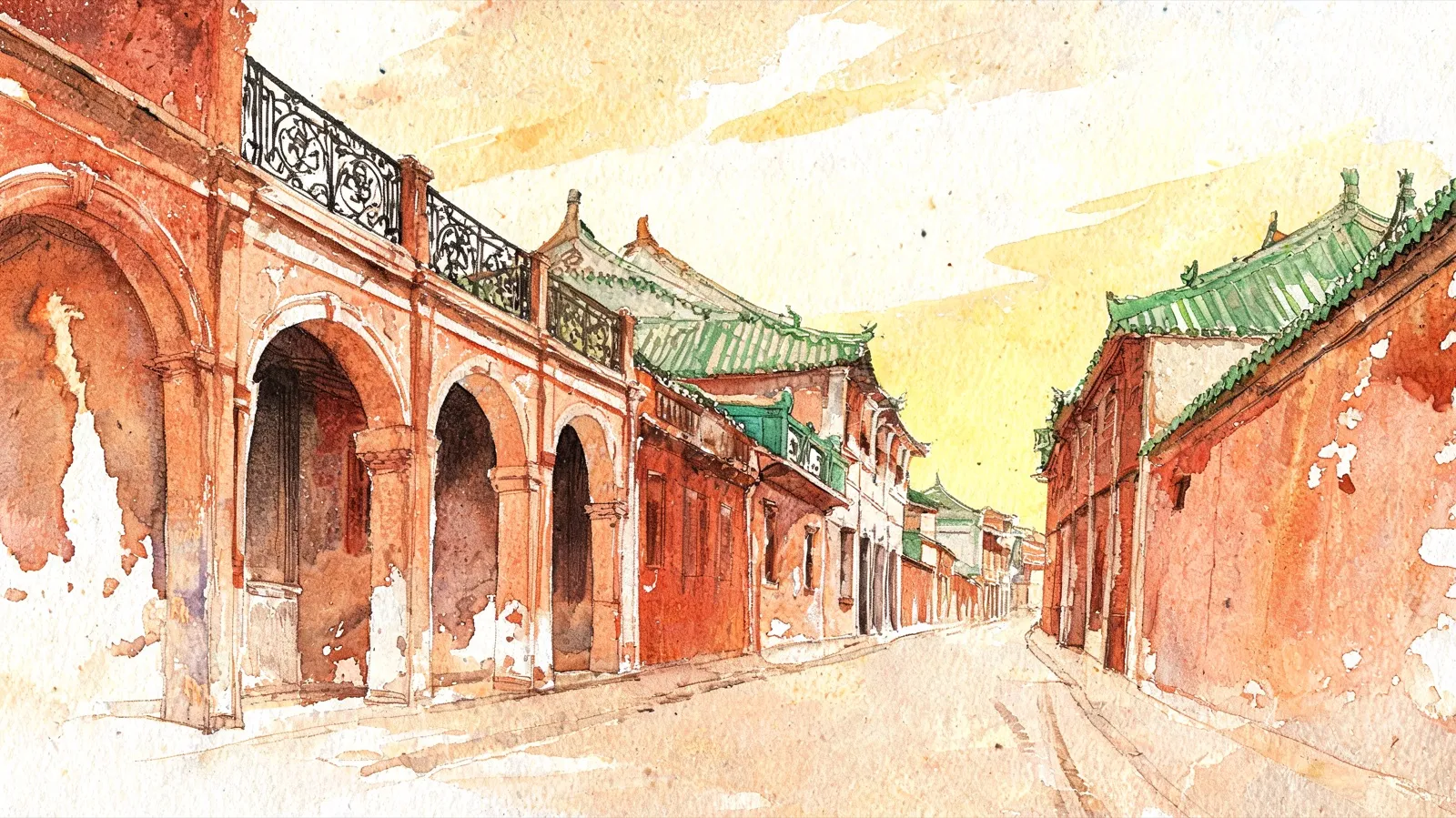
The French built a capital, Fort-Bayard (白雅特城, which locals simply called 西营, “the western camp”), laid out boulevards and raised colonial façades that still stand in Zhanjiang’s Xiashan district. On paper, a piece of the Lui Chew homeland had become a piece of French Asia.
In 1899 the Lui Chew of Melaka raised a clan house — and the homeland's best harbour raised a French flag. Same year, two futures.
The date deserves a pause. 1899 is the very year the emigrants in Melaka founded their association at 97 Jonker Street. No source connects the two events — the resonance is chronological, not causal — but they mark the same historical moment: a homeland weak enough to be leased away was a homeland worth leaving.
Why France wanted it
The ambition was explicit: a French Hong Kong. France’s sphere of influence ran through southern China from Indochina, and Guangzhouwan — a deep, sheltered bay commanding the Qiongzhou Strait — was to anchor it, a counterweight to Britain’s colony down the coast. In 1912 the territory was declared a free port to lure trade.
It never worked. Legitimate commerce stayed thin, and the colony’s real economy settled into what one historian bluntly summarises: “the real bosses of Guangzhouwan were, from its inception until its dissolution, the Chinese opium merchants.” Opium, gambling and smuggling — run through networks reaching Hong Kong and Macau — paid the territory’s way for most of its existence. The French Hong Kong ended up as something closer to a French-flagged grey market.
A Chinese city under a French flag
The deeper truth of Guangzhouwan is how thin the French layer was. The colonial population never exceeded about 300 French residents in a territory of some 189,000 (1911) rising past 200,000 — “a Chinese city in virtually every aspect.” Its people spoke Cantonese varieties and Leizhou Min; French was official and almost nobody’s language. Resistance was there from the first year — two French officials were beheaded in 1899, and reprisals and assassinations ran through the territory’s history — but so was ordinary life: the markets of Chikan (赤坎), the junks trading to Haiphong, Hong Kong, Macau and Guangzhou.
For the Lui Chew story, this is the point: the leased territory was not some foreign enclave next to the homeland. Its fishermen, market women and dockhands were the same coastal people — some Yue-speaking, some Leizhou-speaking — whose kin were, in those same decades, boarding steamships for Malaya.
The war years: the last open door
Guangzhouwan’s strangest hour came with the Second World War. As the Japanese took the Chinese coast — Guangzhou in 1938, Hong Kong in 1941 — the little French territory, neutral under its lease, became one of the last open ports in southern China: an entrepôt whose trade multiplied twenty-fold in two years, and an escape route for refugees fleeing Hong Kong and Hainan. The population, some 209,000 in 1935, swelled to 326,000 by 1940 and to an estimated 600,000 by 1942 — a tripling that made the French corner of Leizhou, briefly, one of the most crowded places on the South China coast.
The door closed in February 1943, when Japanese forces occupied the territory. The end came quickly after Japan’s surrender: Zhanjiang municipality was established in August 1945, and the formal Sino-French handover followed on 19 October 1945 — year 46 of the 99-year lease.
From Fort-Bayard to Zhanjiang
Handed back, the territory was renamed — and here the colonial chapter connects directly to every Lui Chew family record. The name Zhanjiang (湛江) dates only from 1945: it is the post-colonial name that folded the former French port and, in time, the whole peninsula region under one modern city. When a Malaysian gravestone or an association register says Zhanjiang (湛江), it is using a name younger than the migration itself — the emigrants left “Leizhou”; their descendants memorialise “Zhanjiang.” The French interlude is the hinge between those two names.
Today the former Fort-Bayard is Zhanjiang’s Xiashan district, its colonial buildings a preserved streetscape, and the harbour France coveted hosts the South Sea Fleet of the Chinese navy. Of the 99-year lease, less than half was ever used; of the French Hong Kong, what remains is architecture, archives — and the name on the map that the diaspora now carries on its stones.
What it means for the diaspora
What the chapter does give the diaspora is context and a name. Context: the same era that made the homeland leasable — the weak late Qing, the scramble of empires — is the era that made emigration rational; the French flag over the harbour and the steamship tickets to Singapore are two symptoms of one condition. And the name: every descendant who has wondered why the family says “Leizhou” but the gravestone says “Zhanjiang” now has the answer — between the two names lie forty-six French years.
Sources: the treaty dates, population figures, free-port and opium economy, wartime refuge and 1945 handover are drawn from the English and Chinese reference coverage of Guangzhouwan and a 2022 historical feature, all listed on the Sources & disclaimer page. Where sources disagree on precise dates (the 1898 seizure vs the 1899 treaty; the August–November 1945 handover sequence), this page gives the treaty and handover dates and notes the layering rather than picking silently.