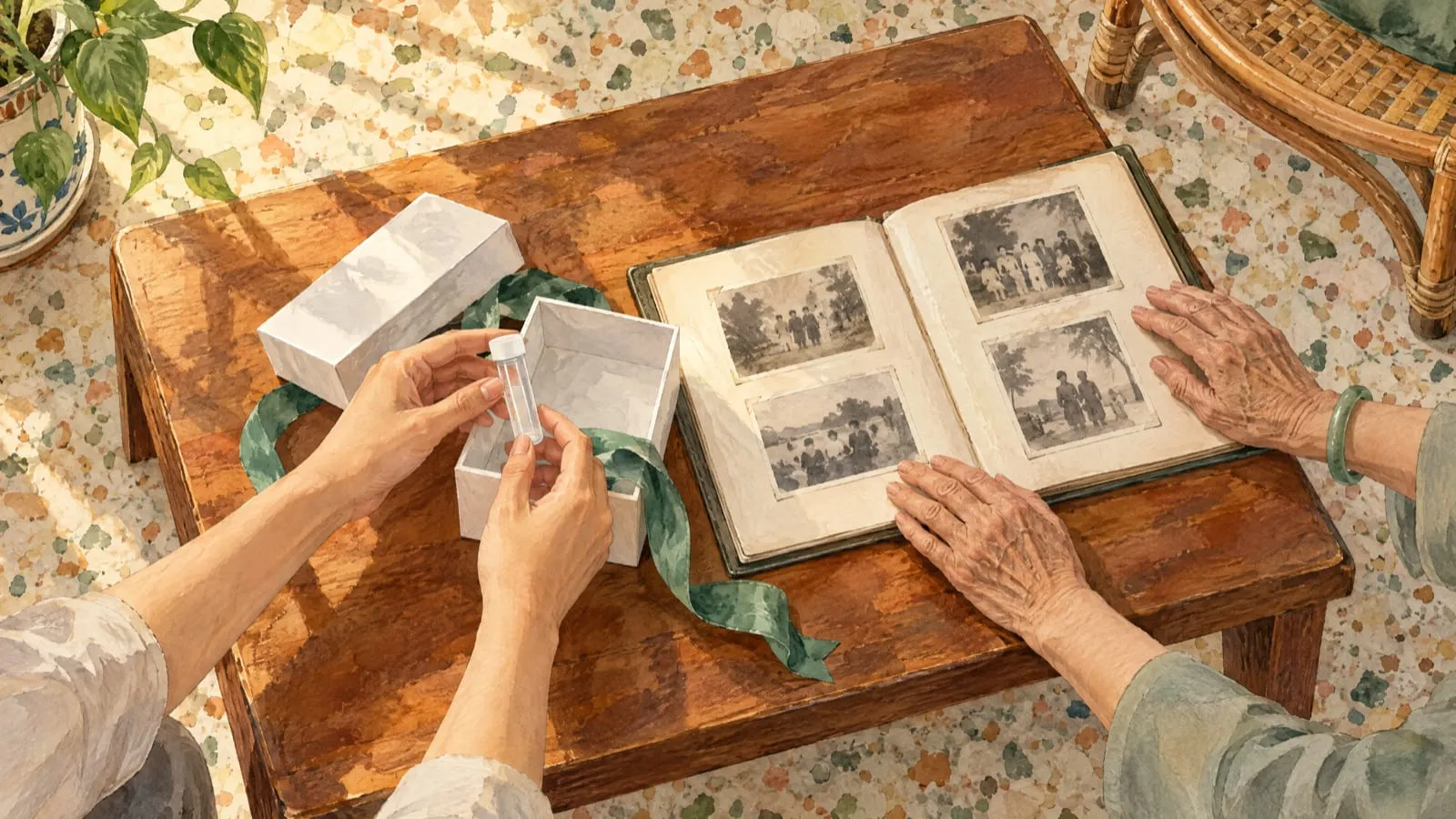
A genealogical DNA test, the kind people take to learn about their family history, can tell you which people sampled today your DNA looks most like. It cannot name your family’s village. It cannot prove your family is Lui Chew either. So if a cousin’s DNA test for Chinese ancestry came back “Southern Han Chinese”, read it as a likeness to people sampled in southern China, not an address.
Lui Chew is the old Malayan spelling of Leizhou (雷州), and the people who carry the name come from the far southwest of Guangdong province. Being Lui Chew is a matter of hometown and language, not something written in your genes. Even 23andMe, a DNA testing company, names no group for Leizhou on its long list of Chinese groups, updated on 2 July 2025. The question “are we Lui Chew?” gets answered on paper: the hometown line on a family grave, the clan book, the association’s records.
That doesn’t make the DNA test useless. It holds two different tools, and one of them can find living relatives your family lost touch with. Where it matters, we say how sure we are. Documented means there is a record behind it. Tradition means it is what families say and keep. Unknown means nobody has found the answer yet.
What does "Southern Han Chinese" mean on a DNA test?
It means your DNA looks most like the DNA of a reference group: a set of people, sampled today, whose families have long roots in one area. Every ancestry estimate, the part of the result that names regions, works this way. MedlinePlus, the health information site of the US National Library of Medicine, explains the steps. The DNA test compares your DNA pattern with databases of people “whose ancestry is already known”. Then it reports its predictions about where your ancestors most likely lived.
AncestryDNA, the DNA test sold by Ancestry, describes its own reference group the same way: people with long-standing, documented roots in a place. It says the comparison points to your possible ancestry hundreds to thousands of years ago.
So the result is a prediction about a very old past, drawn from strangers alive now. It is not a family tree, and it does not know your grandparents’ village.
The label also has a namesake in science. The 1000 Genomes Project, an open collection of human DNA data, has a reference group named Southern Han Chinese, with the short code CHS. Its list of codes gives the Beijing group a city: CHB is “Han Chinese in Beijing, China”. For CHS it gives only “Han Chinese South”. No city, no province. The project’s data portal counts 171 people in that group, so the whole label rests on 171 people.
Your cousin’s DNA test may not use that group at all. MedlinePlus adds that each company uses its own reference databases, so the same DNA can get different estimates from different companies. The picture for a population also changes as more DNA is added, and some populations are better represented than others. So “South” on your result is a direction on a map, not a place. And the same sample could read a little differently next year.
Can a DNA test point to Leizhou?
Not by name on 23andMe’s list of China groups. The closest it gets is a coastal region next door, which can hint at the right corner of China and still prove nothing.
On 2 July 2025, 23andMe added dozens of new genetic groups for China and Taiwan, many of them named for a single river basin or stretch of coast. Near the Leizhou Peninsula the names include Guangdong Coast, Central Guangdong Coast, Western Pearl River Delta, Southern Guangxi and Hainan. None of the names is Leizhou, Zhanjiang (湛江, the city the peninsula’s counties sit under today) or one of the peninsula’s old counties.
So can a DNA test tell which province or village your family came from? Not the village. A province shows up only as a likeness to a region that may carry its name, like Guangdong Coast. Where the edges of Guangdong Coast or Hainan fall, and whether a Lui Chew family would land in one of them, we don’t know yet. If yours does, read it as a hint about the coast your family may have come from. It is not a ruling on whether you are Lui Chew or Hainanese.
| What the result shows | What it can tell you | What it cannot tell you |
|---|---|---|
| "Southern Han Chinese" or a wide South China region | Your DNA looks most like people sampled in southern China today | A province, a county or a village. Whether the family is Lui Chew |
| A coastal group such as Guangdong Coast or Hainan (23andMe, since 2 July 2025) | A likeness to people sampled from that stretch of coast | Whether the family is Lui Chew or Hainanese. No group on that list is named for Leizhou |
| A DNA match, with a relationship range | A relative who tested with the same company, and roughly how long ago you share an ancestor | Who that ancestor was or where they lived, until the two family trees are compared |
| A father-line or mother-line result (Y-DNA or mitochondrial DNA) | Something about one line only: father to son, or mother to child | Anything about the many other ancestors in your tree |
Why can't DNA prove a family is Lui Chew?
Because being Lui Chew was never a matter of blood alone. The Chinese who settled Malaya came as separate dialect groups, each with its own language, guild and clan houses, and the Lui Chew were one of them. Their language is a form of Min, the same branch of Chinese that Hainanese and Teochew belong to. What makes a family Lui Chew is where its line counts its home and the language its elders spoke. Both live on paper and in memory. A test tube holds neither.
Even your elders’ own word counts here. If they always called the family Lui Chew, that is family tradition. Our five-check Am I Lui Chew? test grades it a strong hint, because in Malaysia the name is too obscure to pick up by mistake.
The same holds whichever neighbour your family is weighing. Teochew is a large dialect group from Guangdong’s eastern coast, and Lui Chew a small one from the far southwest. The Lui Chew and the Hainanese are closer still: sibling peoples, one strait apart. Lui Chew and Hainanese compared walks through how the two differ.
MedlinePlus says these tests read only part of a person’s DNA, and they leave out the social and cultural side of who a person is. Peoples also mixed with their neighbours as they moved, so an estimate can differ from what a family expects. We think the line between the Lui Chew and the Hainanese is exactly the kind a DNA test would find hardest to draw.
There is a deeper gap too. A DNA test can only recognise people like those in its reference groups. A large genome study of South China’s peoples names no Leizhou group. A study of Han Chinese on Hainan sampled the island across the strait, not the peninsula. Whether any study or any company’s reference group holds Leizhou speakers from the peninsula itself, we don’t know yet.
Two tools in one DNA test: the estimate and the matches
The ancestry estimate is the part your cousin screenshotted. The second tool sits in another tab, and for a family question it is often the more useful one: the list of DNA matches.
A DNA match is a real relative who took the same company’s DNA test. Your ancestors passed their DNA down to you, and much of the same DNA down to your cousins, which is why matching can connect you. At AncestryDNA, every new customer who joins is checked against you, so the list grows. Each match comes with a relationship range, an estimate of how long ago your shared ancestor lived. It also shows the surnames and birthplaces in that person’s family tree, when they have built one.
So can DNA matches help find an unknown Chinese ancestor? They can, when the right relatives have taken the same company’s DNA test. A second cousin in Muar or a great-uncle’s grandchildren in Zhanjiang only show up if they bought that brand. Even then the match tells you that you are related, not how. Ancestry warns that a shared-ancestor hint does not guarantee your research is correct. The how is worked out by comparing family trees, which brings you straight back to names, dates and places.
Some DNA tests add a father-line or mother-line result. The Y chromosome is a piece of DNA only men carry, passed from father to son. So Y chromosome testing follows the direct male line, and only men can take it. Mitochondrial DNA is a small store of DNA that men and women both have, but only mothers pass it on. So testing it follows the female line. Each covers one line out of the many in your tree. Here’s a neat overlap: the hometown line on a Chinese grave also follows the father’s line, passed down like a surname. Only one of the two names a county.
Which DNA test is best for Chinese ancestry?
We sell nothing and won’t recommend one. “Best” depends on what your family wants to find, so here is what to check.
- If you want a finer estimate, read the company’s own list of China regions before you buy, and look for groups along the Guangdong coast and on Hainan. Expect a region, never a village.
- If you want relatives, take the DNA test your relatives have taken. Matches only come from people in the same company’s database, so ask around the family first.
- If you care who keeps the data, read the owner’s terms, and know that owners change. 23andMe went through bankruptcy, and on 14 July 2025 a nonprofit, TTAM Research Institute, completed its purchase of the testing business. It says it is committed to letting customers change their decision about taking part in research.
The paper trail that answers it better
Three records answer “are we Lui Chew?” better than any DNA test: the grave, the clan book and the association. They are older than DNA testing, and most families can start on them this weekend.
The hometown line on the grave. Chinese gravestones carry a short line naming the family’s ancestral place, the jiguan (籍贯). It is not where the person was born. It passes down the father’s line. A stone reading Haikang (海康), Suixi (遂溪) or Xuwen (徐闻) names one of the peninsula’s counties, which is far more than any DNA result can do. Our guide to reading the jiguan line walks through every name you might find, and what each can and cannot prove.
The clan book. In China, a family’s line is written in lineage books, zupu (族谱), kept at village and county level and filed by place. FamilySearch, the family history website, also holds more than 65,000 Chinese jiapu (家谱) online: family records kept by a clan over many generations, usually starting from its first ancestor. The names inside have not been typed into a searchable index yet, so you search by the place your ancestor came from. That means you need the county from the grave first.
The clan associations. On the public record there have only ever been three Lui Chew associations in Southeast Asia: in Singapore, Melaka and Muar. A family tie to one of them can confirm on its own that a family is Lui Chew. Their member lists aren’t public, so you ask in person. The same five-check test grades this clue and four others by what each can prove.
What we don't know yet
Whether any DNA test has sampled the peninsula. We don’t know yet whether any company has Leizhou speakers from the peninsula in its reference groups. 23andMe’s list names no group for them, and neither study above names one.
Where a Lui Chew family’s result lands. We have no Lui Chew family’s DNA result on record, so we can’t tell you whether families like ours come out as Guangdong Coast, Hainan or something else. A handful of results, with the grave line beside each, would start to answer that.
Whether DNA matches can reach the villages. We don’t know how many people on the peninsula have taken a DNA test, so whether a Malaysian family can match a branch that stayed behind is still open.
For the paper trail, read our step-by-step guide to tracing your Lui Chew ancestry next: the grave, the elders, the letters at home and the association’s records, in the order a family really works. And if your family is Lui Chew and has taken a DNA test, we would love to hear what it said, or take a correction to anything on this page.