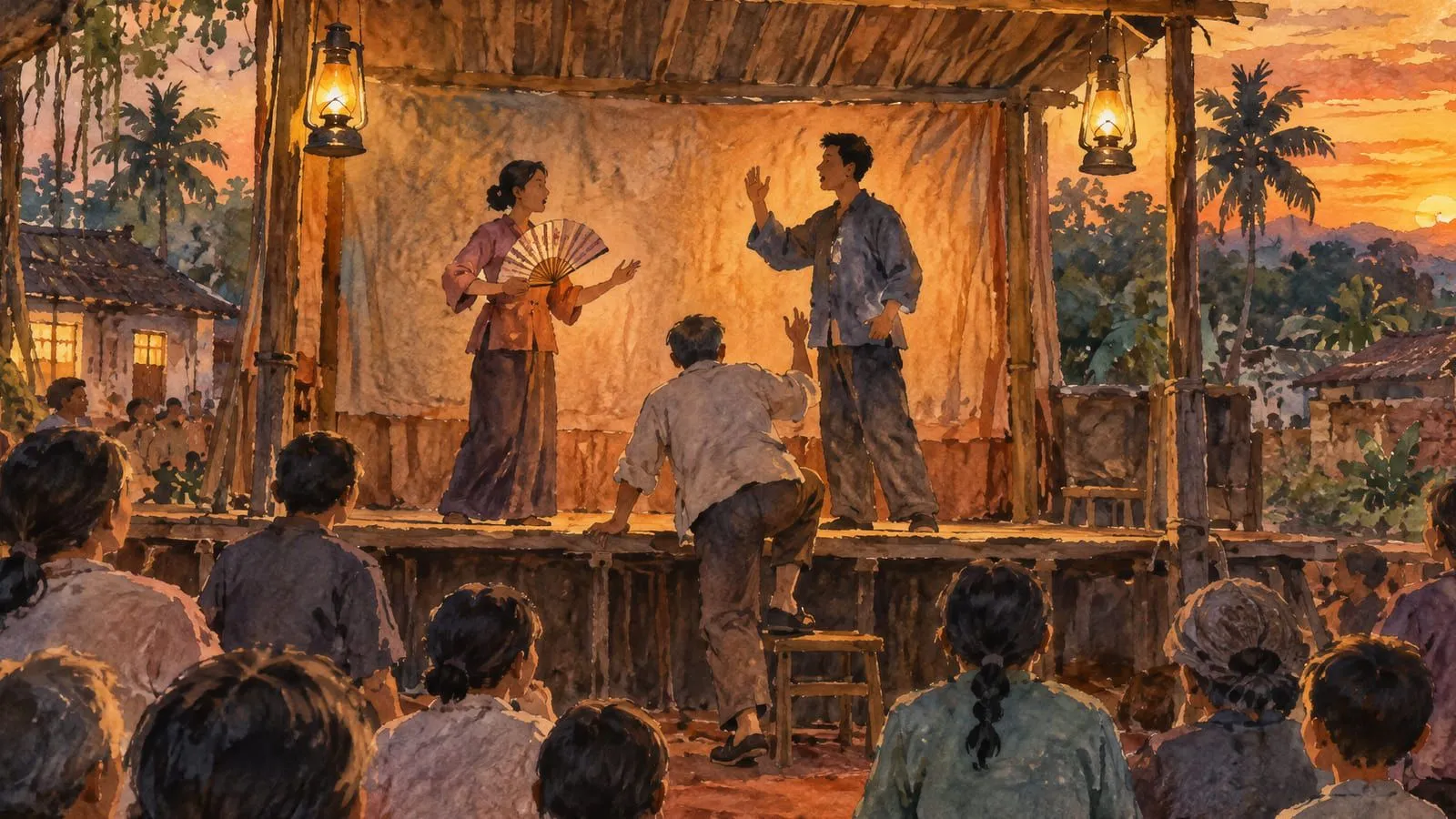
Leizhou opera, 雷剧, is the stage opera of the Leizhou Peninsula, the southern tip of mainland China. Its actors speak and sing in Leizhou Min, the peninsula’s own Chinese dialect, and a band of strings, flute, horns, gongs and drums plays behind them. In English you will also see it written as Lei opera. Leizhou opera grew out of an older folk form, Leizhou song, 雷州歌, by way of a sung-and-acted show called the girl song. China keeps both the song and Leizhou opera on its national list of intangible cultural heritage, the state’s official register of living traditions worth protecting. The song went on in 2008. Leizhou opera followed in 2011.
If a grandparent ever sang you four short lines in Leizhou Min, all the same length, you may have heard the start of all this. A Leizhou song has a strict shape. Four lines. Seven characters to a line, which in Chinese means seven sung syllables. The last words of lines one, two and four rhyme in Leizhou sounds. Line three must not rhyme, and it has to end on the right kind of tone. Singers made these verses up on the spot, and in the old song contests they answered each other with them.
Out of that answering came the girl song. Out of the girl song came Leizhou opera.
A word on dates before we walk that line. Tradition gives these forms ages that run far ahead of anything written down. So below, each date is marked as one of three things: documented, tradition, or not known yet.
What is a Leizhou song?
Leizhou song is one of the four great folk songs of Guangdong province, in the words of the Zhanjiang city government, and it is sung in Leizhou dialect. Its rules are stricter than you might expect from a folk form.
The four-line, seven-character shape is the frame. A singer may add two or three extra characters at the front of a line, a 歌垫, a “song cushion”. Then the tones. Every Chinese syllable carries a tone, a pitch pattern that changes what the syllable means. Chinese verse sorts these tones into two kinds: level tones, 平, which hold their pitch, and oblique ones, 仄, which rise, fall or cut short. A Leizhou song pins them down. Line three ends on an oblique tone. Line two ends on one kind of level tone and line four on the other. The fourth character of both those lines must carry a fixed tone too. The pattern sits close to the 七绝, the seven-character quatrain of classical Chinese poetry, and it makes a verse easy to sing and easy to remember.
The rhymes belong to Leizhou Min alone. Over its history the song has used as many as 34 rhyme groups, the sets of word endings that count as rhyming, merged again and again over time. In the 1990s the Zhanjiang Leizhou Song Research Society cut the 25 that were left down to 17, every one of them sorted by Leizhou sounds. A verse is judged by how it sounds in the dialect, which is why the song lives only as long as people speak it. Our guide to Leizhou Min, the language the Lui Chew carry, covers the dialect itself.
Inside that frame, the tune is free. People sang at the big moments of life and on ordinary days. When a relative died, they sang in place of weeping. The night before a woman married, her sisters gathered to sing with her. There is a Leizhou saying, 一条歌唱到城, “one song sung all the way to town”: on market day you sang without stopping, from the village to the town gate.
Who sang? Everyone, farmers and scholars alike, says the Leizhou city government in its overview of local culture. It counts men who passed the imperial exams, the old civil-service tests for court office, among the song’s makers, and says they joined in the song contests, which were mostly sung, not written. One of them was 陈昌齐, Chen Changqi, a Haikang man who passed the top imperial exam in the eighteenth century, under the Qing emperor Qianlong, and served as a compiler in the Hanlin Academy, the court’s college of scholars. China’s national heritage register, the official record kept for every listed tradition, names his 《断机教子》, “Cutting the Loom to Teach the Son”, as one of the older Leizhou song pieces.
Where did the song come from? Zhanjiang’s government tells it as a story of settlers. Southern Min people, Han Chinese from southern Fujian, began moving onto the peninsula in the Eastern Jin dynasty, which ruled from 317 to 420. They came in large numbers after 陈文玉, Chen Wenyu, became the first prefect, or governor, of Leizhou in 631, by the city’s dating, early in the Tang dynasty. They brought their folk songs, and over a long time those songs mixed with local ones until they became something of their own. The same page calls Leizhou dialect a branch of the Southern Min family, so the settlers’ speech and the song’s sounds share one root. That is the official story of the song’s roots. The city names no document for the mixing itself, so the story stays tradition here. Our page on Chen Wenyu, Leizhou’s first prefect, tells the rest of his story.
What is Guniang Ge, the girl song, and how was it sung?
China’s national register gives the first step. Troupes that sang Leizhou song for an audience were called 雷歌班, Leizhou song troupes. Because women took part, people called what they sang 姑娘歌, Guniang Ge, the girl song. The girl song had written texts, and most of them were songs of advice to the world: one urged people to give up opium, another urged loyalty and right conduct.
Leizhou’s government describes the stage. Guniang Ge is a talk-and-sing art built on Leizhou song, part spoken and part sung. The woman lead was the 歌姑娘, the “song girl”, and the man was the 歌童, the “song boy”, with a supporting player in the old days. They sang off the cuff, danced as they sang and traded quick replies about anything under the sky. The audience could join in. Anyone who climbed onto the stage to answer in song was doing what Leizhou people called 闹台, “stirring up the stage”. Before a play, Leizhou people would put on a round of girl song to warm the crowd, a custom still common before 1950.
So this is the answering game from the village path, moved onto planks and given a partner. That part is documented. How old it is, is another matter.
Tradition puts the girl song deep in the past. Zhanjiang’s government says it has been popular for more than 500 years. Leizhou’s government cites a county gazetteer, a local history book written in China’s Republican era, the 《海康县续志》, for 559 years of girl-song contests on stage. Those 559 years run back from the year the gazetteer was written, not from today, and Leizhou’s government does not give that year. Neither figure is tied to a dated first performance, so both stay tradition here.
Today the girl song is a provincial heritage item, on Guangdong’s second provincial list. Leizhou’s government names its two recognised inheritors, the singers Guangdong’s culture department confirmed as keepers of the form: Chen Jiayue (陈家悦) and Fu Haiyan (符海燕). It also says the girl song is still sung across Leizhou’s towns and villages.
How did Leizhou opera grow out of Leizhou song?
Leizhou’s government lays the road out in four stages: the girl song, then the advice song, then 大班歌, the “big troupe song”, and finally Leizhou opera. The national register explains what changed along the way. Leizhou opera took shape on top of the girl song by borrowing from Cantonese opera, 粤剧. It took Cantonese gong-and-drum patterns, named in the register as chongtou (冲头) and dijin (地锦), and named tunes such as dakai (大开) and xiaokai (小开). Its face paint, costumes, props and acting all leaned towards Cantonese opera too.
What stayed Leizhou was the voice. Because its singing came from Leizhou song tunes, Leizhou opera was first called 雷州歌剧, Leizhou song opera. Then came the change of name. Between the late 1950s and the mid-1960s, the register says, the Zhanjiang district set up bodies to reform Leizhou song opera and train new performers, and renamed it Leizhou opera. The reformers worked hardest on the singing, then remade the stage design and the music, until it had a complete musical system of its own. Leizhou’s government gives the year of the new name: 1964, when the big troupe song became Leizhou opera.
An older everyday name has stuck. Leizhou people still call it 歌班, the song troupe. A new name and a reformed stage, yet the everyday word still remembers that this was a song first.
What does Leizhou opera sound like, and which instruments play it?
Its speaking parts are in Leizhou dialect, and the acting has a strong feel of everyday life. The singing takes a little more explaining.
Chinese opera builds its songs in two main ways. One takes a basic tune and stretches it, slows it or speeds it up to fit the words, the banqiang ti (板腔体). The other strings together fixed, named tunes, the qupai ti (曲牌体). Leizhou opera does both. Its singing falls into three families: 雷讴 (Lei’ou), 高台 (Gaotai) and a mixed family. It runs on five beat patterns: free time with no fixed beat, then slow, middle and fast, and a fifth, 复板 (fuban).
Then the band. The main instruments are the 雷胡, the leihu, a bowed fiddle that carries the place in its name; the bamboo flute; the suona, a loud Chinese reed horn; the saxophone; and gongs, cymbals and drums.
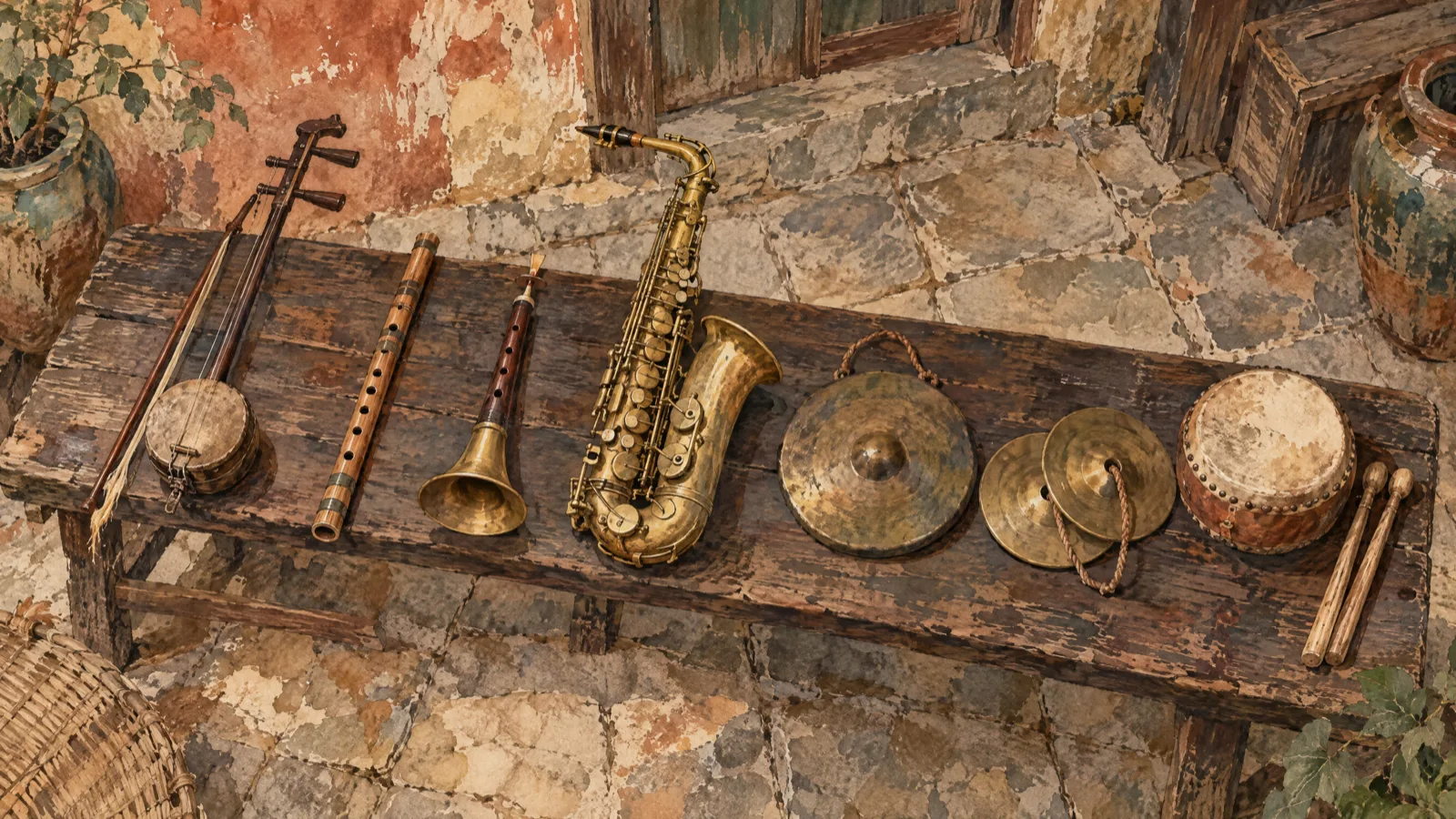
Yes, the saxophone. It sits in the official list between the suona and the gongs, with no comment. When a Western horn joined a Leizhou opera band, and who first brought one in, the register does not say. We would love to know.
Are Leizhou opera and Leizhou song on China's heritage list, and since when?
Both forms are on China’s national list, but not together. China adds to that list in batches, each one published by the State Council, China’s cabinet. The song and Leizhou opera went on in different years, in different batches, under different headings. The girl song between them sits one level down, on Guangdong’s own list.
| Form | List | Heading | Year | Item number | Who says so |
|---|---|---|---|---|---|
| Leizhou song (雷州歌) | National, second batch | Folk literature | 2008 | Ⅰ-81 | State Council notice 国发〔2008〕19号 |
| Leizhou opera (雷剧) | National, third batch | Traditional drama | 2011 | Ⅳ-150 | State Council notice 国发〔2011〕14号 |
| Leizhou song and the girl song (姑娘歌) | Guangdong provincial, second batch | Not given | Not given | Not given | Leizhou city government, 2021 |
| Leizhou opera | Guangdong provincial, third batch | Not given | 2009 | Not given | Leizhou city government, 2021 |
Read down the year column and the order follows the family tree: the parent went national before the child. By the time Leizhou opera reached even the province list, the song had already been on the national one since the year before. When it did go national, in 2011, it was one of 20 traditional drama items on a list of 191.
The girl song does not appear in either of the two State Council notices that list the song and Leizhou opera. As the record stands, it is a provincial item. If you have seen it on a national list, we would like to know.
A listing comes with people. The national register names 金由英, Jin Youying, a woman born in 1939, as a national representative inheritor of Leizhou opera: a performer the state recognises as its keeper, charged with passing it on. It names the company charged with protecting it, 雷州市名城雷剧演出有限公司, a Leizhou city opera company. For Leizhou song, Leizhou’s government names 何希春, He Xichun, as the inheritor Guangdong’s culture department recognised.
Did Leizhou song or Leizhou opera reach the Lui Chew in Malaysia?
This is the question a Lui Chew reader most wants answered, and the record gives half an answer.
For the song, there is one official line. Zhanjiang’s government says Leizhou song is found across ten counties and districts of the peninsula, and in the Leizhou Chinese communities of Singapore, Malaysia and Indonesia, where Leizhou people moved in the past. Coming from the city government, that counts as documented. But it names no town, no singer, no clan house and no date. It tells us the song went with the people. It does not tell us where it was sung, or whether anyone still sings it.
For Leizhou opera, the official record is quieter still. The national register’s entry for it and Leizhou’s own culture overview name no performance in Malaysia or Singapore. Zhanjiang’s page names Malaysia, but only for the song.
What is documented is the stage next door. In Melaka in the 1960s, an all-female troupe from Machap Baru performed Hainan opera, 琼剧, the opera sung in Hainanese. A 2016 research note in the Malaysian Journal of Humanities and Social Sciences says the troupe used it to carry Hainanese culture across Malaysia, Singapore, Brunei and southern Thailand. How much of a Hainan opera a Leizhou Min speaker could follow is its own question, and our word-by-word test of whether a Lui Chew speaker can understand Hainanese takes it on. Did Lui Chew families in Melaka go to watch the Machap Baru players? If no Leizhou troupe was to be had on this side of the sea, did a Lui Chew temple ever book them for a festival? The research note on the troupe does not say, and we do not know yet.
What we do not know yet
Four gaps this page would close if the record held the answers.
How old the song really is. Tradition gives four different ages, and none of them comes with a dated first performance. Zhanjiang’s government says history books record Leizhou song as popular in the Song dynasty, which ruled from 960 to 1279, and the girl song as popular for more than 500 years. Leizhou’s government cites a gazetteer for 559 years of girl-song contests, and elsewhere says the road from song to opera runs back more than 800 years. What the documents fix is much later: an eighteenth-century song by Chen Changqi, a reform between the late 1950s and the mid-1960s, a new name in 1964, and the listings of 2008, 2009 and 2011. The long ages are tradition until someone finds the paper behind them.
When the saxophone joined the band. The national register lists it but gives no date, and names no one who brought it in.
Where the song was sung in Malaysia. The city’s line says the song travelled. It does not say to which towns, or for how long.
Which verses your family sang. No register holds those. They exist only in the people who remember them.
The song lives only as long as the dialect does, so the natural next step is the language itself: can a Lui Chew speaker understand Hainanese? tests it word by word. And if a grandparent of yours ever sang in Leizhou Min, at a wedding, a funeral, or just on the way to the market, we would love to hear the song, the story behind it, or a correction to anything on this page.