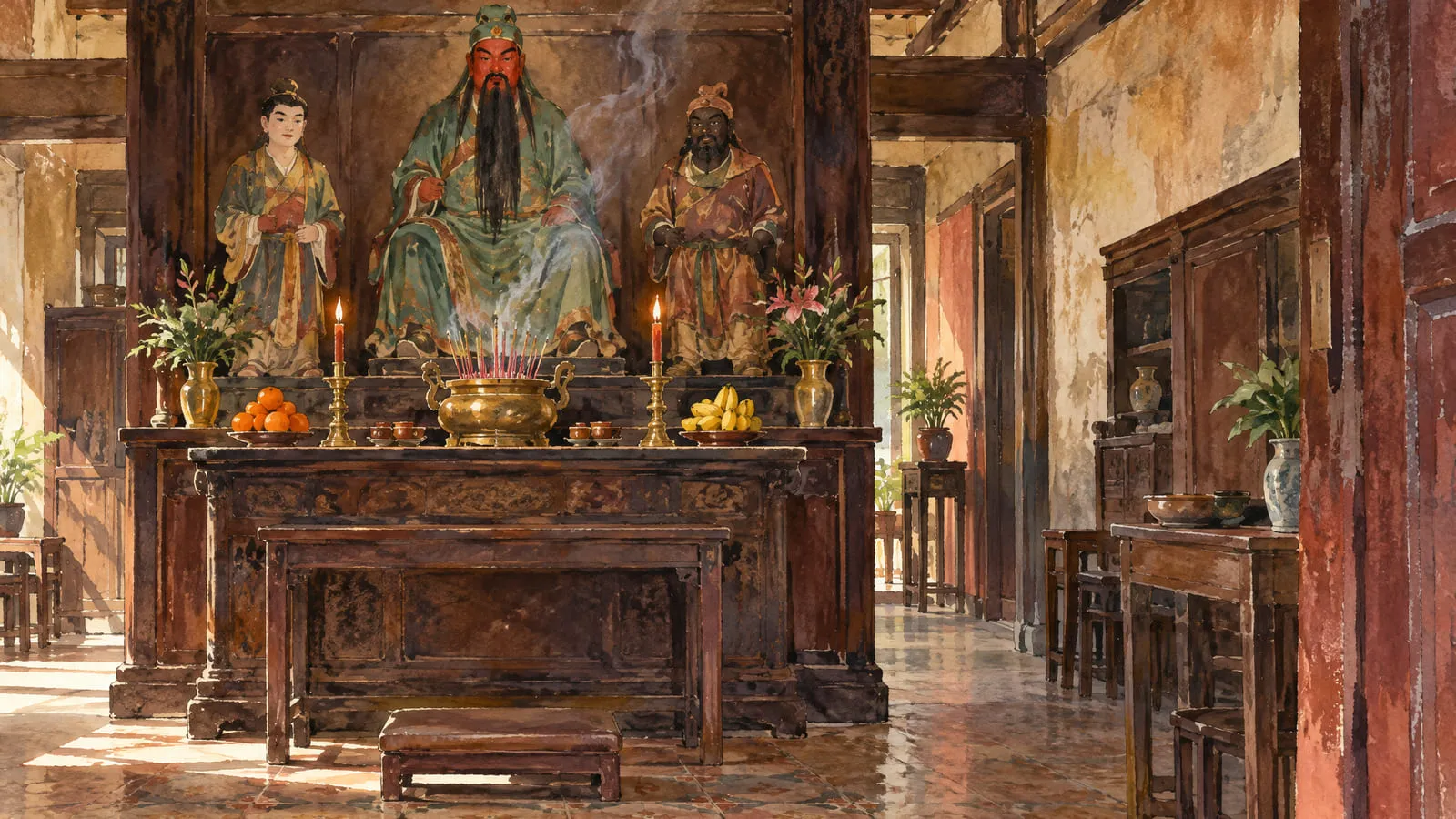
Guandi, 关帝, is the god at the head of the altar in the Melaka Leizhou Association, the Lui Chew clan house at 97 Jonker Walk in Melaka. In life he was Guan Yu, 关羽, a general of China’s Three Kingdoms era, the age of rival warlords around the year 200. He died in early 220 and was later worshipped as a god. Clan houses and other brotherhoods keep Guandi as a god of keeping faith. China’s national heritage register, the state’s official list of living traditions, names trust and loyalty as the core of his worship. This house keeps his day on the 13th day of the 5th month of the lunar calendar, the Chinese calendar that follows the moon.
You might expect a god from the Leizhou Peninsula here, the homeland at the southern tip of mainland China. Instead the main seat belongs to Guandi, and in the usual way of his images he has a red face and a long beard. On this altar he is named Guan Sheng Di Jun, 关圣帝君, roughly “Holy Emperor Lord Guan”. Two figures stand beside him: his son Guan Ping and his attendant Zhou Cang. Elsewhere you may see Guandi called Guan Di, Guan Gong (关公, “Lord Guan”) or Kuan Kong.
His story comes in three layers, and they blur easily. There is the history, the Records of the Three Kingdoms, 三国志. There is the novel, the 14th-century Romance of the Three Kingdoms, 三国演义. And there is custom, what people do at his altar. This page marks which layer each part comes from.
Who is Guandi, and what is he the god of?
Start with the man. Before he was Guandi the god he was Guan Yu, and that is the name the history uses. The Records of the Three Kingdoms was written by the historian Chen Shou. Its chapter on him gives his courtesy name, the name friends and equals used, as Yunchang, 云长. He came from Xie, in a region then called Hedong. Today that is Yuncheng, in Shanxi province. He fled his home district and joined Liu Bei, a warlord of the age, as one of his earliest followers. In the history, Liu Bei and his two captains, Guan Yu and Zhang Fei, slept in the same bed and treated each other like brothers.
Then comes the episode that shows what he stood for. In the year 200 the warlord Cao Cao captured him, treated him generously and gave him rank. He repaid Cao in battle: he rode into the enemy’s ranks and cut down Yan Liang, a general of Cao Cao’s rival Yuan Shao. Then he left. The history gives his reason in his own words. He knew Lord Cao treated him well, he said, but he had received great kindness from General Liu and had sworn to die with him. He could not turn his back on that. So he sealed up every gift Cao had given him, left a letter of farewell, and went back to Liu Bei.
He died in early 220. The forces of Sun Quan, who had broken his alliance with Liu Bei, caught him and put him to death at Linju, together with his son Guan Ping. His year of birth is not known.
The titles came after, and with them the god. After his death he was named Marquis Zhuangmou, 壮缪侯, a noble’s rank. Emperors of later dynasties kept raising him. The name on the Melaka altar, Guan Sheng Di Jun (关圣帝君), is the last four characters of a long title the Wanli Emperor of the Ming dynasty gave him in 1614. In 1644 the Qing dynasty’s Shunzhi Emperor gave him a title of his own, Zhongyi Shenwu Guansheng Dadi (忠义神武关圣大帝), which puts loyalty and righteousness first.
So what is Guandi the god of? Chinese folk custom sets him beside Confucius and honours him as the “Martial Sage”, 武圣人. Many people call him a god of war. Businessmen in Shanxi, Hong Kong, Macau and Southeast Asia also keep him as a god of wealth, because he is thought to bless the honest and guard them from the wicked. That role came late: its earliest known records date only to the eighteenth century. Small shrines to Guandi stand in homes, in shops and in fraternal organisations, groups whose members are bound to each other by a pledge.
The heart of his worship fits in eight characters: 信义为本、忠诚为贵, trust and right conduct at the root, loyalty above all. Chinese at home and overseas widely share that idea. That is the god at the head of the Jonker Walk altar. Whatever else he is, Guandi is a god of keeping faith.
Why would a clan house keep the god of sworn brothers?
First, what kind of house this is. A huiguan, 会馆, is a clan house for people who came from the same home place in China. It joins people by where they came from, not by blood, so its members carry many surnames. The Lui Chew body in Muar was set up, in its founder’s words, to lead, protect and mediate for fellow Lui Chew. Its jobs ran from a bed for a new arrival to settling quarrels, and what a huiguan actually did walks through each one.
Now the oath itself. In the novel’s first chapter, three men meet at a village inn: Liu Bei, the butcher Zhang Fei, and a tall stranger who gives his name as Guan Yu. The next day, in the peach garden behind Zhang Fei’s farm, they burn incense and swear. “Though of different surnames, now that we are brothers, we will share one heart and one strength,” they vow. “We do not ask to be born in the same year, month and day. We only wish to die in the same year, month and day.” This is the Oath of the Peach Garden, 桃园结义.
That oath is the novel’s, not the history’s. The history’s chapter on him has no peach garden in it. What the history does have is the bond: the shared bed, the brotherly kindness, the man who would not stay with Cao Cao.
Different surnames, sworn to each other. You can see why a house of migrants with no kin in common might set Guandi at its head. That is our guess, not the association’s word. Why its founders chose him, we do not know yet. What we do know is his place. Guandi holds the main seat, 主座, the place of honour at the head of the altar, and six more figures follow him. That is why the house reads, from the door, like a Guandi temple with other gods as guests.
Other sworn brotherhoods took him too, and not all of them were clan houses. A watercolour in Singapore’s national collection shows Guandi as the guardian of the Heaven and Earth Society, 天地会. It was a brotherhood of the Qing dynasty, and Singapore’s secret societies grew from it. The society’s rite for new members ended in a blood oath sworn before an altar. Many Hong Kong police stations keep a shrine to Guandi as well. The god is the same in each. What changes is who is making the promise.
Who are the two figures standing beside Guandi?
Look to either side of him. On the Melaka altar the pair are Prince Guan Ping, 关平太子, and General Zhou Cang, 周仓将军. The same pair stands beside Guandi in a watercolour and in a temple woodblock print in Singapore’s national collection. They come from different layers of the story.
Guan Ping is history. The Records of the Three Kingdoms names him as the son of Guan Yu, and says father and son were put to death together at Linju. “Prince” is the title the altar gives him.
Zhou Cang is the novel’s. He is a character of the Romance of the Three Kingdoms, and the history’s chapter on Guan Yu never names him. He grew so famous as Guan Yu’s aide in the novel that people came to worship him beside Guandi.
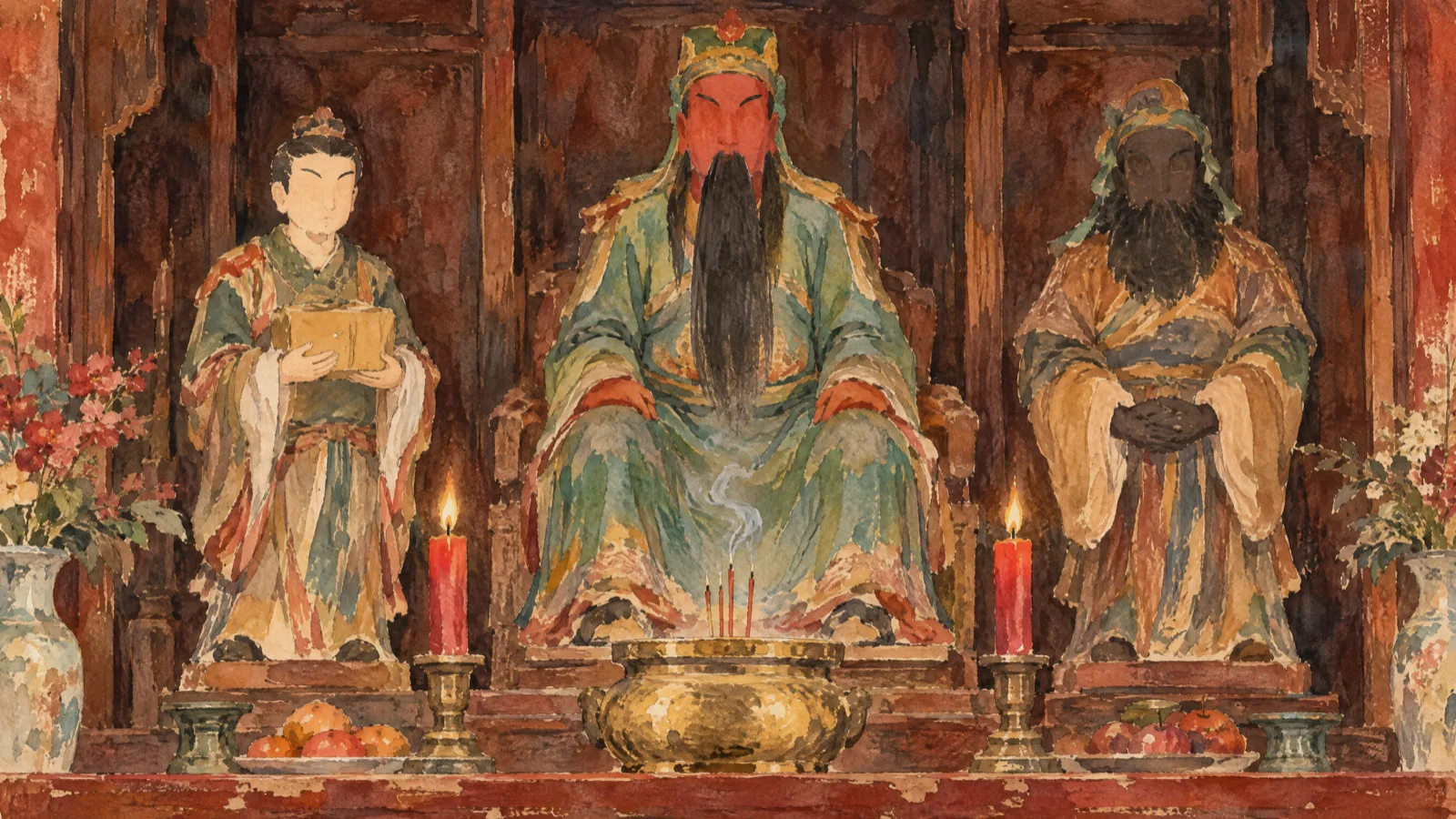
You can tell the three apart by their faces. In the usual way of painting them, Guandi’s face is red, Guan Ping’s is white and Zhou Cang’s is coal black. In the watercolour, Guan Ping also holds his father’s seal, wrapped in cloth.
Why does Guandi have a red face?
Not because of the history. The Records of the Three Kingdoms admires his beard, not his face. A reply to one of his letters called him simply “the Beard”, 髯, and the history explains why: he had a fine beard. Of the colour of his face, the chapter says nothing.
So where did the red face come from? There are two possible answers. The first is the novel’s first chapter. There Liu Bei looks over the stranger at the inn and sees a man nine chi tall (a chi is the old Chinese foot). He has a beard two chi long, lips as red as if painted, and a face like a dark red jujube, the Chinese red date: 面如重枣. The second answer is the opera stage, where a red face marks a loyal and upright man. That one comes with no source, so treat it as a guess.
Either way, the red face is custom, not history. A painter who gives Guandi one is following the story, not a record of the man.
When is Guandi's day kept at the Melaka Leizhou Association?
On the 13th day of the 5th lunar month. The house keeps two festival days, and this is Guandi’s, which it calls his birthday, 千秋宝诞. The other belongs to Bai Ma Lao Shi, 白马老师, the White Horse Master.
That date has a history of its own, and it is a court date. The Kangxi Emperor of the Qing dynasty fixed the 13th of the 5th month as the day for Guandi’s birthday rites. Those rites were held at Guanlin in Luoyang, a shrine that grew up where his head was buried. The county magistrate, the local official, led them. His hometown keeps another day. Since old times Xiezhou, in Yuncheng, has held a temple fair, a festival at the temple, on the 24th of the 6th month, which it keeps as his birth. Xiezhou’s ancestral Guandi temple, first built by imperial order in 589, is the largest Guandi temple in China.
| Lunar date | Who keeps it | What it marks | Who says so |
|---|---|---|---|
| 13th of the 5th month | Melaka Leizhou Association, 97 Jonker Walk | His birthday (千秋宝诞) | AngKongKeng temple directory |
| 13th of the 5th month | The Qing court, by the Kangxi Emperor's order | The day of his birthday rites | China's national heritage register |
| 13th of the 1st, 5th and 9th months | Guanlin, Luoyang | The spring rite, the birthday rite and the autumn rite | China's national heritage register |
| 24th of the 6th month | Xiezhou, Yuncheng, his hometown | His birth (关帝生辰), with a temple fair | China's national heritage register |
| 8th of the 4th month and 9th of the 9th month | Xiezhou, Yuncheng | Two more temple fairs | China's national heritage register |
Read down the first column and the Melaka house sits with the court and with Luoyang, not with Guandi’s hometown. That much is a fact about the calendar. What it means is open. Did the founders bring the 13th of the 5th from Leizhou? Did they take it up from the clan houses and temples around them in Melaka? We do not know yet, and the answer might say where the Lui Chew learned their Guandi.
What we do not know yet
Three questions stay open.
Where the Lui Chew got their Guandi. Did he come with the first migrants from the Leizhou Peninsula, or did they take him up in Melaka? We do not know yet, and the calendar above only hints at the answer. The homeland’s own great god, Lei Zu, 雷祖, is not on this altar at all. The Bai Ma Lao Shi page explains why Lei Zu’s cult did not travel.
Since when Guandi has held the main seat. The house was founded in 1899. When Guandi took the head of its altar, we do not know.
What his day looks like in this house. We know the date, but not what is done on it: the offerings, who comes, how long it runs. If you have been, you know more than we do.
So the next step stays on the same altar. Guandi shares it with the odd one out among its gods: read the story of Bai Ma Lao Shi, the White Horse Master, next. And if your family has stood in the Jonker Walk clan house on Guandi’s day, we would love to hear the story, see a photo, or take a correction to anything on this page.