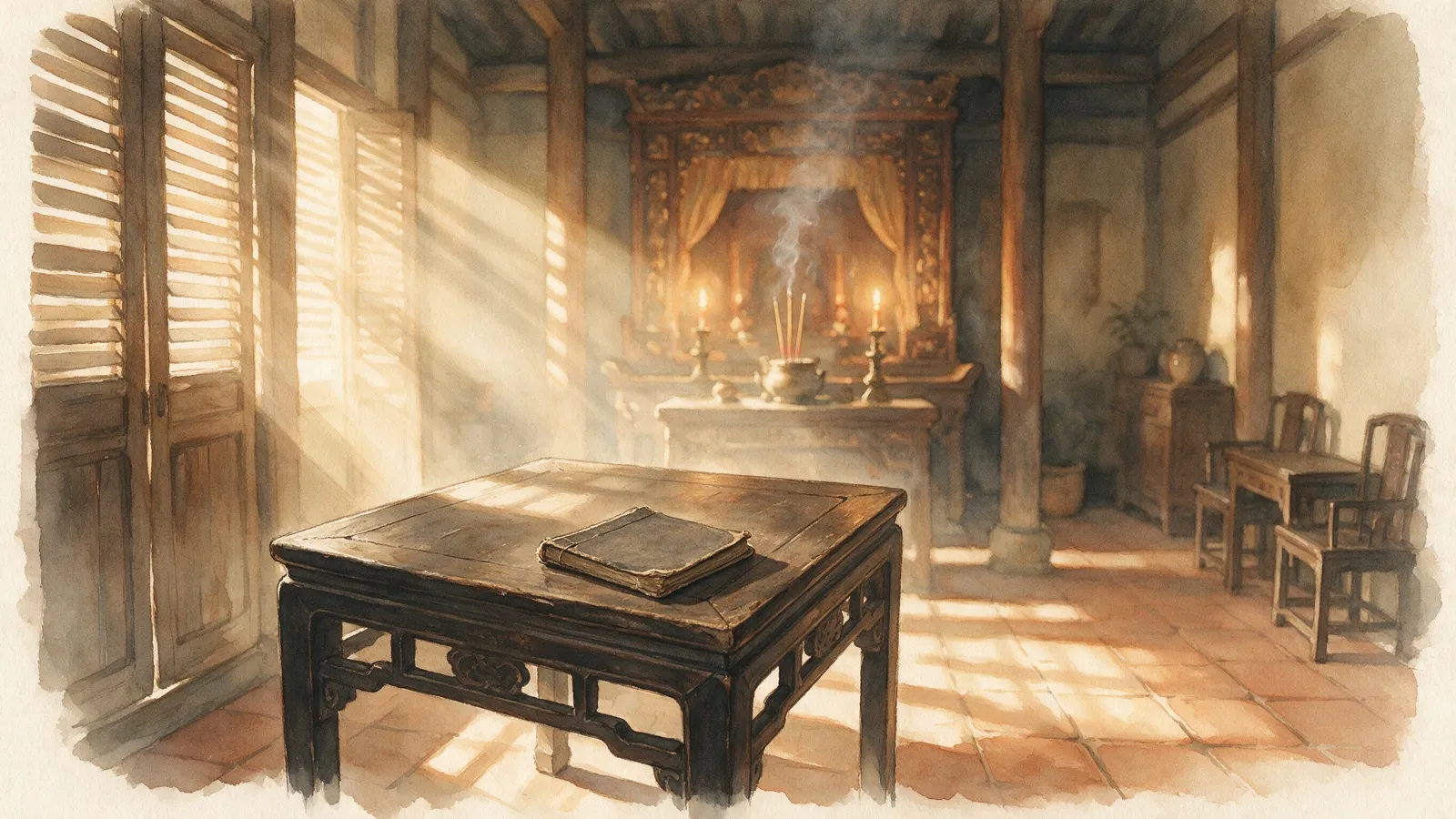
For the Lui Chew, the people of the Leizhou Peninsula at the southern tip of mainland China, it did seven jobs. It gave a new arrival a bed. It lent and gave money, like a small bank. It settled quarrels, like a court. The clan house kept a shrine and paid for schooling. It ran itself through an elected committee, and later built and owned a commercial building. And it kept a line open to the homeland.
Bed: a roof for the man who just got off the boat
The simplest job was to give a stranger somewhere to sleep. The Muar hall shows this plainly.
Persatuan Lui Chew Johor’s own history describes the two-storey building that opened at 76 Jalan Lima on 11 September 1934. It puts the whole building in one sentence: downstairs was the shrine, with a table the men could meet around, and upstairs were a front room and a back room kept for Lui Chew men to sleep in (楼下是神殿,安有八仙桌可供开会用,楼上有后房和前房,是供雷侨借宿用). So a man could arrive with one name to ask for and a floor to sleep on, before he had found either work or family.
That job belonged to a particular kind of migration. The men came alone, and many expected to go home again. The public record does not show the lodging outlasting that migration. Neither association’s public materials describe a current lodging function, and at Muar the 1934 hall itself is gone, replaced by the commercial building that opened in 2004.
Bank: welfare, loans, and paying for a burial
It found him work, lent him money, settled his quarrels, kept a shrine where he could burn incense to familiar gods, ran scholarships for his children, and, when the time came, buried him in its own ground.
The promise behind this job was informal: help in sickness, debt, unemployment or death, and a proper burial for those with no family near.
As of August 2026, Muar’s own site lists two sets of written rules among its live documents. One covers welfare (福利章程). The other covers the burial ground (义山章程). 义山 means “righteous mountain”, and it is the Chinese term for a community cemetery. A community cemetery is one of the oldest jobs a huiguan does anywhere. It is the guarantee that a member is buried among his own.
The clearest dated proof that this promise changed shape is 1994. Under chairman Xu Yaquan, the Johor body scrapped two kinds of payment. The first was the yearly membership fee. The second was a set of separate donations collected at three festivals: Qingming, when families sweep the ancestral graves, and Zhongyuan and Dongzhi. Those festival donations were called incense-oil money (香油捐). Every member became a permanent member instead. So the assumption changed, in 1994, from paying every year to belonging for good, for the members it already had. That was the same year the association reset its award rules into four named kinds.
Court: settling it before it reached a colonial courtroom
This is the job with the plainest first-hand evidence, because the Muar body’s own history states the purpose it was founded for.
Around 1913, a man named Zheng Maolan gathered the Lui Chew of Muar into a bang (帮). A bang was an informal network: migrants who spoke the same dialect, organised to help each other and to trade, before any formal association existed. Zheng is described as an ex-Qing scholar. That means he was an educated man who had served the Qing, the dynasty that then ruled China. It had collapsed two years earlier, and men like him reached the towns of British Malaya without the institutions they had expected to belong to.
The record gives his purpose as three verbs: to lead, protect and mediate for fellow Lui Chew (领导雷州人,保护雷州人及替同乡解决纠纷). This site reads the three verbs like this. Lead meant coordinating the small community. Protect meant help with the colonial legal system, and with disputes with employers or with other bang. Mediate meant settling quarrels between Lui Chew inside the community, rather than in front of a colonial court. That reading is ours, not the association’s: its own pages carry the 1913 sentence in Chinese and give no English version of it.
Zheng died in 1924, before the hall that housed this job was built. The bang had already become a formal association in 1919, fifteen years before it had a building of its own, and the purpose he set for it outlived him.
A quarrel settled inside the clan house left no court record. That is exactly why this job is easy to understate. What survives is the purpose the founder stated.
Shrine: the gods that made the crossing
Both documented Lui Chew clan houses kept a shrine, and Melaka’s is a working temple in daily practice. Its altar carries seven figures.
At the head is Guan Sheng Di Jun (关圣帝君), better known as Guandi: the general Guan Yu, worshipped as a god after his death, and the patron of Chinese clan associations. He is attended by Prince Guan Ping (关平太子) and General Zhou Cang (周仓将军). Then come Guanyin (观音), the figure of compassion, honoured alongside Guandi in the clan houses; the Thousand-Armed Guanyin (千手观音), listed as a figure of her own on the temple roster; Tu Di Gong (土地公); and, unusually, Bai Ma Lao Shi (白马老师), the White Horse Master.
Bai Ma Lao Shi is the odd one out, and the interesting one. He is most likely a Min folk deity. Min (闽语) is the language family of China’s southeast coast, the one Hokkien and Hainanese also belong to, and it points at Fujian, the province the Lui Chew’s own ancestors came from before they ever reached Leizhou. His likely origin is Bai Ma San Lang (白马三郎), a Fujian folk hero worshipped as a god from around the 2nd century BCE.
Two dates mark the clan house’s year: Bai Ma Lao Shi’s birthday on the 17th day of the 1st lunar month, and Guandi’s on the 13th day of the 5th. The clan house keeps documented public hours of 07:30 to 22:00.
What is missing matters as much as what is there. Lei Zu (雷祖), the Thunder Ancestor and the homeland’s own most important god, is not on this altar. Neither is the stone dog (石狗), the carved stone guardian of the Leizhou Peninsula and a folk cult found nowhere else. That absence is a small, sourced clue: this community’s deepest layer of identity runs through Fujian, not only through the peninsula it is named for.
School: scholarships, and a youth wing built to outlast the founders
A clan house that only looked after arriving adults would have ended with them.
Both associations run a formal youth wing: Melaka’s Youth Section (青年部) and Muar’s Youth Corps (青年团). A women’s group (妇女组) runs alongside Muar’s youth wing.
Muar’s 1994 rules reset its awards into four named kinds. To the existing prize for school results it added a scholarly award (学术奖), a prize for sport, and a prize for outstanding achievement. The association’s page names the four kinds but does not define them, so we cannot say what the scholarly award rewarded that the school-results prize did not. Separately, and with no date on the association’s own page, its current document list carries a named hardship scholarship, the Xie Jufu fund (谢居富清寒子弟助学金), for children of families with little money. Beside it sits an award form for members’ children. Both were listed as of August 2026.
None of this is nostalgia. A 2026 paper in the Journal of Nusantara Studies, an academic journal, finds that getting young people to take part is central to whether a Malaysian Chinese clan association keeps going. Both Lui Chew associations already run the youth wings that finding points to.
Governing itself, then owning a building
A huiguan is also, less romantically, an organisation that has to run itself. It has a committee, a rule book, and a record of who has led it. Melaka’s clan house is council-governed. Muar’s committee is a board (董事会): under the association’s own constitution every valid member can vote and stand for it, and a director serves a three-year term.
As of August 2026, Muar keeps its rule book, the constitution (会馆章程), and a list of its past chairmen (历届主席) among its live documents. Melaka’s long-serving past chairmen include Deng Fuming.
Muar then took governance one step further, into ownership. It went like this:
- In 2003 the board put a proposal to the members: spend the association’s savings to knock down the ageing hall on Jalan Lima and put up a commercial building in its place, so that rent would pay for welfare and scholarships from then on.
- The members approved it.
- The board broke ground on 2 September 2003.
- The building was finished on 30 June 2004.
- It opened on 28 November 2004 as the Lui Chew Building (雷州大厦). The four characters of its name were written by the calligrapher Pan Yongming. Among the guests of honour was a descendant of Chen Yongzhu, the man who had given the association the land back in 1925.
Beyond the clan house: ties that reach back to the homeland
The huiguan’s job did not stop at Malaya’s shore. Here the record is shared rather than split.
Both Malaysian associations were named among the delegations at the first World Leizhou Peninsula Friendship Conference. This is a gathering of Leizhou people from around the world, and the first one was held in November 2018 in Zhanjiang, the mainland city the homeland peninsula belongs to. Both are also confirmed members of 五馆六地, “five associations, six locations”, a network that links Lui Chew bodies across several cities.
Two things are documented for one association only. Melaka hosted a return visit from a Zhanjiang overseas-Chinese delegation in 2023. Muar co-hosted the network’s eleventh inter-association conference at its own centenary in 2014; at least eleven such conferences had been held as of that year.
Melaka and Muar, job by job
The two documented Lui Chew associations do not carry the same evidence for every job. Reading them side by side shows the real shape of the record.
| Job | Melaka Leizhou Association | Persatuan Lui Chew Johor (Muar) |
|---|---|---|
| Bed | Not documented as a lodging function, now or in the past | Documented: the 1934 hall's upstairs rooms, built for men from out of town |
| Bank | Described in general terms as mutual aid; no written rules published | Documented: welfare rules, burial-ground rules, the 1994 change to fees |
| Court | General description only | Documented in the purpose its founder stated: lead, protect, mediate |
| Shrine | Documented in the fullest detail: a seven-figure altar, two dated festivals, public hours | Documented as present in 1934 (a ground-floor shrine); no current altar detail published, but the constitution sets four rites a year, each on the lunar calendar (the 15th of the 1st month, Qingming in the 3rd, Zhongyuan in the 7th, Dongzhi in the 11th) |
| School | Youth Section documented; no scholarship detail published | Documented: Youth Corps, Women's Group, four named 1994 award kinds, plus a separately listed Xie Jufu hardship-scholarship form |
| Governance and building | Council-governed; past chairmen named | Documented in the fullest detail: constitution, past-chairman list, the Lui Chew Building |
| Homeland ties | Both: named at the 2018 conference, member of Five Associations, Six Locations (五馆六地). Melaka alone: hosted the 2023 return visit | Both: named at the 2018 conference, member of Five Associations, Six Locations (五馆六地). Muar alone: co-hosted the network's 11th conference in 2014 |
What we don't know yet
Sources for the claims on this page: the two associations' own published materials, cited on the Sources & disclaimer page; the AngKongKeng.com clan-house documentation project for the Melaka altar detail; a 2026 study in the Journal of Nusantara Studies on Malaysian Chinese clan associations and youth; and this site's own Taking Root in Malaysia, glossary and association pages. This site is independent and is not affiliated with either association; for anything current, membership, fees, or events, contact the association directly.