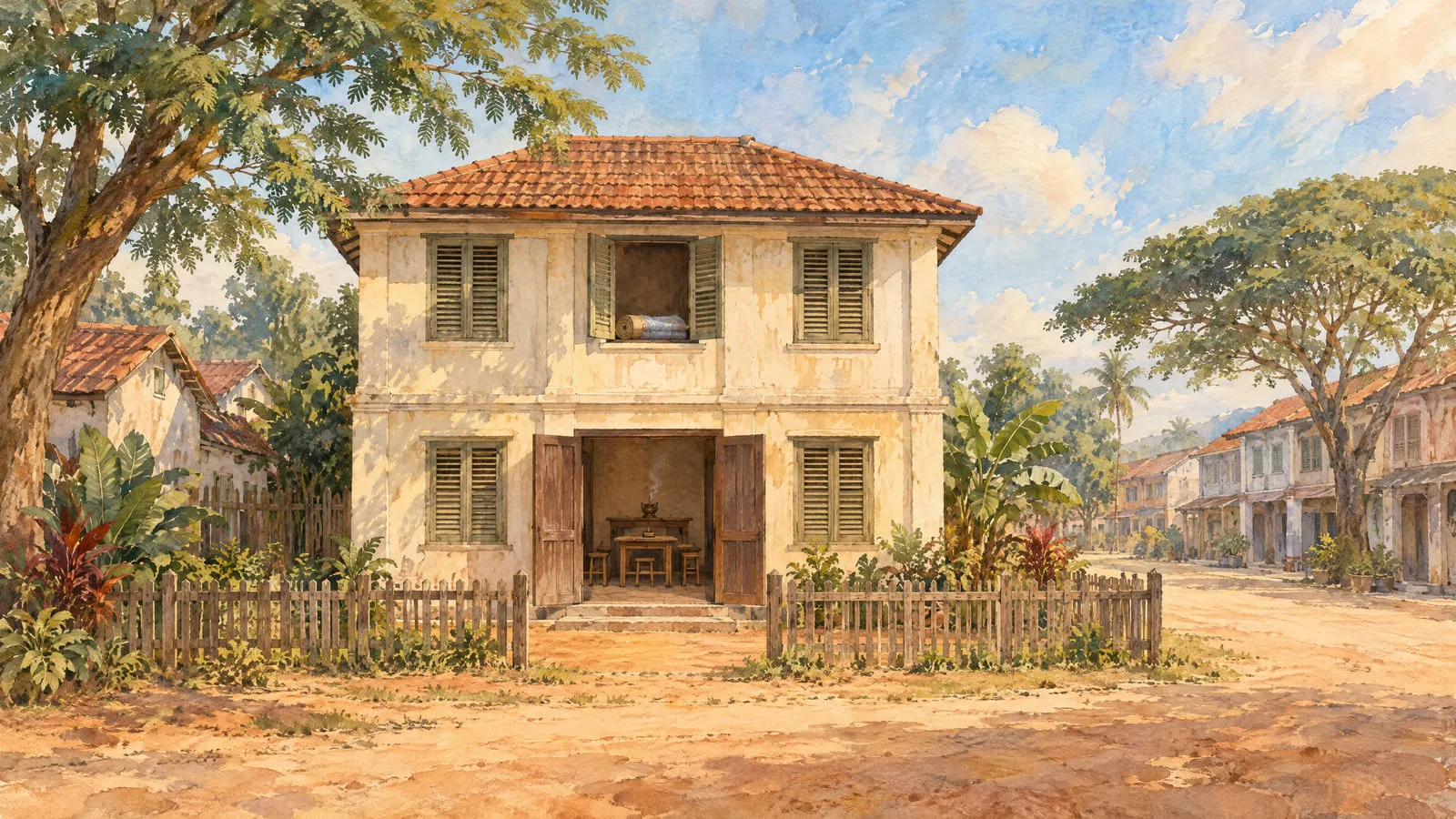
Three men founded and built the Lui Chew association in Muar, 麻坡, in Johor. Zheng Maolan (郑茂兰) was the founder. In about 1913 he gathered the Leizhou people of Muar into a bang, 帮. A bang was a loose group of migrants who spoke the same dialect and looked after each other. The association counts its hundred years from that bang. Zheng Maolan died on 11 July 1924, before the association had a house. Chen Yongzhu (陈永祝) gave the land for the house in 1925. Chen Shanqing (陈善庆) was chairman when it opened, on 11 September 1934.
Lui Chew is the older Malayan and Singaporean spelling of Leizhou, 雷州. Leizhou is the homeland at the southern tip of mainland China that these families came from. Today the Muar body is called Persatuan Lui Chew Johor, 柔佛州雷州会馆. Persatuan is the Malay word for association. A fourth builder, Deng Fuming (邓福明), belongs to the older clan house in Melaka, not to Muar. He has his own section below.
The house these men made stood at No. 76 Fifth Road, 五马路, in Muar. It was a clan house, or huiguan (会馆): the home of an association of people from the same part of China. This one had two floors and stood on its own. Downstairs was the shrine, with an Eight Immortals table, 八仙桌, a large square table that seats eight. Members met around it. Upstairs were a front room and a back room, where Leizhou people could stay the night. In the association’s words, no other building on Fifth Road was like it then.
If an elder named one of these men to you on a visit to Muar, here is each man’s story, and what we do not know yet.
One note on the names. This site writes them in Mandarin pinyin, the standard way to spell Mandarin in the Latin alphabet. Your family may know the same men by a different spelling. The Chinese characters are the ones the association itself prints.
Who was Zheng Maolan (郑茂兰)?
Zheng Maolan founded the Muar Lui Chew association, and he was its first chairman. He started the Leizhou bang in Muar early in Republic year 3. A Republic year is a year in the calendar of the Republic of China, which counts 1912 as year 1. The association gives the Western year as about 1913. (Why the two years do not quite match is explained further down.) Read how the bang system worked across Malaya for more on groups like his. The association gives his bang three jobs: to lead the Leizhou people, to protect them, and to settle quarrels between people from home.
The association calls him 前清人士, “a man of the former Qing”. The Qing was the line of emperors that ruled China until 1912. The Republic of China was founded on 1 January that year. So the words tell us he grew up under the emperors. Some accounts call him a Qing scholar. The association’s words do not say that. They say when he lived. They do not say that he passed the old exams or held an office.
The bang did not stay a bang. In Republic year 8, its leaders went to congratulate the Muar Guangdong association, 麻坡广东会馆, the clan body of the town’s people from Guangdong province. There they saw that people of every kind had an association of their own. Even the chamber of commerce, the body for the town’s merchants, had a club. So they turned the bang into an association and named it the Muar Leizhou Association, 麻坡雷州会馆. In the association’s own words, the bang was the association before it had the name.
The association names nine Leizhou leaders of those years, in this order: Zheng Maolan (郑茂兰), Chen Qixiang (陈其祥), Chen Shanqing (陈善庆), Chen Zixiang (陈自祥), Wu Guoping (误国平), Yang Yasheng (杨亚升), Zhuang Yabiao (庄亚标), Zheng Bangsheng (郑邦圣), Chen Qizhang (陈其彰). Zheng Maolan comes first. Chen Shanqing is third. These men helped their fellow Leizhou people and worked to build a clan house. One name, Wu Guoping (误国平), begins with a character that is not a usual surname. It may be a typing slip, but we do not know.
The association’s roll of chairmen, its list of every chairman in order, puts him first too. It heads the list with 雷州帮-雷州会馆首届主席: 郑茂兰先贤: the first chairman of the Leizhou bang and association, Zheng Maolan.
Then the story turns sad. On 11 July in Republic year 13, which is 1924, Zheng Maolan died. The association’s words are 终未能完成大志而西归: in the end he could not finish his great aim before he passed away. The clan house he had worked for opened ten years later.
For a long time the association counted its birthdays from that 1934 opening, not from him. Its present board changed that. In its words, the work the forebears did twenty years before 1934 had to be put on record, so that later generations could remember it with thanks. Not to do so would be unfair to them. So it now counts its history from the year Zheng Maolan and the others formed the Leizhou bang. It says it has a hundred years of history.
What we do not know yet. His birth year. Which county or village in Leizhou he came from. What work he did in Muar. Where he is buried. Whether any photograph of him survives, and whether his family is still in Muar. The association’s history gives none of these.
Who gave the land for the Muar clan house? Chen Yongzhu (陈永祝)
Chen Yongzhu gave the land the Muar clan house was built on. After Zheng Maolan died, the other leaders kept going. The association names three of them, Chen Shanqing, Li Changwu (李昌五) and Chen Qizhang (陈其彰). In 1925 they set out again. They won a gift from a fellow townsman, 同乡: someone from the same home district back in China. He was Chen Yongzhu. His gift was a piece of land on Fifth Road, a little over 5,000 square feet, 约五千多方尺, to build the clan house on. Our history of Persatuan Lui Chew Johor gives the street its Malay name, Jalan Lima.
Chen Yongzhu is not one of the nine bang leaders on the list above. The association calls him only a fellow townsman. He was the man who made the house possible.
Later he led it too. After Chen Shanqing, the association says, the next chairman was Chen Yongzhu. The roll of chairmen agrees and lists him as the third: 第三届主席: 陈永祝先贤.
His family stayed with the house. In 2003 the association began to rebuild the old Fifth Road site as a commercial building, the Lui Chew Building, 雷州大厦. It set 28 November 2004 for the opening. One of the two guests it asked to open the building was Chen Chunfa, 陈春发, a descendant of the man who gave the land. That is seventy-nine years after the gift.
Chen Yongzhu and Chen Shanqing share a surname, Chen, 陈. Nothing in the association’s history says they were related.
What we do not know yet. When Chen Yongzhu came to Muar, and from where in Leizhou. How he came to own the land, and what work he did. How long he served as chairman. How Chen Chunfa was related to him: the association says descendant, 后裔, and nothing closer.
Who was the first chairman of the Muar clan house? Chen Shanqing (陈善庆)
Chen Shanqing was chairman when the clan house opened in 1934, so he was the first chairman to lead it in a house of its own. He runs through the whole story. He is the third name on the list of bang leaders from Zheng Maolan’s day. He is the first name among the leaders who set out again in 1925 and won the land.
Getting there took paperwork. In 1932 the association sent the government a new constitution, its written rules. On 14 April 1934 the Johor office for Chinese affairs, 柔佛州华民政务司, gave its approval. It was the state government office that handled Chinese matters, such as this approval. The two-storey house on Fifth Road went up, and on 11 September 1934 the association held its opening ceremony. It kept that day as its anniversary from then on. The association names the chairman at that time: 当时主席为先贤陈善庆, the late Chen Shanqing.
So was he the first chairman? That depends on what you count. The roll of chairmen lists him as the second: 第二届主席: 陈善庆先贤. The first on that roll is Zheng Maolan, for the bang and the association together. Chen Shanqing was the first chairman to lead it in a house of its own. If an elder calls him the first chairman, that is what they mean, and both are true.
What we do not know yet. His birth and death years. Where in Leizhou his family came from. The year he became chairman, and the year he handed over to Chen Yongzhu. Whether any photograph of him survives.
Who was Deng Fuming (邓福明) of the Melaka Leizhou Association?
Deng Fuming is named as one of the long-serving past chairmen of the Melaka Leizhou Association, 马六甲雷州会馆. He was not a Muar man. The Melaka clan house stands at No. 97 Jonker Street. By its own tradition it was founded in 1899, fourteen years before Zheng Maolan’s bang, so it is the older of the two. Read the story of the Melaka Leizhou Association for the house he led.
His record is one line. It names him among the long-serving past chairmen, and it comes from an entry on the Melaka association in Baidu Baike. Baidu Baike is a Chinese online encyclopedia that anyone can edit, so it is a lead, not proof. The line gives no years, no other office and no family.
So we can say what kind of man he was in the story: one of the men who kept a clan house going, the same work Chen Shanqing and Chen Yongzhu did in Muar. We cannot say more than that yet.
What we do not know yet. When he chaired the Melaka association, and for how long. When he lived. Where in Leizhou his family came from. If the Melaka association keeps a roll of its chairmen as Muar does, that roll would be the place to start.
Why do the dates not quite line up?
If an elder reads the association’s Chinese history to you, you may notice something. It gives many dates twice: a Republic year, and a Western year beside it. Republic year 1 is 1912. So Republic year 3, when the bang began, is 1914 by that count, but the association writes “about 1913”. Republic year 15, the year of the land gift, is 1926, but the association writes 1925. Zheng Maolan’s death, in Republic year 13, has no Western year beside it. By the same count it is 1924, so that one is safe.
This page keeps the association’s own years, 1913 and 1925. They are the years its history gives, and its hundred years are counted from 1913. But if an elder tells you 1914 or 1926, they may be reading the Republic years, and they are not wrong. Here is how the years fit together, as the association gives them.
| When | What happened |
|---|---|
| about 1913 | Zheng Maolan starts the Leizhou bang in Muar |
| Republic year 8 | The bang becomes the Muar Leizhou Association |
| 11 July 1924 | Zheng Maolan dies, before the clan house is built |
| 1925 | Chen Yongzhu gives the land on Fifth Road |
| 14 April 1934 | Johor's office for Chinese affairs gives its approval |
| 11 September 1934 | The house opens, with Chen Shanqing as chairman |
Where might more of their story be?
The fullest record may be a book. In its notice for its centenary dinner, the association said it was preparing a centenary souvenir book, 百年馆庆纪念特刊. A souvenir book is the printed history a clan body makes for a big anniversary. The association said the book had to keep the history of Leizhou and of the association complete. It asked members and their families who held valuable old photographs or papers to hand them to the association. If your family has a copy of the book, it may hold more about these men than anything online.
The association’s own records are the other place to look. Its office is at 46 Jalan Sisi in Muar, in a building it bought later. The Fifth Road site now holds the Lui Chew Building.
If you are going back to the elder who named one of these men, these questions are a good place to start:
- Ask which county or village in Leizhou your family came from.
- Ask whether anyone in the family stayed in the upstairs rooms at Fifth Road, or knew Chen Shanqing or Chen Yongzhu.
- Ask whether the family has the centenary book, or any old photograph taken at the clan house.
- Check the family graves and ancestor tablets, the wooden name boards kept on a home altar, for a name on the list of nine.
The builders who came after
The work did not stop with the first house. Chen Bingxiang (陈炳祥), the fourth chairman, opened membership to Lui Chew people across Johor. Fu Zhitian (符之田) backed the purchase of the larger building on Jalan Sisi. Xu Yaquan (许亚权) became chairman in 1994 and gave the association its present name. Chen Yaoshan (陈姚杉) chaired the committee that built the Lui Chew Building, and the calligrapher Pan Yongming (潘永明) wrote its name. As of October 2026 the roll of chairmen lists Wu Yong (吴勇) as the eighth, and the present, chairman.
These are not famous names, and that is the honest point. No nationally famous Malaysian or Singaporean public figure is reliably documented as being of Lui Chew origin. A small people’s notable names are its builders: the man who gathered everyone together, the man who gave the land, and the men who kept the doors open. Meet more of them in our A to Z of Lui Chew people. Their surnames, Zheng and Chen among them, are in the Lui Chew surname registry.
The house they built is the next chapter. Persatuan Lui Chew Johor: a century in Muar follows it from 1913 to the Lui Chew Building. What a huiguan actually did for its members shows what the upstairs rooms and the shrine were for. And if your family descends from Zheng Maolan, Chen Yongzhu, Chen Shanqing or Deng Fuming, or holds a photograph or a date for any of them, we would love to hear the story, or a correction. That is how the “we do not know yet” lines on this page get shorter.