
The figures that circulate for the Lui Chew, the people of the Leizhou Peninsula at the southern tip of mainland China, run from 197 to 8 million. This page rates eight of them. That spread is not a counting error. Each figure counts a different thing: speakers of a language, members of a club, residents of a prefecture, or descendants of a migration.
The largest of the overseas figures is 1.5 million. This page follows that one back. It ends up at a single sentence on a Chinese municipal government portal, on a page stamped 2017, unsourced in every archived copy we could find.
Every figure here, and how far to trust it
Each row says what its number counts, which is where the confusion lives.
| Figure | What it counts | Source and date | Verdict |
|---|---|---|---|
| About 1.5 million | "Overseas population" of Leizhou Min. No country named | A Leizhou City People's Government page that cites nothing. The Baidu Baike entry carrying the same sentence names that portal as its source | Do not use. The trail is one step long and ends with no source, no method and no date |
| More than 8 million | "Domestic population coverage" of the same language | The same sentence, from the same page | Do not use. Same sentence, same trail |
| About 2.8 million | Native speakers of Leizhou Min inside China | English Wikipedia, citing a Zhanjiang gazetteer of 2004 that we have not seen | Usable with its date and its chain. Say both: the year is 2004, and the volume itself is unread here |
| About 4.5 million | People of the Leizhou grouping across a listed set of districts, excluding Cantonese and Tanka | Chinese Wikipedia, with no source shown on the sentence | Weak. Quote it only as an unsourced estimate |
| "Only a few thousand" | Leizhou people in Malaysia, not speakers | Chen Limao's 2023 field study | Use it, with its limits. Peer-reviewed, and still an aside with no stated method |
| 197 | Registered members of the Singapore clan association | The Singapore clan federation's own register | Solid. The only exact figure of the three associations |
| More than 1,000 | Registered members of the Melaka association | This site's Melaka page, reporting the association's own materials; the upstream entry is unreachable | Usable as a membership count only. Single-sourced |
| About 400, or more than 430 | Residents of Tiang Dua New Village, half or 60 to 70 per cent of them Leizhou | Two press reports, April 2022 and October 2024. The proportions are the village head's; the 2022 resident count is the reporter's | Solid as press reporting, and the two disagree |
The 1.5 million figure, traced
The Leizhou City People’s Government runs a page about the local language. Its date stamp reads 30 April 2026. Its source line reads 来源:本网, which means “source: this website”. So the page cites nothing at all. The sentence that matters says the language is spoken across a list of districts, and then: 国内人口覆盖800多万,海外人口约150万. In plain English, “domestic population coverage more than 8 million, overseas population about 1.5 million”.
The same string of characters sits in the Baidu Baike entry for 雷州话 (the Leizhou language). Baidu Baike is a community-written Chinese encyclopedia, the rough equivalent of Wikipedia. The Internet Archive, a service that saves dated copies of web pages, holds a copy of that entry from 5 June 2022. Read the two side by side and they match character for character, from the district list through to the 1.5 million.
Then the useful part. In that 2022 copy, the paragraph carrying the figure ends with a footnote marker, and the footnote reads 雷州话.雷州市人民政府 (Leizhou language. Leizhou City People’s Government), cited 2 April 2020. Baidu is naming where its editors got the paragraph: the Leizhou City People’s Government.
So the trail runs one step and stops. The encyclopedia points at the government portal. The portal points at nothing.
These are not two sources agreeing. They are one sentence in two places, and the encyclopedia says so itself. Treat a figure that turns up in both as turning up once. A wiki footnote records where an editor found something rather than proving it, and it is the only account either page offers.
The sentence is much older than the page carrying it. Under a section called 雷州方言 (Leizhou dialect), the portal has republished this text at more than one address. The Internet Archive holds one of the earlier ones, saved on 22 March 2022, and that page carries the same sentence, the same 来源:本网 (source: this website) line, and a date stamp of 12 September 2017. A capture from July 2023, at the address used today, shows the same sentence and the same line under a stamp of 24 May 2023. The page at that address in August 2026 reads 30 April 2026.
So one unsourced sentence has sat on a government portal since at least 2017, restamped each time the portal republishes it, at a new address or at the old one. Every restamp makes the figure look newer than it is. Baidu’s editors were reading that portal in April 2020, in between. Which page they read is not recoverable, because the footnote link is an internal Baidu redirect and the portal has held several dialect pages.
Two more things are true of the sentence itself.
It says “overseas”. It does not say Malaysia and Singapore. Every restatement that narrows it to those two countries, including this site’s own until now, is narrowing a claim the source never narrowed.
It is about the language, not about ancestry. The sentence describes how far 雷州话, the Leizhou language, reaches. Read plainly, it claims 1.5 million people who speak Leizhou Min outside China. That is a much harder claim than “1.5 million with Leizhou ancestry”, and it is the one the words make.
The 8 million figure comes from the same line
The domestic half of that sentence has the same provenance, and the same hole where a source should be.
Here is one check on it. The Leizhou Peninsula belongs to the prefecture of Zhanjiang. A prefecture is a Chinese administrative region, roughly a city and the counties around it. China’s Seventh National Population Census counted Zhanjiang’s resident population at 6,981,236 as of 1 November 2020, every language included, down slightly from 6,993,304 ten years earlier.
That does not make 8 million impossible, because the sentence’s own district list reaches beyond Zhanjiang into southeastern Guangxi. It does mean more than a million of the count has to come from outside the peninsula’s own prefecture. Neither page breaks the figure down by place, so there is no way to see where those people are.
The Baidu copy will not settle it either. Beside the article, its summary box gives the population as 700万以上(2015年), more than 7 million, dated 2015. The body sentence on the same screen puts domestic coverage alone above 8 million and carries no date. Those two do not strictly conflict, because “more than 7 million” is a floor rather than a total. What the box does not say is which population it means: the field beside it, for where the language is used, names the peninsula and overseas communities in one breath. Even the page’s own summary declines to say what it is counting.
The 2.8 million figure, and where it really comes from
This is the figure this site carries for China, and the one English Wikipedia gives. This site has also put it in the same breath as Ethnologue’s endangerment rating, which is easy to read as Ethnologue being its source. Ethnologue is not its source.
The 2.8 million comes with the year 2004 attached, and Wikipedia credits it to 湛江市志, the Chorography of Zhanjiang City, volume 36, published in 2004 by Zhonghua Book Company. A chorography is an official local gazetteer, a reference book a Chinese city compiles about itself. That is a decent source. We have not read the volume, so what is verified here is the attribution, and the count inside the book remains something we are taking on Wikipedia’s word. Say both when you quote it, along with the year: 2004 is 22 years ago.
Ethnologue does have a rating, and it is not a population one. Glottolog, the language catalogue maintained by the Max Planck Institute for Evolutionary Anthropology, records the same language under the name Leizhou Chinese and marks it threatened, quoting Ethnologue’s own scale at level 6b, “Threatened”. That level describes transmission, meaning whether children are still learning the language, so a large speaker count and a poor rating sit together without contradiction. We could not fetch Ethnologue’s own page: it returned an access-denied error to us on 18 August 2026, so its rating reaches this page only through Glottolog’s citation of it.
What the ground shows
Somebody has looked at this directly.
Chen Limao’s 2023 field study is where the figure this page uses for Malaysia comes from, and it is peer-reviewed, meaning other specialists checked it before publication. It says, on page 1620: “The number of Leizhou people in Malaysia is only a few thousand, which is extremely endangered, unlike the strong Chinese dialects such as Cantonese and Chaozhou dialect in Malaysia.”
Read that sentence carefully, because two details get lost when it is passed on. It counts Leizhou people, and this site has restated it as speakers in places. And it carries no footnote and no method: it sits in the introduction, as one of three reasons the author gives for choosing the topic. The paper’s own evidence is about pronunciation, gathered on three field trips from five named speakers. Its prior-work section names only the author’s own two 2019 articles as having discussed Malaysian Leizhou at all.
The clan associations publish membership, and membership is not population. Singapore’s Lui Chiu Hoe Kuan, founded 1892, lists 197 members in the Singapore Federation of Chinese Clan Associations directory. Of the three documented associations, that is the only exact figure: the other two publish a rounded one or none at all. The Melaka Leizhou Association reports more than 1,000 registered members, single-sourced to its own materials. The Muar association publishes no membership figure.
Which means this site’s “around 1,200 registered members” across the three bodies is really Melaka plus Singapore. Muar adds an unknown number on top, so the true total is higher and nobody knows by how much.
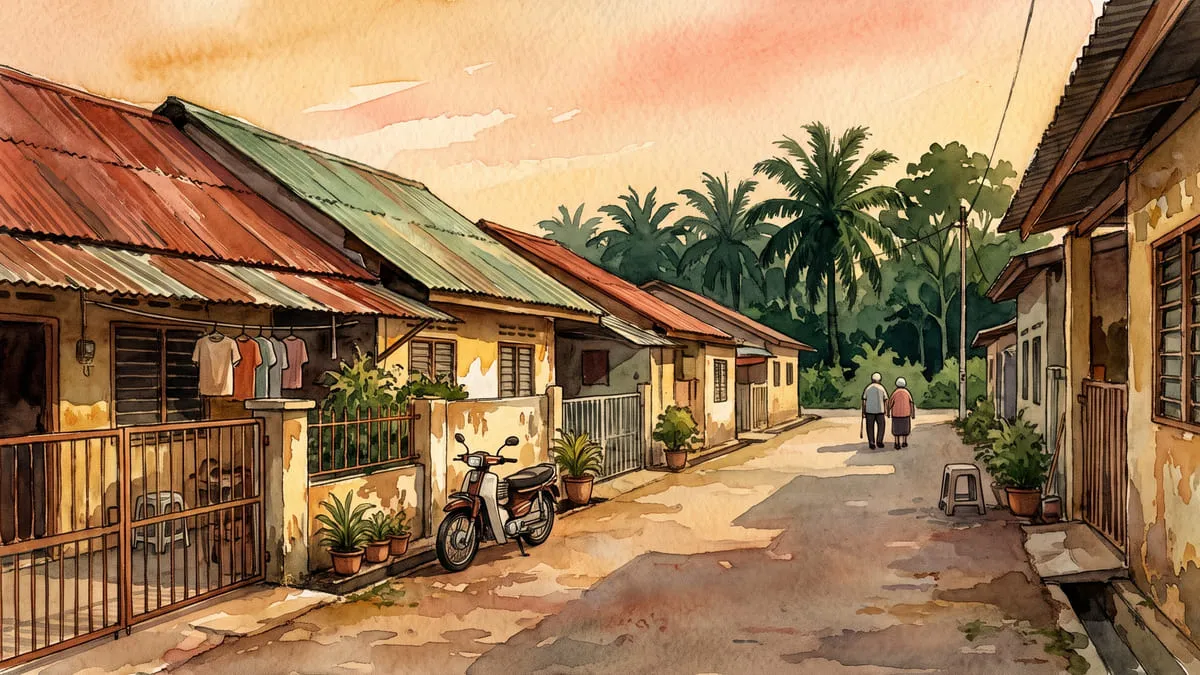
Two press reports have counted one village, and they disagree. Tiang Dua New Village in Melaka is the only place this page found published Leizhou figures for. Sin Chew Daily reported in April 2022 that the village was down to about 400 residents from more than a thousand in the 1970s and 1980s, across roughly 140 households, and that half the villagers were Leizhou. China Press reported in October 2024 that it holds about 150 households and more than 430 residents, of whom 60 to 70 per cent are Leizhou.
The proportions in both reports come from the same man, the village head Jiang Yuxian; the 2022 resident count is the reporter’s own. So the Leizhou share went from a half to 60 or 70 per cent in the two and a half years between the two reports, and neither report says why. The 2024 one also quotes him saying the village is, apart from the Leizhou Peninsula itself, the place overseas where the most Leizhou people live. Neither report describes a survey.
What these numbers mean for the language, as against the community, is worked through on Are the Lui Chew endangered?. This page supplies the figures; that one supplies the argument.
Two checks anyone can run
You do not have to take our word on any of this. Both of these use published official tables.
Check one: Singapore’s census has a lid on it. The 2020 Census of Population counts 3,006,769 Chinese residents in nine named dialect groups, plus one catch-all called “Other Chinese” holding 244,529 people. A dialect group here is the ancestral home region a family traces to, the way Hokkien, Teochew and Hainanese are counted separately. Leizhou is not one of the nine. So every Lui Chew in Singapore sits inside that 244,529, sharing it with every other unnamed group in the country. Even if the whole bucket were Lui Chew, Singapore could not hold a sixth of 1.5 million.
Check two: Malaysia’s population-by-ethnicity table has no dialect line. The table the Department of Statistics Malaysia publishes for population by ethnicity carries six categories: Malay, other Bumiputera, Chinese, Indian, other citizens and non-citizens. No finer breakdown appears in it. Ethnic Chinese Malaysians numbered about 6.83 million on the 2026 estimate. Put that beside Singapore’s 3 million Chinese residents from the 2020 census, mixing a current estimate with a census count, and 1.5 million would be roughly one in seven of every ethnic Chinese person in both countries combined.
Neither check disproves the sentence outright, because the sentence says “overseas” and never names a country. That is the trouble with it. A claim vague enough to survive every test is also a claim nobody can use.
What we don't know yet
Smaller gaps, so you can see this page’s edges. Where the Leizhou City government drew its figures from is unknown, because the page names nothing. Ethnologue’s own page for Leizhou we could not reach. Muar publishes no membership figure, and no association publishes a year-on-year series, so nobody can say whether any of these numbers are rising or falling. One peer-reviewed study of Tiang Dua, by Liao Wen-hui and Lee Jie-yi in 2025, sits on our sources page unread here. Its lead author is the historian the 2024 report quotes, so it is not a wholly separate line of evidence, but it may still hold a better village figure than either press report. If your family carries a Lui Chew identity no roll or study would catch, a contribution closes the big gap.
Sources for the figures on this page: the Leizhou City People's Government dialect page; the Baidu Baike 雷州话 (Leizhou language) entry, pinned through the Internet Archive; Chen Limao (2023) in the Open Journal of Applied Sciences; English Wikipedia's Leizhou Min article and Chinese Wikipedia's 雷州民系 (Leizhou people) article; Glottolog's entry for Leizhou Chinese; the Zhanjiang Seventh National Population Census bulletin; the Singapore Department of Statistics Census of Population 2020; the Department of Statistics Malaysia population table; the Singapore Federation of Chinese Clan Associations members' directory; Sin Chew Daily (3 April 2022) and China Press (5 October 2024); and this site's own Global Lui Chew, endangerment and association pages. All of them are listed on our Sources & disclaimer page. This site is independent and is not affiliated with any clan association or government body. Figures are stated as of August 2026.