
No Lui Chew clan association is on record in Kuala Lumpur, nor in Penang, Ipoh, Klang or Johor Bahru. Four are on record, all in Malaysia and Singapore: the Lui Chiu Hoe Kuan in Singapore, from 1892; the Melaka Leizhou Association, from 1899 by its own tradition; Persatuan Lui Chew Johor in Muar, from about 1913; and the Kuching Lui Chiu Association in Sarawak, from 1941.
Why so few? Two things are documented: the Lui Chew came late, and they were few. That this explains the towns with none is our reading. Which association a family joined when its own town had none, we do not know yet.
The Lui Chew, 雷州, are the people of the Leizhou Peninsula, at the southern tip of mainland China. A clan association, or huiguan, 会馆, is a clan house for people who came from the same home place in China. It gave a newcomer a bed, settled quarrels and kept a shrine. Every answer below carries one of three labels. Documented means a dated record says so. Community tradition means the community tells it that way, but no paper from the time backs it. Unknown means no record answers it yet.
Is there a Lui Chew clan association in Kuala Lumpur?
No, not on record. Kuala Lumpur, Penang, Ipoh, Klang and Johor Bahru have plenty of other clan houses, but none of them is Lui Chew. Malaysia has no national Lui Chew federation either. A federation is one national body that links all the associations of a dialect group, and every larger dialect group has one. A dialect group is a community of Chinese migrants who shared a home language, such as the Hokkien, the Cantonese or the Hainanese, the people of Hainan Island.
No record is not the same as proof of none. Small circles of Lui Chew could have met in other towns, collected dues and faded away without ever registering. Malaysia’s Registrar of Societies, the government office where clubs and associations register, is the one place that could settle it. Until its files are checked, a Kuala Lumpur circle stays unknown.
One documented detail widens the map for families outside Muar. Persatuan Lui Chew Johor’s own history says that a later chairman, Chen Bingxiang, 陈炳祥, began recruiting fellow Lui Chew from all over Johor. Its name changed to match: Roushu Mapo Leizhou Huiguan (柔属麻坡雷州会馆), which the association explains as the hall in Muar for the Lui Chew of Johor state. In 1994 it took the name it still uses, Persatuan Lui Chew Johor. So a family in another Johor town could belong to a Lui Chew clan association without one in its own town.
Where are the Lui Chew clan associations in Malaysia and Singapore?
There are four, in founding order. Three stand on the Strait of Malacca. The fourth, and the newest, is in Kuching, Sarawak.
| Founded | Association | Where | How sure we are |
|---|---|---|---|
| 1892 | Lui Chiu Hoe Kuan (新加坡雷州会馆) | Geylang, Singapore | Documented: dated in the Singapore clan federation's members' directory |
| 1899 | Melaka Leizhou Association (马六甲雷州会馆) | 97 Jonker Street, Melaka | Community tradition: the association's own date; some records give 1898 |
| About 1913 as a bang; 1919 as an association | Persatuan Lui Chew Johor (柔佛州雷州会馆) | Muar, Johor | Documented: the association's own dated history |
| 15 August 1941 | Kuching Lui Chiu Association (砂拉越古晋雷州公会), first called the Lui Yang Association (雷阳公会) | Kuching, Sarawak | Documented: a Kuching heritage record |
Singapore came first. The Lui Chiu Hoe Kuan is the oldest documented Lui Chew clan association anywhere in Southeast Asia, seven years older than the one in Melaka. “Lui Chiu” is the old Singapore spelling of Leizhou (雷州). Its one published member count gives 197, with no date attached. It belongs to the Singapore Federation of Chinese Clan Associations, the national body that links the island’s clan associations. Who founded it, and where it first met, is not on record. The Singapore Lui Chiu Hoe Kuan page gathers the little that is documented.
Melaka is the largest by its own count. The Jonker Street clan house reports more than 1,000 registered members, in a count of its own with no date attached. It is also a working Guandi temple: its main altar honours Guan Yu, a general who became a god and the patron of Chinese clan associations. Its 1899 date comes from the community’s own records. No founding deed or minute book from that year is known, and some records say 1898. So 1899 is community tradition, and a well-established one. The Melaka Leizhou Association page covers the clan house, its altar and how to visit.
Muar kept the fullest record. Around 1913 Zheng Maolan, 郑茂兰, gathered the Lui Chew of Muar into a bang, 帮. He was a scholar who had served the Qing dynasty, China’s ruling house, which had collapsed two years earlier. A bang was an informal network of migrants who spoke the same dialect. This one was set up to lead and protect fellow Lui Chew and to settle their quarrels. In 1919 the bang became a formal association. Its own history dates each step after that, down to the Lui Chew Building, 雷州大厦, opened in 2004, whose rent pays for welfare and scholarships. The Persatuan Lui Chew Johor page tells its hundred years in Muar in full.
Kuching is the newest. On 15 August 1941 a group of Lui Chew pioneers in Kuching formed the Lui Yang Association, 雷阳公会. Around 2000 it was renamed the Kuching Lui Chiu Association. An older history backs a Lui Chew presence in the town. A 1987 social history of Kuching by the historian Craig Lockard names the “Luichews, whose home area was the Luichew Peninsula of Kwangtung” as one of the small speech groups, or dialect groups, that settled there. Kwangtung is the old spelling of Guangdong, the province Leizhou belongs to. Counted from 1941, the association’s 85th anniversary fell on 15 August 2026. Whether it was marked, we do not know yet.
Why are there so few Lui Chew clan associations?
Three reasons have a record behind them. One town cuts against them, and the gap between the two is still open.
They were few. This is documented. No census has ever counted the Lui Chew on their own. Malaya’s 1957 census sorted the Chinese by mother tongue: it named the Hokkien, Teochew, Cantonese, Hainanese and Hakka, and put everyone else into “six other dialects”. Leizhou Min, the Lui Chew language, was one of those six. Even the Hainanese, the Lui Chew’s closest kin, were only about three percent of Malaysia’s Chinese around the year 2000, and the Lui Chew were fewer still. A 2023 field study counts the people who still speak the Lui Chew dialect in Malaysia in the few thousands.
They came late. Also documented. In Melaka the founding dates stack up like layers: the Teochew association in 1822, the Hainan association in 1869, the Lui Chew clan association in 1899. Each group that landed found the best trades already taken by the groups before it, and the Lui Chew were at the back of the line. Few and late is the pattern every record agrees on. That it explains the towns with none is our reading, and the next two points test it.
A clan association needed someone to call it together. Documented, for one town. Muar shows how one came to be. First came a man to gather people: Zheng Maolan and his bang. Then came an example. In 1919, the association’s history says, the bang’s leaders went to congratulate the Muar Kwangtung Association, the association for people from Guangdong. They saw that every kind of people had a hall of its own, and that even the chambers of commerce had clubs. So they turned the bang into an association. That is one town’s story, not a rule. Our guess is that a town with no Lui Chew clan association lacked one of the two: enough Lui Chew to fill a room, or someone to call them in.
Being few did not stop Kuching. This is documented too, and it is the surprise. In the early twentieth century not many Lui Chew lived in Sarawak, and their association is counted a minority among Kuching’s Chinese associations. They worked in charcoal kilns on the edge of town and along the coast, and in sago-processing factories. In town they ran charcoal shops, coffee shops and hawker stalls. Few as they were, they formed their association in 1941 “for stronger ties and solidarity”.
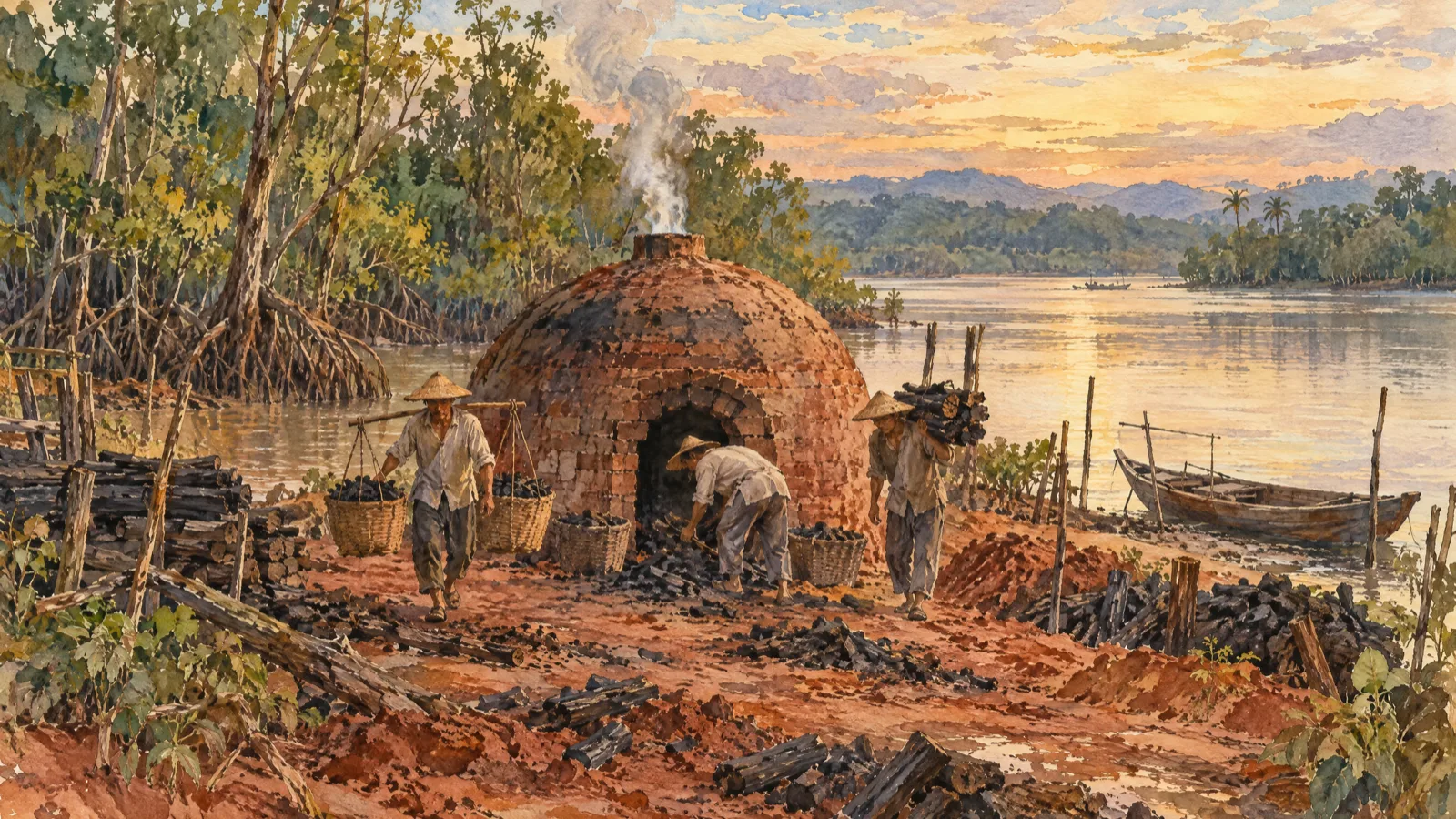
So small numbers cannot be the whole answer. Why Kuching built one and Kuala Lumpur has none on record, we do not know yet.
If your town had no Lui Chew clan association, which association did your family join?
There are four possible answers: a Hainanese association, a Lui Chew clan association in another town, a bigger association for people from Guangdong, or none at all. No record yet shows which one any family chose. Your own family’s papers are the best place to find out.
The usual guess is a Hainanese association. It is not a wild guess. The Lui Chew and the Hainanese are close kin. Both descend from the same migration out of Putian, in Fujian province, late in the Song dynasty, and they have had some seven centuries of separate history since. The linguist Hou Jingyi groups their two languages as one branch of Min Chinese, the language family both belong to. He calls it Qiong-Lei, 琼雷: Qiong for Hainan, Lei for Leizhou. Not every linguist accepts that grouping, but nobody disputes how close the two are. In official counts, Leizhou Min was sometimes filed next to the Hainanese. And where the Lui Chew built a handful of clan associations, the Hainanese built dozens across the region, with national federations to tie them together. How close the Lui Chew and the Hainanese are has its own page, with the two peoples side by side.
But no record shows it happening. No Hainanese association’s roll, no association history and no family paper on record names a Lui Chew family or group as members. It is the usual assumption, and it may be right. Until a record turns up, it stays a guess.
The other answers fit the record just as well. A family might have joined a Lui Chew clan association in another town, as Johor’s Lui Chew could with Muar. It might have joined a bigger association for people from Guangdong. Or it might have joined nothing, and kept its Lui Chew life at home and at the temple. Tiang Dua, 丁赖新村, a village in Melaka founded in 1949, shows that a Lui Chew community can stand without a clan association. Lui Chew families live there side by side, with a temple of their own to the White Horse Master, a folk god most likely carried down from their forebears in Fujian. None of these paths is documented for any such family.
What you can check. The strongest clue sits with your own family. Ask which clan association your elders belonged to, paid dues to, or got a scholarship from. Look for a membership certificate or a photo taken in a clan house. Read the county on an old gravestone: Haikang (海康), Suixi (遂溪) or Xuwen (徐闻) point to the Leizhou Peninsula, while Wenchang (文昌) or Qionghai (琼海) point to Hainan. A tie to a Hainanese association does not rule out Lui Chew roots. How to trace your Lui Chew ancestry walks through each of these checks, step by step.
What we do not know yet
Three questions stay open, and the biggest one hides in a name.
Who belongs to Wuguan Liudi (五馆六地). The Melaka and Muar associations both belong to a network called Wuguan Liudi (五馆六地), “five associations, six locations”, which links Lui Chew clan associations across several cities. It had held at least eleven conferences by 2014, when Muar co-hosted the eleventh at its own centenary. Its full member list is not public. Are Singapore and Kuching in it? We do not know. Even if both were, that makes four of the five. And five associations in six places suggests that at least one place has no Lui Chew clan association of its own. Which place that is, we do not know either.
How the Kuching association lives today. Its story on record stops at the renaming, around 2000. We do not know how many members it has, where it meets now, or whether it keeps ties with the associations on the Strait.
Where families with no association went. The Hainanese guess above stays a guess until someone finds a Lui Chew name on a roll.
The best next step is the oldest Lui Chew clan association on record in Malaysia, and one you can walk into: read about the Melaka Leizhou Association at 97 Jonker Street next. And if your family belonged to a Lui Chew clan association not named here, or joined a Hainanese or other association instead, we would love to hear the story, or take a correction.